
Last updated on June 22nd, 2026 at 09:39 pm
Project Showcase · Tampa, Florida
Custom Concrete Bar Top & White Glass Outdoor Bar — Ulele Restaurant, Tampa
Two materials. Two environments. One commission that required understanding exactly why each one belonged where it was placed. Concrete infused with 100 arrowheads and 50 seashells for the interior. Fifty-five feet of white glass for the outdoor bar. Both still in perfect condition a decade later.
Project Summary
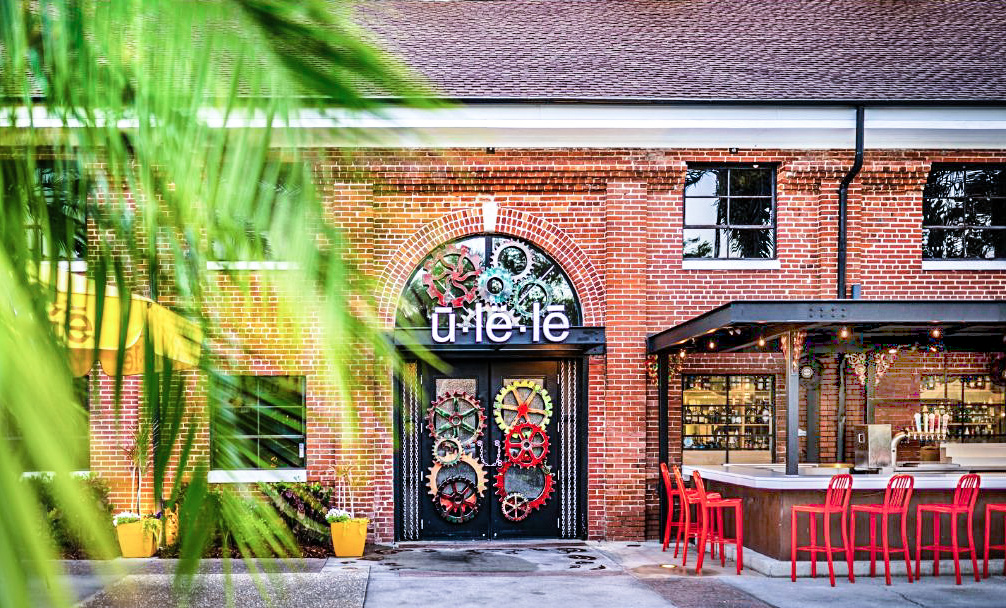
Ulele Restaurant White Glass Outdoor Bar Top — Tampa Heights — Downing Designs
This project features two custom bar top installations fabricated and installed by Downing Designs, Tampa, FL for Ulele — the native-inspired restaurant and brewery opened by Richard Gonzmart of the Columbia Restaurant Group on the banks of the Hillsborough River in Tampa Heights in August 2014.
The indoor installation is a custom concrete bar top, 1.5 inches thick, infused with 100 pre-colonial arrowheads and 50 Florida bay seashells collected by Richard Gonzmart himself along the Pinellas County intercoastal waterways. The outdoor installation is a 55-foot white glass bar top, 30 inches wide — a continuous luminous surface running along the face of the historic brick building, exposed to the Florida sun, rain, and daily commercial use since 2014.
The architects were The Beck Group — Mark House, Joe Harrington, and Jeet Singh — whose offices are immediately adjacent to the restaurant. Richard Gonzmart came to the Downing Designs studio personally to begin the conversation, accompanied by his two German shepherds and a collection of arrowheads unlike anything found in a typical design meeting.
Ulele has been cited by 83 Degrees Media as one of the most Instagrammed restaurants in Tampa. The Downing Designs bar tops are the permanent background of thousands of photographs taken there every year — most visitors never knowing what they're resting their drinks on, or what those surfaces are made of, or where the artifacts inside them came from.
Project Specifications
Fabrication & Installation Detail — Ulele Restaurant, Tampa FL
| Client | Richard Gonzmart, Columbia Restaurant Group |
| Location | Ulele Restaurant, 1810 N Highland Ave, Tampa, FL 33602 |
| Architects | The Beck Group — Mark House, Joe Harrington, Jeet Singh |
| Opened | August 2014 |
| Indoor Bar Top | Custom concrete — 1.5″ thick, artifact-infused |
| Artifact Inclusions | 100 pre-colonial arrowheads + 50 Florida bay seashells |
| Outdoor Bar Top | White glass — 55′ long × 30″ wide |
| Glass | White Glass (aka Nanoglass) — luminous finish, non-porous, maintenance-free |
| Outdoor Condition | Original installation — still pristine after 10+ years of daily commercial service |
| Fabricator | Downing Designs — Tampa, FL — sole craftsman |
| Category | Commercial Hospitality — Restaurant / Brewery |
Why concrete indoors and white glass outdoors?
This is the question the Ulele project answers better than any specification sheet could.
The indoor bar at Ulele sits inside a room with century-old exposed brick walls, raw timber beams, cast iron details, and the accumulated weight of a building that has witnessed generations of Tampa history. Richard Gonzmart's family has been part of this city since 1903. The arrowheads in his collection predate that by centuries. Concrete — tactile, earth-rooted, heavy with inclusion — is the only material that could enter that room without shrinking. It belongs to the same world as the brick and the river and the artifacts inside it.
The outdoor bar is a different environment entirely. Full Florida sun. Daily rain in summer. Humidity that never really leaves. Thousands of drinks served every week on a surface that cannot be babied, sealed on a schedule, or refinished between seasons. White glass is impervious to all of it. It does not stain. It does not etch. It does not absorb anything. The surface that looked perfect on opening day in 2014 looks the same today — and will look the same in another decade.
Neither material could do what the other does in its specific location. That's not an accident. That's a design decision made before a single measurement was taken.
The arrowheads: what's actually inside the concrete bar top
Richard Gonzmart collected arrowheads as a young man along the Pinellas County intercoastal waterways. The geology of some pieces was extraordinary: alternating layers of red and green, millions of years old, formed by processes that still aren't fully understood.
Before a single pour was planned, one of the more remarkable arrowheads was secured to a 2×4 with a hot glue gun and taken to a diamond blade — not to cut it, but to expose what was behind its outer shell. What emerged from inside that stone informed the entire design approach for the bar top. Richard and I were like two kids discovering cool geology for the first time.
One hundred arrowheads. Fifty Florida bay seashells. All set into the concrete matrix, polished flush with the surface, permanently embedded in a bar top that thousands of people touch every week. Pre-colonial Tampa Bay, cast in concrete, serving drinks today in a restaurant named for a native Floridian word meaning "to give life to water."
The depth of that composition is not decorative. It is archaeological. And it was Richard Gonzmart's idea — brought to a craftsman who understood how to make it permanent.
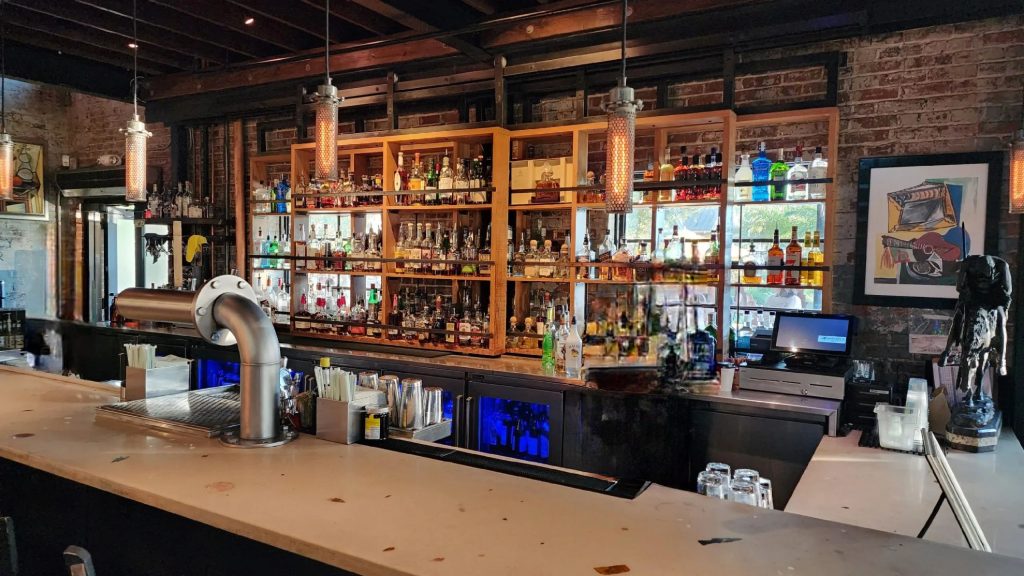
Indoor Concrete Bar Top Full Width — Ulele Restaurant Tampa — Downing Designs
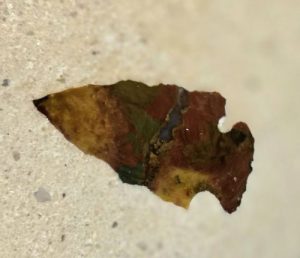
Pre-colonial arrowhead — Richard Gonzmart collection
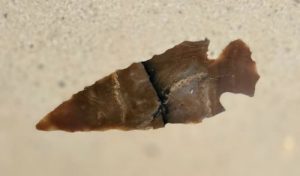
Arrowhead cross-section revealing layered geology
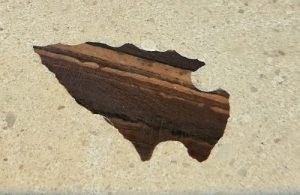
Arrowhead polished flush with concrete surface
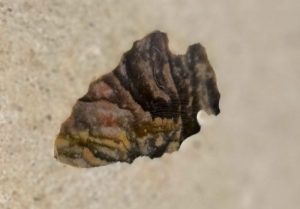
One of 100 arrowheads cast into the concrete matrix
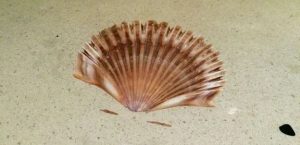
One of 50 Florida bay seashells cast into the concrete surface
What concrete can do that glass cannot — and vice versa
The Ulele project is the most direct demonstration in the Downing Designs portfolio of why material choice is a design decision, not a preference.
Concrete accepts inclusions. It can receive artifacts, aggregate, pigment, and embedded objects and hold them permanently in a polished matrix. It reads as warm, tactile, and connected to the physical world. In a room with exposed brick and cast iron, it speaks the same material language. It requires sealing on a schedule and responds to its environment over time — developing a patina that stone and glass do not.
White glass accepts nothing and releases nothing. It is non-porous by nature — fired at temperature to a permanently sealed surface that cannot stain, cannot etch, and cannot absorb. In an outdoor commercial environment exposed to Florida weather and daily service, that is not a minor advantage. It is the entire argument. White glass also reads as luminous — catching and reflecting light in a way that concrete cannot — which is why the outdoor bar at Ulele glows against the brick facade in a way that photographs consistently and draws the eye from the street. We have measured the temperature of this material in Florida summer sunlight before, and it stays very cool to the touch because it reflects light energy away, rather than absorbing it.
A designer who understands both materials can place each one exactly where it belongs. That is what happened at Ulele. That is what the Downing Designs portfolio makes possible for the next client who wants to have that conversation.
How does a 55-foot outdoor white glass bar top hold up after a decade of Florida weather?
It looks the same as it did in 2014.
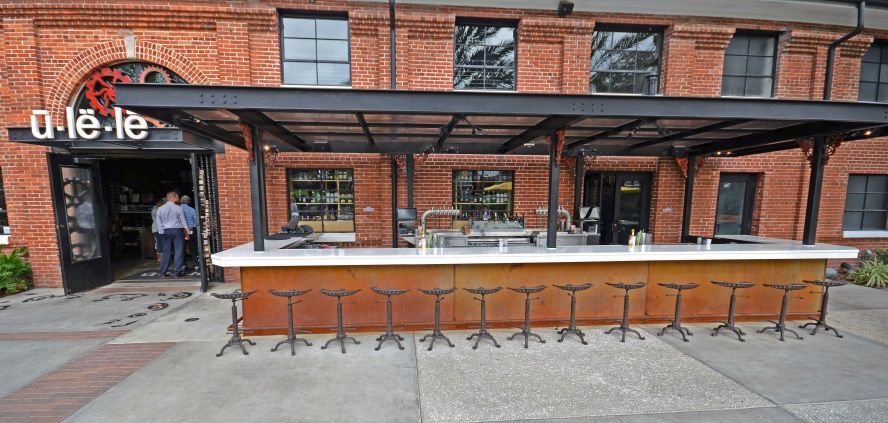
White Glass Outdoor Bar Top — Ulele Restaurant Tampa — Downing Designs
White glass does not degrade under UV exposure the way painted, coated, or resin surfaces do. It does not absorb moisture. It does not crack, fade, or require refinishing. The kiln-firing process that creates the surface seals it permanently — there is no coating to wear away, no sealer to reapply, no maintenance protocol beyond ordinary cleaning.
For a commercial outdoor installation in Tampa — where summer delivers daily afternoon rain, humidity rarely drops below 70%, and a bar top may be wiped down hundreds of times per week — the durability profile of white glass is categorically different from every other material option on the table. A decade of daily service at Ulele is the proof.
What does the Columbia Restaurant Group's commission mean for Downing Designs?
Richard Gonzmart's family has operated the Columbia Restaurant — Florida's oldest restaurant — since 1903. They have been building, renovating, and commissioning custom work in Tampa for over 120 years. When Richard visited the Downing Designs studio personally — with his German shepherds, his arrowhead collection, and a vision for a restaurant that would honor Tampa's native history — he was not making a vendor selection. He was making a design partnership decision.
The result is a bar that is part of Tampa's ongoing story — not just the Columbia Restaurant Group's story, but the city's. Richard was born 300 yards from where Ulele now stands. The arrowheads in the bar top came from the same waterways his ancestors navigated. The outdoor white glass bar runs along the face of a building on the Hillsborough River that has been part of Tampa Heights for over a century.
When a commission carries that kind of weight, the materials have to be worthy of it. We believe they are.
Can concrete and white glass surfaces coexist in a single hospitality installation?
Yes — and Ulele demonstrates exactly how. The key is understanding that each material has a domain where it performs best, and designing the composition so each surface is doing what only it can do.
At Ulele, concrete owns the interior — where its warmth, its artifact capacity, and its connection to the building's material history make it the right answer. White glass owns the exterior — where its imperviousness, its luminosity, and its decade-proven durability in Florida weather make it the only answer.
The two surfaces never compete because they are never asked to do the same thing. That is the design logic of a layered material composition — and it is available to any hospitality client willing to have the conversation about what each surface actually does before deciding what it should be made of.
Downing Designs has fabricated custom concrete bar tops, white glass bar tops, kiln-formed glass countertops, and architectural glass installations for restaurants, breweries, and hospitality spaces across Tampa Bay and throughout Florida for over 25 years. If you are designing a hospitality space and want to discuss material options — we welcome that conversation.
Start a Conversation
Every Downing Designs project begins with a drawing and a conversation. If you have a bar, a space, or a material question — that's enough to start.