
Last updated on June 23rd, 2026 at 08:57 am
You don't need a vocabulary to know when something's beautiful. Nobody stands in front of the Mona Lisa asking for a breakdown of brushstroke technique. Is she smiling? Is she frowning? Who cares. It's beautiful. Leave it alone.
That's how we feel about a great glass bar top edge polish.
We could talk about reflection and refraction. We will, a little. But the truth is simpler than the physics: a properly polished glass edge doesn't sit on a countertop — it leaps off it. Refraction magnifies the edge. The edge becomes its own entity, separate from the surface, grabbing light, inhaling it, and magnificently re-presenting it on the edge. No stone does this. No quartz, no granite, no composite. Glass is the only material on the planet that performs this trick. The point is, your edge is front and center to every guest at your glass bar top. It's right there. You better get it right, or risk losing the most important facet of your bejeweled bar tops.
Here are the standards by which great glass bar tops should be judged: Every edge is to be hand-finished through six progressive polishing stages, down to 5,000 grit. The same principle shows up in hand-rubbed Italian lacquer cabinetry, finished through dozens of coats with hand-sanding between each one, and in hand-polished Italian supercar paint, finished by a craftsman instead of a spray booth. In every case, the cost isn't the material. It's the absence of every flaw a faster process would have left behind.
There is exactly one way to get an edge like this. A craftsman, deciding by hand and by eye when the work is actually finished — not a machine running a program. Tishas the effect of making a glass bar top, whether it is 0.5 inches thick or 2 inches thick, feeling soft on its its corners. These are called roundovers, and we do these on the top and bottom edges for saftey and comfort
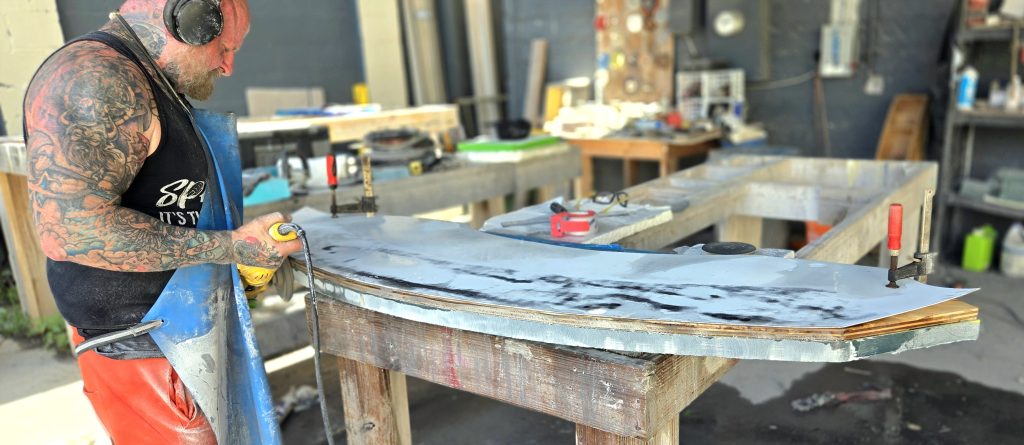
Hand polishing glass counters and bar tops by hand — Downing Designs Tampa
What Lens-Quality Polishing Actually Does
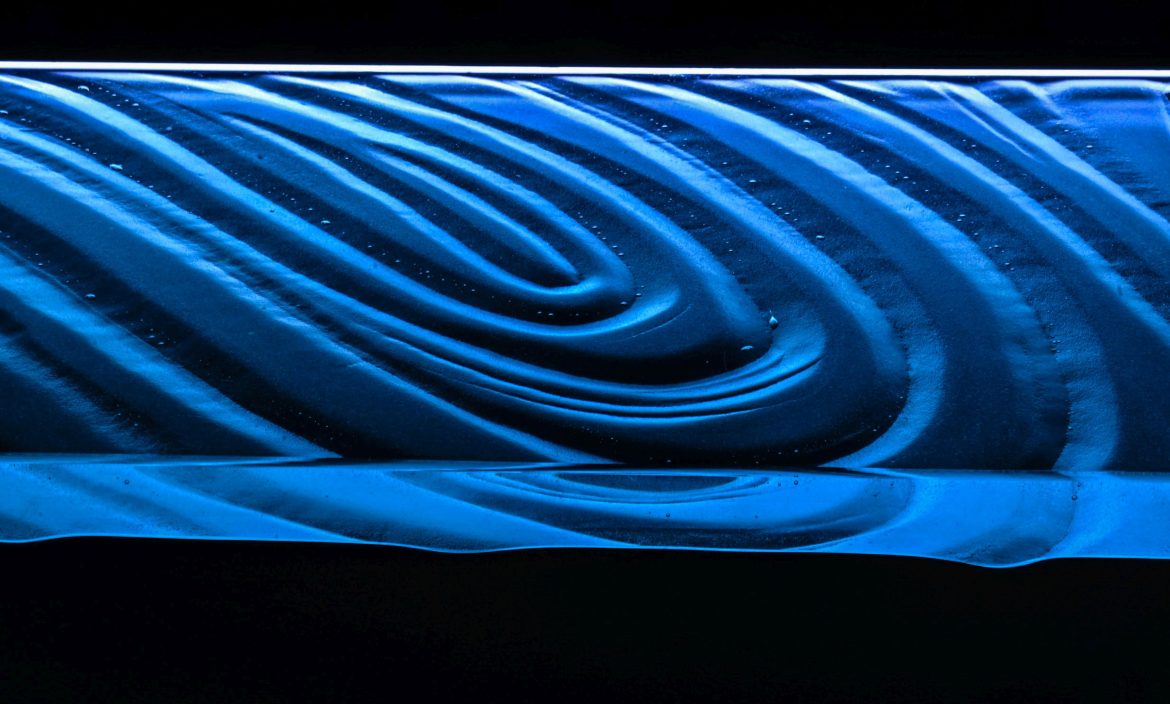
A polished glass edge acts like a lens. Light entering the edge bends, magnifies, and refracts — the same optical phenomenon that makes a pool's floor look closer than it is, or that splits white light into color through a prism. At 1.5" thick, the edge of a Downing Designs bar top has enough optical depth to make the textures inside the glass appear roughly 25% larger and closer than they actually are. The edge isn't a boundary. It's a window into the interior of the piece.
This is why edge polish isn't cosmetic. It's structural to the entire light performance of the bar top.
Look closely at the images below. There is a vast difference in edge polish quality amongst glass bar top fabricators. If it is not done right at the factory, it is unlikely to get remedied in the field.
What a Machine-Polished Edge Looks Like
Most fabricators run a CNC router through three fixed bits — rough, medium, fine — in a programmed sequence. It's fast. It's consistent. And it leaves lines. You can see them immediately on a new piece if you look closely, and more so over time as the tooling wears, because a worn bit doesn't know it's worn. It just keeps cutting.
These are not lens-quality edges. Not even close.
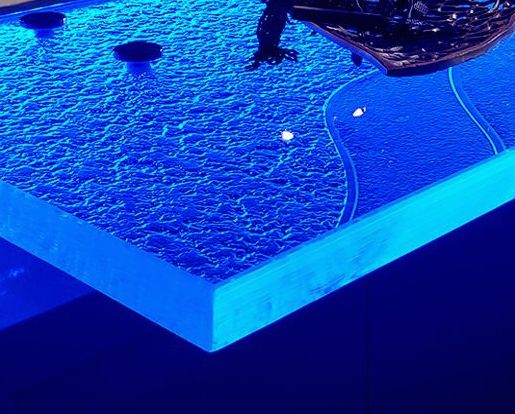
CNC edge polish ruins an otherwise beautiful glass piece
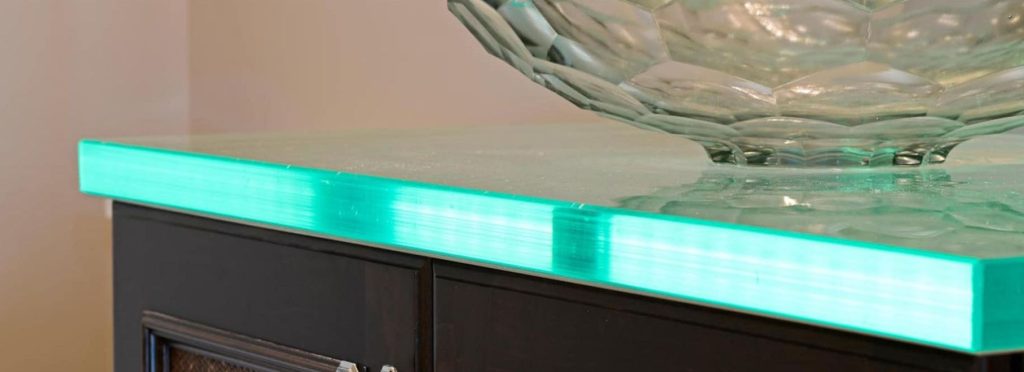
Lines on face, harsh beveled edge, no optical polish
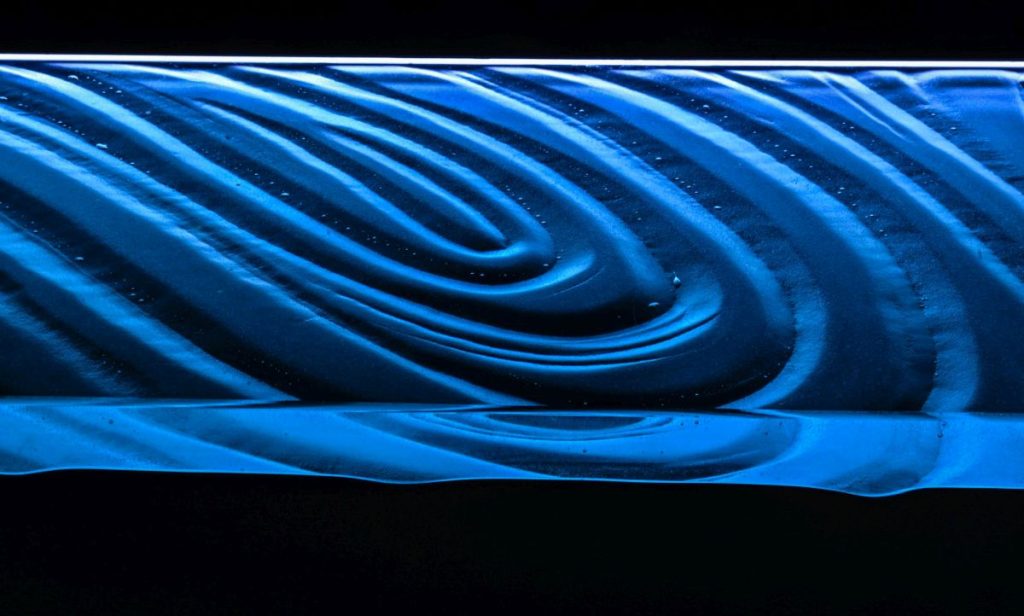
Close-up macro photograph of a hand-polished glass bar top edge with COB LED lighting in deep blue, showing lens-quality edge clarity and light refraction and magnification — Downing Designs Tampa
The difference between these and a Downing Designs edge isn't a matter of preference. It's a matter of whether the edge performs optically at all. Anyone looking closely at our samples and photographs would fairly conclude that Downing Designs edge polish quality is superior — because we take the time and effort to make it lens quality. Downing Designs previously distributed for a foreign manufacturer. We are well familiar with the limitations of their edge quality.
On Color
The spec sheet will tell you the LED controller supports millions of color combinations across the full RGB range. All true. But spec sheets don't tell you what actually happens at 9:30 on a Friday night.
In practice it almost always comes back to three or four colors. And for us, it always comes back to the same family: light blue, aqua, turquoise. There's something about that range against low-iron glass — it doesn't just light the bar, it makes the glass look like it's lit from inside the ocean. No two moments look exactly the same. The light shifts with perspective, with the time of night, with how many people are standing around it.
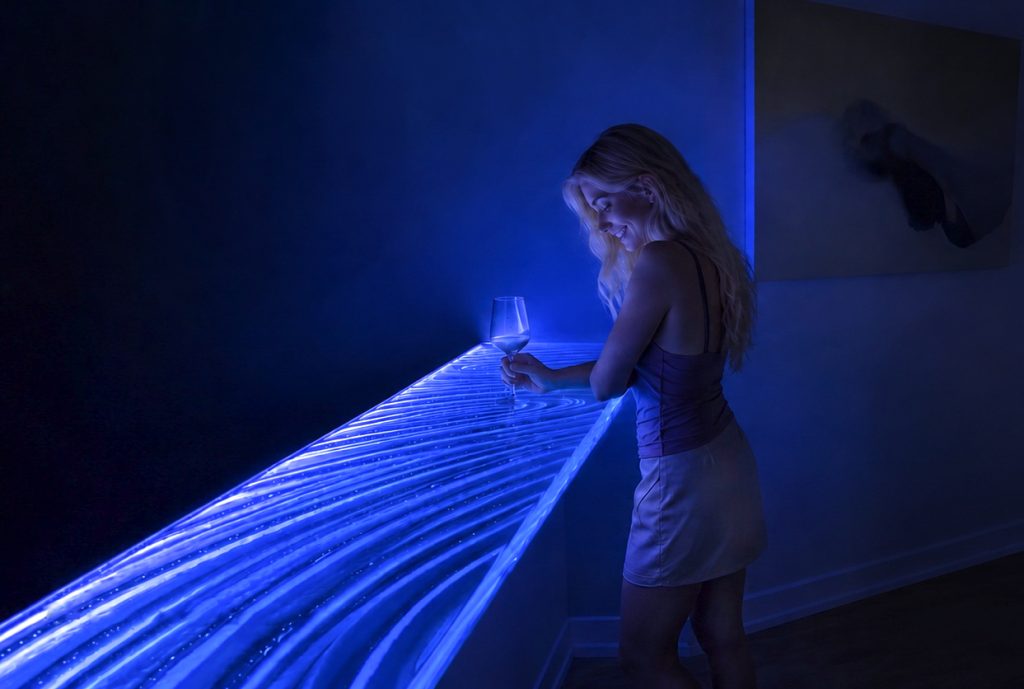
Glass high bar cantilevered over a kitchen island — 126" long x 20" wide x 1.5" thick low-iron, LED illuminated glass with The Ambiance Machine™ by Downing Designs
On Durability
The edge profile at Downing Designs is a roundover — top and bottom — soft to the touch and engineered to dissipate impact energy from bottles, bar stools, and everything else a bar top absorbs over its lifetime. If an edge ever needs attention after years of use, it can be re-polished in place. The material doesn't degrade. The finish can always be restored.
For outdoor installations, our COB LED systems are IP-68 rated — fully waterproof, encased in silicone, running on low-voltage 12V or 24V DC power. Safe for outdoor kitchens and poolside bar tops.
The Point of This Post
Anyone can sell you a glass slab. Polishing the edge so it performs like this — so it becomes a second light source instead of just a stopping point — is a different skill entirely. Most shops don't do it. Most shops can't. That's not an opinion. That's what these photos show.
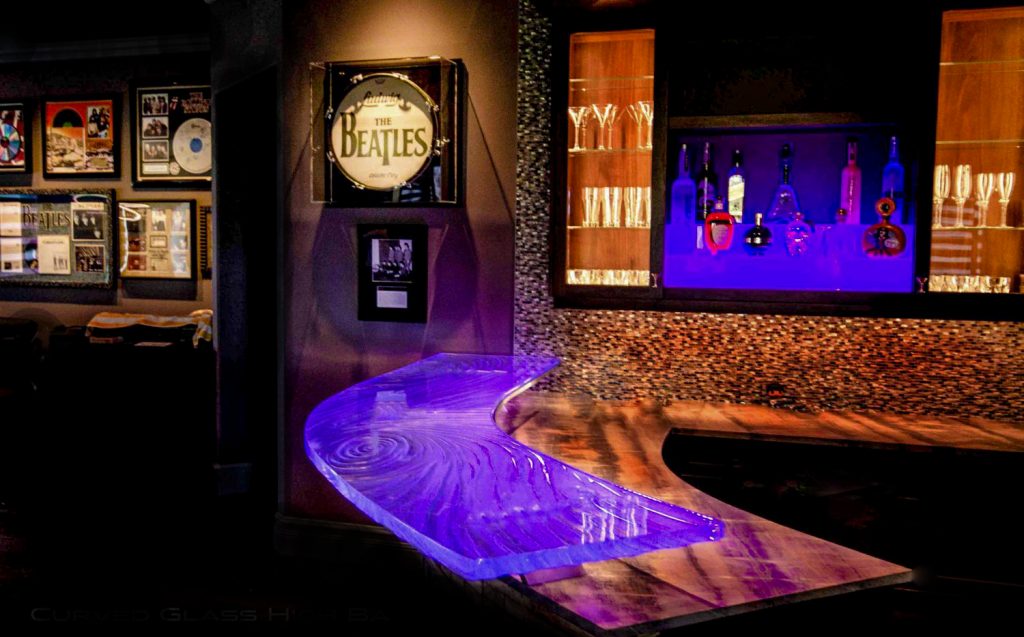
Naples Florida glass bar top with LED — custom shape, Downing Designs
Frequently Asked Questions
What makes a Downing Designs hand-polished glass bar top edge different from a CNC machine-polished edge?
A hand-polished edge is finished through six progressive grit stages — 100, 200, 400, 800, 1,600, and 5,000 — using fresh diamond and sandpaper grits on every project. Machine-polished edges run three fixed bits in a programmed sequence, leaving visible tool marks that worsen as the tooling wears. Hand polishing eliminates every scratch pattern left by the previous stage until none remain.
What is lens-quality edge polishing on a glass countertop?
Lens-quality polishing brings the edge to optical clarity — the same standard used in camera lenses and precision glass instruments. At this level of polish, the edge refracts and magnifies light rather than simply reflecting it, making interior textures appear deeper and the surface appear lit from within.
Why is Downing Designs more expensive than other glass bar top fabricators?
Because the glass countertop or glass bar top edge alone goes through six progressive hand-polishing stages using fresh grits on every single project. Most fabricators run a machine through three fixed bits: rough, medium, fine. Done. The difference shows up immediately under close light and compounds over time as machine tooling wears down. It's the same reason a multi-coat hand-rubbed Italian lacquer cabinet costs more than one from a hardware store, and the same reason a hand-polished supercar paint job costs more than a factory spray booth. You're not paying for material. You're paying for the absence of every flaw a faster process would have left behind.
How do I clean a hand-polished glass bar top edge?
Use a soft non-abrasive cloth and a gentle glass cleaner like Windex. Avoid abrasive pads or harsh chemicals that can affect edge clarity. For bar tops with integrated LED lighting, turn the lights off and allow them to cool before cleaning around the LED channel.
What edge profile does Downing Designs use on glass bar tops?
A roundover profile on both the top and bottom edge — soft to the touch, safe for high-traffic bar environments, and engineered to dissipate impact energy from bottles and bar stools.
Our project page is full of installations we have performed. Here is our St. Petersburg, FL project.

Jeff Downing
Founder, Lead Designer & Custom Glass Countertop Expert
Jeff Downing of Downing Designs, is a Tampa Florida–based design studio specializing in custom Glass Countertops, Glass Bar Tops, Glass Vanity tops and Glass Stair Treads. With decades of hands-on experience, Jeff is widely recognized for delivering textured glass surfaces integrated with LED lighting to create dazzling abstract statement pieces.
"Glass. Lights. Ambiance".