

Last updated on June 16th, 2026 at 09:25 am
The question most homeowners never think to ask — and why it’s the only one that matters.
It’s 9:30 on a Friday night. The overhead lights have been dimmed. Someone has poured the first real drink of the evening — not the hurried glass of wine from earlier, but the intentional one. The kind that means the night has officially started.
Your guests are settling in. The conversation is looser now. Someone leans against your bar. And in that moment, without anyone saying a word, your home either has it — or it doesn’t.
That “it” isn’t accidental. It isn’t furniture. It isn’t even just the lighting. It lives inside the surface — and in these moments, when the light gets low, it sets the stage for a memorable evening. That “it” is ambiance.
This is the question we ask before we design anything at Downing Designs: What does this bar feel like at 9:30pm? Not at noon. Not in a showroom. At the hour when your home becomes the place everyone wants to be.
Per Frolk: A luxury bar should age well. It should feel just as appropriate at a holiday gathering as it does during a quiet pour on a Wednesday evening.
I could not agree more
Why the Hour Matters
Most surfaces are designed for daylight. Granite looks its best in a kitchen flooded with morning sun. Quartz earns its keep in the clean, even light of a design showroom. Even most glass products are photographed at midday, lit from above, showing off clarity and color.
But a bar isn’t a kitchen. And 9:30pm isn’t noon.
The bar in a private home is a stage set for a specific kind of moment — the end of the week, the arrival of friends, the unhurried hour. That’s when the surface has to perform. Not under task lighting. It has to create ambiance.
Most glass manufacturers never even think to ask this question. They answer a different one: How durable is it? How does it clean? What are the edge options? All valid. None of them put you in the room at that hour.
We’ve spent twenty-five years asking the right question. And the answer has consistently led us back to the same material — kiln-formed glass — because it’s the only surface that actually changes with the light rather than simply enduring it.
What Glass Does That Nothing Else Does
There’s a physics to it that’s worth understanding, even if you never think about physics.
Most surfaces — stone, concrete, wood, quartz — are opaque. Light lands on them and stops. They divide the space rather than opening it up. Opaque surfaces just sit there. They don’t do anything with the light.
Our glass is fundamentally different. Light enters it. Depending on the thickness, the texture, the color, and the angle, that light refracts, bends, scatters, and glows from within. A 1.5-inch kiln-formed glass bar top doesn’t reflect candlelight the way marble does. It radiates and distributes it — slowly across the surface and into the room, onto people’s faces, illuminating your beverage.
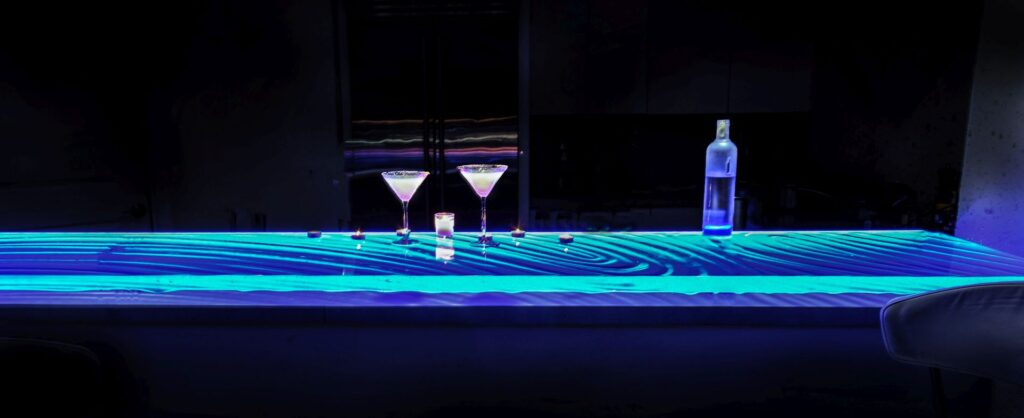
At noon, this is attractive. At 9:30pm, with the overheads at twenty percent and a row of warm LEDs illuminating the surface from beneath, it becomes something else entirely. The bar becomes the light source. The room organizes itself around it.
This is not a feature. It’s a function — and it’s one that exists nowhere else in the material world at this price point and at this scale of customization.
When we integrate dotless LED systems with a glass bar top, we’re not adding a novelty. We’re completing the circuit between surface and atmosphere. The color temperature, the intensity, the way the light moves through the glass versus sitting on top of it — these are design decisions that happen long before installation, in the early conversations about what this room should feel like when the night gets going.
The Ambiance Machine™
We call it The Ambiance Machine™ — not because it’s a product, but because it’s a way of thinking about what a designed surface actually does in a room.
The framework is simple: Feel, Form, and Light.
Feel is the first question. Not what do you want it to look like, but what do you want people to feel when they walk into this room? Warmth. Sophistication. Energy. Privacy. The answer to that question drives every decision that follows — the color of the glass, the texture of the surface, the depth of the pour, the edge treatment.
Form is where the engineering meets the artistry. The dimensions of a bar top aren’t just practical measurements. They’re compositional decisions. Where does the bar begin and end? How does it turn a corner? What happens at the overhang where someone rests their arms and their drink? Form isn’t an afterthought. It’s the structure that makes Feel possible.
Light is where it all comes alive. A surface designed for Feel and built with precision in Form will perform exactly as intended when the light changes — because it was always designed for that moment, not for the photograph.
The Ambiance Machine™ is what separates a glass bar top from a glass bar top. One is a material. The other is an experience, engineered from first principles.
Why Handcraft Changes the Equation
There’s a difference between a bar top that comes from a factory and one that comes from a fabricator.
At scale, glass countertops are processed through production lines. Edges are finished by CNC equipment. Surfaces are controlled by repeatable mechanical tolerances. The product is consistent — just like a printing machine knocking out copy after copy. It’s also, by definition, the same as every other product that came through that line. Look at the predictable textures offered by glass factories: parallel lines, mechanically consistent from top to bottom, every panel identical to the last. That’s not craftsmanship — that’s a tool making a pass. There’s no surprise in it. No moment where the material did something unexpected and the maker followed it.
What happens in our studio is different. The texture in a Downing Designs surface isn’t applied — it’s discovered. It emerges from direct kiln work by hand, from glass that moves and a craftsman who reads it and responds. Every square inch is unrepeatable, because it was made by a person in conversation with the material — not a process optimizing for consistency.
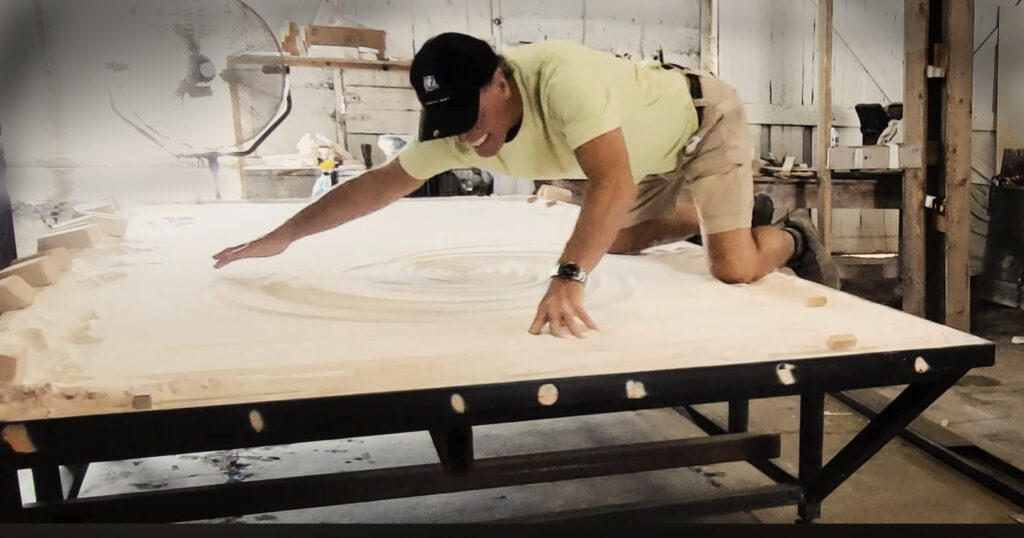
At Downing Designs, there is no production line. Every piece is built by hand in our 10,000-square-foot Tampa studio — designed, kiln-formed, finished, and installed by the same craftsman. The edges are hand-polished — rounded, smooth to your touch, not sharp, not machined. The texture is developed through iterative kiln work, not preset programming. When we say custom, we mean that no two pieces share the same set of decisions, because no two rooms share the same 9:30pm. Our glass bar tops change your room.
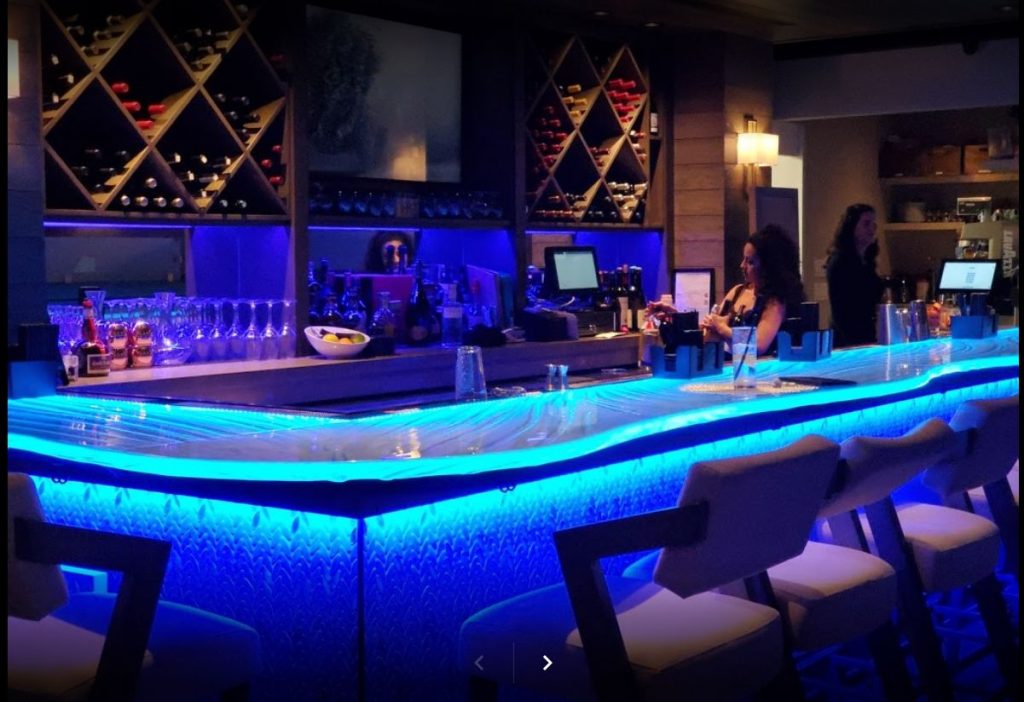
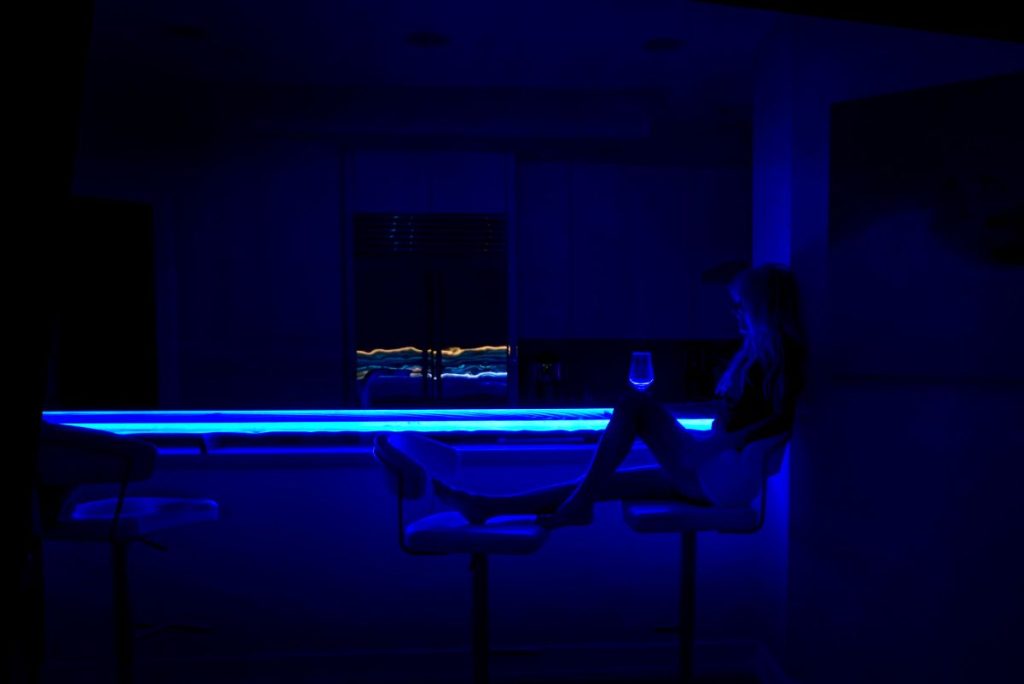
Downing Designs LED Illuminated Glass Bar Tampa
This matters in ways that don’t show up in a specification sheet. It shows up in the way light catches a hand-polished edge differently than a CNC edge. In the way a fabricator who has asked the 9:30pm question thousands of times over twenty-five years makes different choices, at every stage, than a manufacturer optimizing for throughput.
It’s also why we work nationwide — and occasionally beyond. When a client on a private Caribbean island or a West Palm Beach restaurant needing a signature bar top that holds its own at that hour, in that setting, among those guests, they’re not looking for a product. They’re looking for a result. The single-fabricator model is how we guarantee the result travels with the piece.
Rooms Where the Question Has Been Answered
The L-shaped bar top we installed on Bayshore Drive in Treasure Island — 118 inches on the long run, 59 inches on the return, crane-lifted into place — was designed for a waterfront setting where the Gulf light is extraordinary at dusk and the bar needed to perform well after the sun was gone. The dotless LED system underneath means the glass continues to glow after the sky goes dark. The room doesn’t lose its atmosphere when the light source changes. It gains one.
A private island project — the kind we don’t put a name to, at the client’s request — required a bar top that would anchor an indoor-outdoor space used primarily in the evening, by guests who had seen everything. The question wasn’t whether the glass would look good. It was whether the room would feel like something rare. We believe it does.
That’s the measure. Not the specification. The room. At the hour.
The Question to Ask Your Fabricator
Before you choose a surface — before you look at samples, before you talk about dimensions, before you discuss lead time — ask this:
What will this bar feel like at 9:30pm?
If the answer comes back in terms of material properties, you have your answer. If it comes back in terms of the room, the light, the feeling of the evening — you’ve found your fabricator.
We’ve spent twenty-five years learning how to answer that question well. We’d be glad to answer it for your room.
Downing Designs is a custom luxury glass fabrication studio based in Tampa, Florida, with projects across the United States and internationally. Every bar top is designed, kiln-formed, and installed by a single craftsman with over 25 years of experience. To start a conversation about your project, visit downingdesigns.com.
Frequently Asked Questions
What makes kiln-formed glass different from other bar top materials?
Kiln-formed glass is created by heating raw glass in a programmable kiln until it softens, flows, and fuses into a single solid piece. Unlike stone, quartz, or concrete — which are opaque and simply reflect light — kiln-formed glass allows light to enter, refract, and glow from within. This means the surface behaves differently at different times of day and under different lighting conditions. At 9:30pm, with low overheads and integrated LED illumination beneath the surface, a kiln-formed glass bar top becomes a light source in its own right. No other material at this scale and price point does what glass does in a room after dark.
What is The Ambiance Machine™?
The Ambiance Machine™ is Downing Designs’ proprietary framework for designing surfaces that perform as atmospheric elements — not just functional ones. It is built on three pillars: Feel, Form, and Light. Feel establishes the emotional intention of the space before any material decisions/ are made. Form translates that intention into precise compositional and structural choices. Light is the final activator — the element that brings the surface to life at the hour it was designed for. The Ambiance Machine™ is the reason a Downing Designs bar top feels different in a room than a bar top that was simply specified and installed.
How does LED lighting work with a custom glass bar top?
At Downing Designs, LED integration is a design decision, not an afterthought. We use dotless LED strip systems — engineered to eliminate the visible hot spots of traditional LED strips — positioned beneath the glass so that light enters the material rather than sitting on top of it. The result is a surface that appears to glow from within. Color temperature, intensity, and in many installations, full RGB color control, are all specified as part of the original design conversation. The LED system and the glass are designed together, because the way light travels through a particular thickness, color, and texture of glass determines how the final room will feel.
What does “hand-textured” mean — and how is it different from factory-produced glass?
Factory-produced glass textures are applied mechanically — a tool makes a pass across the surface in a controlled, repeatable motion. The result is consistent and predictable: parallel lines, uniform depth, every panel the same. At Downing Designs, texture isn’t applied — it’s discovered. It emerges from direct kiln work, where the glass moves under heat and a craftsman reads the material and responds to it in real time. No two surfaces share the same texture, because no two sessions in the kiln are identical. The difference shows up exactly where it matters most: in the way light catches a hand-worked surface versus a mechanically processed one, particularly at low light levels when texture becomes the primary visual element.
How much does a custom glass bar top cost?
Custom kiln-formed glass bar tops from Downing Designs typically begin at several thousand dollars and scale with size, complexity, edge treatment, color, texture development, and LED integration. Large-format or architecturally complex commissions — L-shaped configurations, cantilevered installations, crane-lift projects — represent a more significant investment. We don’t publish fixed pricing because no two projects share the same set of decisions, and pricing a custom piece before understanding the room, the vision, and the installation conditions would produce a number that means nothing. The right starting point is to have a sketch and a conversation. We’re straightforward about investment from the very first exchange.
Do you install outside of Tampa?
Yes. Downing Designs works nationwide and internationally. Projects have been completed across Florida — Tampa, St. Petersburg, Naples, Jupiter, Fort Myers, West Palm Beach — as well as in other states and on private islands in the Caribbean. Because every piece is designed, fabricated, and installed by the same craftsman, the quality of the result doesn’t change with geography. Travel, logistics, and installation are factored into every project conversation from the outset.
How long does a custom glass bar top take to build and install?
Most custom glass bar top commissions are completed within four to eight weeks from the point of confirmed design and deposit, depending on complexity. Large-format or multi-piece installations with custom LED integration may require additional lead time. The build begins with precise templating or measurement, followed by kiln work, finishing, and final polish — each stage performed by hand in our Tampa studio. We don’t rush the kiln. The schedule is set by the piece, not by a production target.

Jeff Downing
Founder, Lead Designer & Custom Glass Countertop Expert
Jeff Downing of Downing Designs, is a Tampa Florida–based design studio specializing in custom Glass Countertops, Glass Bar Tops, Glass Vanity tops and Glass Stair Treads. With decades of hands-on experience, Jeff is widely recognized for delivering textured glass surfaces integrated with LED lighting to create dazzling abstract statement pieces.
"Glass. Lights. Ambiance".