
Every Surface Tells a Story: The Design Philosophy Behind White Glass, Lava Stone, and Textured Glass
Introduction
There’s a moment I return to often when I think about why I do this work.
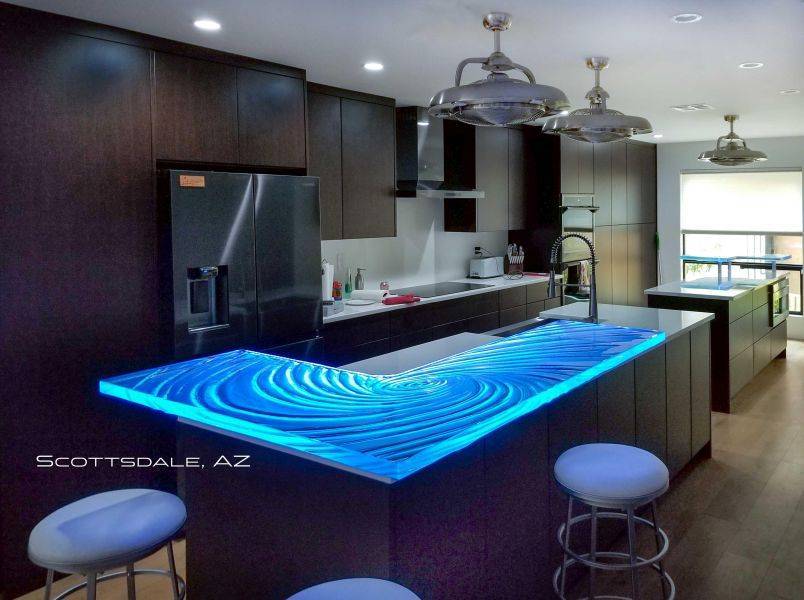
I was standing in a client’s nearly finished kitchen — a sprawling open-plan space in a hillside home in Scottsdale, AZ — watching the late afternoon light move across the different countertop surfaces. The White Glass island caught the abundant sunlight and mirrored it back into the room like a quiet amplifier. The White Glass perimeter counters reflecting the ambient sunlight and LED illumination with equal enthusiasm. And on the high bar peninsula, the Textured Glass surface illuminated the large kitchen with a soft, 360 degree light that changed every few minutes until the sun shifted below the horizon. In open-plan homes, this approach does something else entirely: it defines space without walls. A shift in countertop material at a coffee station or bar peninsula communicates a change in purpose as clearly as any architectural detail.
Nobody in that room was thinking about “countertops”. They were thinking about how good the space felt.
That’s the goal. That’s always been the goal.
Over the years at Downing Designs, my work has increasingly revolved around three materials that, together, create what I’ve come to think of as a complete visual language for high-end interiors: White Glass, Textured Glass and Lava Stone. Each has its own personality. Each behaves differently in light. Each invites a different relationship with touch and use. And when they’re combined thoughtfully, they create interiors that feel layered, intentional, and impossible to ignore.
This is the philosophy behind the way I design: contrast, not conformity.
Why Every Surface Must Earn Its Place
If you walk into a typical kitchen or bar, you can often sense when everything was chosen from a single mood board — safe, matching, coordinated to the point of being forgettable. Nothing offends, but nothing surprises.
High-end countertop design lives in a different world.
In a luxury home, every major surface has to earn its spot. It should contribute something specific: light or shadow, warmth or coolness, texture or smoothness, quiet support or bold expression. I think of surfaces the way a composer thinks about instruments. You don’t want a room full of drums or nothing but electric guitars. You want balance, tension, and release. You want moments where the room breathes, and moments where it speaks.
That’s where the combination of White Glass, Lava Stone, and Textured Glass becomes so powerful — not because they match, but precisely because they don’t. We create spaces that feels considered, layered, and genuinely custom — the difference between a kitchen that was decorated and one that was designed. In our major market of Florida, cities such as Tampa, St Petersburg, Sarasota, Ft Myers, Naples, Miami, Ft Lauderdale, Boca Raton, and West Palm Beach prefer colorful kitchens and outdoor bar areas.
White Glass: The Surface That Listens
White Glass countertops are, in my experience, one of the most misunderstood materials in luxury fabrication. Clients often come to me thinking of them as simply a modern alternative to white marble or quartz. Clean. Bright. Practical. And yes, they are all of those things. But that framing undersells what White Glass actually does in a room.
White Glass is a listener. It receives light rather than commanding it. In a space with strong natural light, it becomes almost luminous — not glowing in a theatrical way, but alive with a soft, interior brightness that no stone surface can replicate. In lower light, it holds a clean, quiet presence that makes surrounding materials feel more grounded. It creates visual rest.
White Glass Countertops represent:
- Purity – A clean, crisp visual anchor that immediately modernizes a space.
- Reflection – They pick up subtle hints of surrounding color, metal, and wood and bounce it back into the room.
- Light – Even though they cant be backlit, white glass surfaces feel luminous, as if they have an inner glow.
From a fabrication standpoint, White Glass demands precision. The material is unforgiving of imprecise edge work — every profile, every joint, every cutout is visible in a way that wood or heavily veined stone naturally conceals. This is why I treat White Glass installations as a kind of discipline. The craftsmanship either shows beautifully, or it shows painfully. There is no middle ground.
In practice, I use White Glass where I want a surface to recede just enough to let the room’s architecture take over — a large island in an open-plan kitchen, a bathroom vanity beneath a dramatic skylight, a chef’s prep surface where function and serenity need to coexist. It provides the sustained note that holds everything else together. It tends to magnify the space in a natural way. Homeowners are always amazed by the before/after feel…its always 25% more spacious. That’s really valuable.
Lava Stone: The Surface That Remembers
If White Glass is the language of light, Lava Stone Countertops are the language of earth and fiery color.
Lava Stone starts life in the most dramatic environment imaginable — inside a volcano. After it’s quarried and cut, it’s enamel‑glazed and fired again, transforming that raw energy into a refined, incredibly.
It has a luxurious, vibrant glaze that is heatproof, hygienic and stain-resistant.
From a design perspective, Lava Stone brings three critical qualities into a space:
- Tactile depth
Lava Stone doesn’t feel like a generic polished slab. It has a subtle, almost magnetic presence under your hand. Even in a glossy finish, it reads as more organic, more grounded. You can specify matte for an even softer, more “stone-like” feel, or metallic glazes if you want a hint of shimmer. The depth comes from the fact that vitreous enamel coating is composed mostly of glass. - Movement and complexity
The enamel glaze Colors can be quiet and neutral or wildly expressive. Unlike many man‑made materials that look the same from every angle, Lava Stone has depth and visual movement — a shift in tone as you walk past, an interplay of color and light that’s never static. - Functional strength
Because of its volcanic origins and vitrified enamel surface, Lava Stone Countertops are heat inert, non‑porous, UV stable, and virtually maintenance‑free. Hot pans, outdoor sun, food acids — it shrugs them all off. That makes it a perfect candidate for outdoor kitchens, tables, and bars, particularly in sunny climates where lesser materials fade or fail.
Lava Stone is also among the most durable countertop materials I work with. Clients who choose it are usually clients who intend to live in their homes for decades, not years. It’s a long-term statement.
I position White Glass as the anchor material in a multi-surface installation. Against the purity of White Glass, you immediately get contrast: light versus color, cool versus warm, air versus earth.
A fun video here shows the process.
Textured Glass: The Surface That Speaks
Then there’s Textured Glass — and if White Glass listens and Lava Stone remembers, Textured Glass speaks.
This is the material I reach for when a design needs a moment of pure visual energy. Textured Glass surfaces interact with light in a way that is genuinely kinetic. The surface relief — whether it’s a subtle ripple, a suave beach sand pattern, catches light at shifting angles throughout the day, creating a surface that is never quite the same twice. In a bar application or a statement bathroom vanity, this is extraordinary. The countertop becomes part of the room’s atmosphere rather than simply its furniture. It’s the material that “plays” with light rather than simply reflecting it.
Textured Glass Countertops:
- Capture and bend light in omni-directional fashion.
- Create three‑dimensional patterns that change as you move around the space.
- Feel simultaneously solid and fluid — like frozen water, carved ice, or rippled sand.
From a fabrication perspective, Textured Glass requires as much problem-solving as artistry. The texture must be preserved through all edge finishing and any cutout work, which means planning the installation from the very first template. I’ve developed specific approaches over the years for handling Textured Glass around undermount sinks and integrated hardware that protect the visual continuity of the surface. Every detail matters because this material rewards attention to detail.
Just off the kitchen, the bar area is where designs can get bolder. This is the perfect place for a Textured Glass Bar Top.
At night, with LED lighting washing over and through the textured glass, the bar becomes a glowing art piece. Guests run their hands over the sculpted surface, noticing the way the light refracts through every ridge and valley. It feels intimate, dramatic, and tailored — not something you’ve ever seen in a catalog.
- It introduces more drama and texture, signaling that this area is for entertaining and atmosphere.
- I use Textured Glass strategically and sparingly. Overuse dilutes its impact. One well-placed Textured Glass surface in a kitchen or bar creates intrigue. Multiple surfaces competing for that same energy create chaos.
The Tie It Together: A Case in Composition
The Scottsdale project taught me something I now apply to every multi-material installation: the order of visual weight matters.
In that kitchen, we sequenced the materials deliberately. White Glass anchors the room’s perimeter — it’s what your eye finds first when you enter, because it carries the most visual mass. The White Glass island sits at the center, catching light and creating an open, welcoming focal point. The Textured Glass bar atop the White Glass functioning almost like a visual punctuation mark — a surface that says: this is where the kitchen ends and the evening soiree begins.
Most fabricators work primarily with one material category and try to stretch it across every application. There’s nothing wrong with that — but it limits what a space can become.
By specializing in Custom Glass Countertops, White Glass Countertops, Textured Glass Countertops, and Lava Stone Countertops, Downing Designs can create a palette with a broader vocabulary:
- Light and reflection
- Texture and shadow
- Warmth, coolness, and contrast
- Indoor elegance and outdoor resilience
Why This Combination Sets Us Apart
Clients don’t always walk in asking for this combination by name. They come in saying:
- “I want my kitchen to feel like a gallery, not just another remodel.”
- “We entertain a lot at night — I want the bar to be a showpiece.”
- “We live outside half the year; I need surfaces that can keep up.”
My role is to translate those desires into surfaces that tell the right story — one of refinement, durability, and emotional impact.
Mixing textures strategically — for example, incorporating textured glass panels — adds a custom, luxurious feel while keeping material costs balanced.
What Clients Are Really Choosing in Countertops
When clients come to Downing Designs and we start talking about a multi-material installation, the conversation eventually moves past specifications and finishes to something more fundamental: what do you want this space to feel like in ten years? For those seeking a stylish and modern kitchen, some of the best color combinations include crisp white with charcoal gray, navy blue with light oak, or matte black paired with brass accents. These combinations offer a contemporary look while remaining timeless, ensuring your kitchen will still feel fresh and inviting years down the line.
Luxury countertop fabrication isn’t about trends. The materials I’ve built my practice around — White Glass, Lava Stone, Textured Glass — are not trending. They’re enduring. They reward the kind of design thinking that considers light at different hours, use over years, and the way a surface changes as you live with it.
Every surface tells a story. My job is to make sure the surfaces in your home are telling the right one — and that together, they’re telling a story worth remembering.
Jeff Downing is the founder of Downing Designs, a luxury countertop fabrication studio specializing in White Glass, Lava Stone, Textured Glass for high-end residential and commercial interiors.
FAQ Frequently Asked Questions
What makes lava stone countertops unique?
Lava Stone is Volcanic Lava Rock, glazed with several coats of vitreous enamel and baked at 1800F. Lava stone countertops possess an extraordinary depth of color, where hues appear to emanate from within the stone rather than sitting on top. Lava stone countertops are heat-resistant, scratch-resistant, non-porous, and highly durable — making them one of the most long-lasting countertop materials available for luxury kitchens and bathrooms.
Are lava stone table tops suitable for indoor and outdoor use?
Yes. Lava stone tabletops are exceptionally well-suited for both indoor and outdoor applications. The vitreous enamel glaze — composed primarily of glass — makes the surface hygienic, stain-resistant, and heatproof. Its resistance to the elements and extreme temperatures makes it a preferred choice for outdoor dining tables, bar surfaces, and kitchen islands in open-plan or indoor-outdoor living spaces. Many Parisian bistros employ lava stone table tops for their outdoor table tops.
Can lava stone be used as the colorful statement element in a kitchen design?
Absolutely. One of lava stone’s greatest design strengths is its availability in a rich range of vibrant saturated colors. This makes it the ideal choice when a designer wants to introduce a bold, colorful focal point — such as a kitchen island or table top — without sacrificing durability or sophistication. The depth of color in lava stone is unmatched by synthetic materials because the vitreous enamel glaze creates color that appears to come from within the surface itself.
How do lava stone countertops work alongside White Glass countertops in the same kitchen?
Lava stone and White Glass countertops are a natural pairing in multi-surface kitchen design. White Glass perimeter counters provide a clean, light-reflective anchor that makes the room feel more spacious — typically creating a sense of up to 25% more visual space. A lava stone kitchen island introduces color, depth, and visual weight as a counterpoint. Together, the two materials create contrast that feels intentional and layered: the White Glass makes the lava stone appear more richly colored, and the lava stone makes the White Glass feel brighter and more luminous.
What color options are available for lava stone countertops and tabletops?
Lava stone countertops and tabletops are available in an unlimited spectrum of colors, applied through the vitreous enamel glazing process. Options range from deep, neutral tones like noir, charcoal, and slate to bold, vibrant colors including rich blues, greens, reds, and warm earth tones. Because the glaze fuses at high temperatures, colors are permanent, fade-resistant, and consistent across the surface — making lava stone one of the most color-customizable natural countertop materials available.
How durable are lava stone countertops compared to other luxury countertop materials?
Lava stone countertops rank among the most durable options in luxury fabrication. The surface is heat-resistant (you can place hot pots directly on it), scratch-resistant, non-porous, and impervious to staining. Unlike natural marble or quartzite, lava stone does not require sealing and will not etch from acidic substances. It is a material chosen by homeowners who intend to live in their homes for decades, as it ages with character rather than deteriorating over time.
|
Feature |
Glazed Lava Stone |
Quartz |
Granite |
Marble |
Concrete |
|
Heat Resistance |
Excellent (No damage) |
Low (Resin melts) |
Good (Sealing needed) |
Moderate (Stains/Etches) |
Good (Needs sealer) |
|
Stain Resistance |
Excellent (Nonporous) |
High (Mostly Nonporous) |
Moderate (Sealing needed) |
Low (High porosity) |
Low (High porosity) |
|
Scratch Resistance |
High (Hard enamel) |
Very High |
High |
Low |
Moderate |
|
UV Resistance |
Excellent (No fading) |
Moderate (Can yellow) |
High |
High |
High |
|
Maintenance |
Very Low (Soap/Water) |
Low |
Moderate (Regular sealer) |
High (Etches easily) |
Moderate (Regular sealer) |
|
Indoor / Outdoor |
Both |
Indoor Only |
Both |
Indoor |
Both |
|
Cost |
Very High ($$$$) |
High ($$$) |
Moderate ($$) |
High ($$$) |
Moderate ($$) |
Can a lava stone kitchen island be designed as the single colorful focal point in an otherwise neutral kitchen?
Yes, and this is one of the most effective design strategies in high-end kitchen fabrication. A lava stone island in a bold color — set against White Glass perimeter countertops and neutral cabinetry — functions as the room’s visual anchor and primary color statement. This approach follows a deliberate compositional logic: the neutral surfaces allow the lava stone’s color and depth to read as intentional and curated rather than overwhelming. The result is a kitchen that feels designed, not merely decorated.
Is lava stone a good investment for a luxury kitchen remodel?
Lava stone is one of the strongest long-term investments in luxury kitchen design. Its durability means it will not need to be replaced due to wear, etching, or staining — common issues with marble and some engineered stones. Its timeless aesthetic and color depth ensure it does not feel dated as design trends shift. And when paired strategically with materials like White Glass countertops or Textured Glass bar surfaces, lava stone elevates the overall design in a way that adds lasting value to the home.
How much does Lava Stone cost
Lava stone countertops plus shipping can start at $400 per sq ft and take 10 weeks to fabricate. Larger element can run towards $750 per sq ft. Smaller tables are cheaper and faster to make. Downing Designs has many options, but the first step is to simply send us your sketch, and we can accurately quote your project price delivered.

Jeff Downing
Founder, Lead Designer & Custom Glass Countertop Expert
Jeff Downing of Downing Designs, is a Tampa Florida–based design studio specializing in custom Glass Countertops, Glass Bar Tops, Glass Vanity tops and Glass Stair Treads. With decades of hands-on experience, Jeff is widely recognized for delivering textured glass surfaces integrated with LED lighting to create dazzling abstract statement pieces.
"Glass. Lights. Ambiance".