
Glass. Lights. Ambiance.
One color. One surface. A ripple across the whole interior design.
What if the most important color decision in a room wasn’t the paint, the cabinetry, or the flooring, but a single custom-colored glass surface?
Picture a kitchen island in saturated blue. Your saturated blue, not one from a catalog. A dining table in warm terracotta. A restaurant bar in deep emerald that sets the personality of the entire room. Your personality. Your color palette. Unique to you.
These aren’t just countertops in unusual colors. They’re design decisions that everything else answers to. Ask one question first: what color does this room actually need? Then coordinate the surrounding finishes after that target color is established.
At Downing Designs in Tampa, FL, we develop custom glazed-enamel colors on solid, opaque white glass for kitchen islands, bar tops, dining tables, vanities, and other architectural surfaces. The color becomes the starting point of the design, not another pick from a limited catalog.
One thoughtfully designed surface can shape the palette, materials, balance, and character of a whole room.
I.One Surface Sets the Direction
Every great interior has a hierarchy. Some elements recede, and others lead. A kitchen island is built for the lead: it sits at the center, anchors the kitchen, and connects to the living and entertaining spaces beyond.
The room doesn’t need another color. It needs a reason for that color.
The problem is often the same: a beautiful but visually unremarkable kitchen. There is a difference between sprinkling color throughout a room and establishing one deliberate focal point.
Give that island a custom-fired color no catalog offers, and it no longer has to match the cabinets or disappear into the palette. It sets the tone. Cabinet finishes, hardware, flooring, pendants, and furniture can all follow its lead.
The same holds for a dining table, a vanity, or a hospitality bar. The goal isn’t to make everything compete for attention. It’s to give the room a clear point of view.
Think in terms of social utility
Establish a visual hierarchy. Which surface offers the most social utility? Where will people gather, at the island or the bar top? Focus on that surface, and spend a little more on that piece.
Spend a little less on the low-social-utility elements, such as the perimeter of the kitchen where “stuff” collects. Your budget stays intact, and you get the most from every dollar.
Downing Designs is your design partner for the centerpiece around which an interior can be developed, not simply a countertop supplier.
II.The Color Comes First: A New Way to Specify Custom Countertops
Traditional selection starts with a compromise: which available color works with what we’ve already chosen?
Custom glazed-enamel glass flips the question. Start with the color you actually want, then build around it. Develop a custom-colored surface that gives the room its direction. Our glazed-enamel technology is what makes the philosophy actionable.
A deep blue island might sit beautifully with natural white oak, restrained brass, and warm neutral walls. A rich green could pair with walnut and brushed metal. Terracotta might find its match in creamy plaster, natural wood, and quiet upholstery.
These aren’t formulas. Every result depends on the specific colors, finishes, proportions, and light. What changes is the surface’s role: it becomes the lead voice in the design, not a material chosen to fit decisions already made.
The premise: rather than choosing the countertop last, make the intended glazed-enamel color an early part of the design brief.
- Identify the intended atmosphere and color direction.
- Establish a target from a paint chip or a physical object.
- Order a fired sample.
- Evaluate it beside the proposed cabinetry and other finishes.
- Finalize the palette before commissioning the full surface.
III.Why Custom Color Changes the Possibilities
We develop fired-enamel colors on a solid, opaque white glass substrate. The enamel is translucent in its first millimeter and opaque beyond it. It is not transparent colored glass and it is not backpainted. It’s a fired enamel surface with its own design vocabulary.
A designer might start with a Benjamin Moore or Sherwin-Williams chip, a RAL reference, a corporate identity color, a piece of art, or an original idea. The goal is a fired sample you can evaluate as real material before the finished surface is commissioned.
Matching in fired enamel is a development process, not a transfer of digital values. The substrate, enamel formulation, application, and firing all shape the result. That’s why the physical sample matters.
IV.The Domino Effect
A single colorful island, bar top, or dining table can become the visual anchor that organizes everything around it. Color changes the perceived temperature of a room, light interacts with cabinetry and walls, and a distinctive surface can make otherwise ordinary materials look intentional.
- Custom-blue island: contrast against warm wood and pale walls, with restrained surroundings that let the island lead.
- Deep-green bar: the identity of a restaurant, hotel, or private club, with wood, metal, walls, and lighting chosen to support the mood.
- Terracotta dining table: a warm anchor that guides chairs, flooring, artwork, and objects, a unifying element rather than just a place to eat.
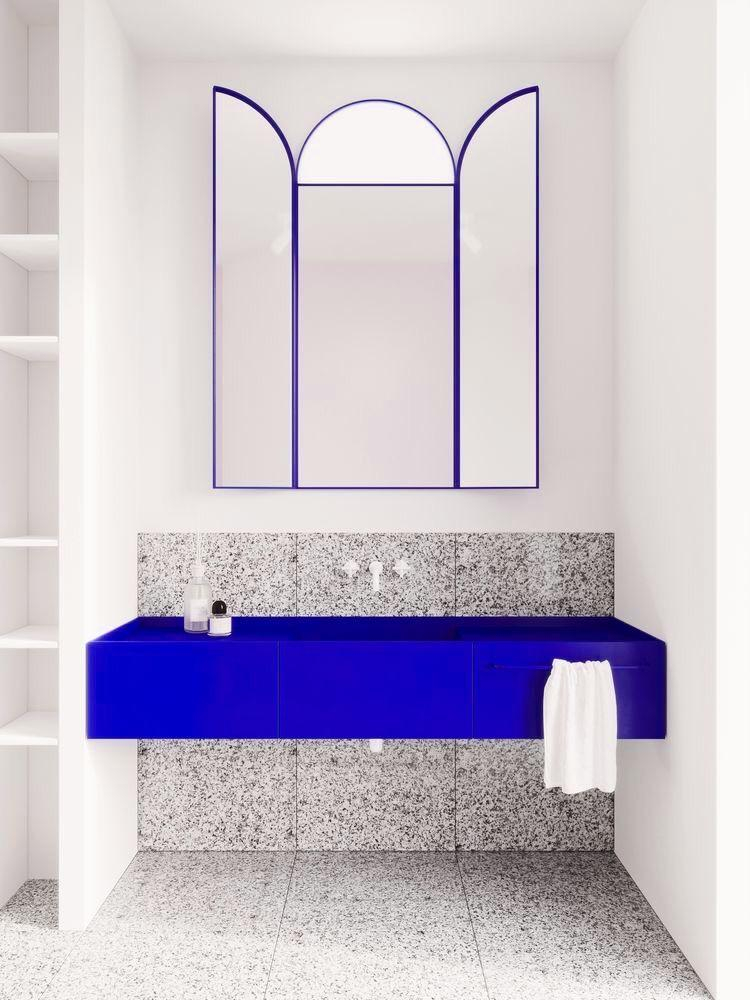
- Custom-color vanity: personality in an otherwise neutral bath, reinforced by cabinetry, mirrors, hardware, and walls.
This is why the color conversation belongs early, while it can still influence everything else.
V.Light, Finish, and Surroundings
The enamel is translucent in its first millimeter and opaque beyond it, and light shapes how it reads either way. Daylight, warm-white LEDs, cooler artificial light, gloss, reflections, and neighboring colors all change a finish’s apparent character.
A color that feels calm in a bright showroom can turn dramatic against dark cabinetry at night. A warm surface looks different beside cool white walls than beside natural oak. That’s the surface responding to its illumination and its neighbors.
So judge color in the room where it will live. Set a fired sample beside the proposed cabinetry, flooring, and finishes, and look at it in more than one light. A few minutes with a physical sample can prevent a much larger compromise later.
A colored surface is not merely a color swatch enlarged to countertop size. Its texture, translucency, thickness, lighting, and surroundings determine how that color is experienced.
We call it our Ambiance Machine™ because the surface and the lighting work together to set the tone for the room, and for the adjacent rooms around it. A few design ideas worth exploring:
- The interplay of light entering the glaze, reflected light, and surface texture.
- Why a textured glass surface creates a different experience from a flat, glossy one.
- How integrated LEDs can transform a bar or island after dark.
- How a designer can create distinct daytime and nighttime experiences with one surface.
- Using contrast to make the centerpiece more powerful.
VI.From Color Reference to Finished Surface
Custom color should be an informed decision, not a guess from a screen. Two ways to begin:
- Closest Fired Color: $75. Choose from our existing fired-color library. We select the closest match and ship the sample by express service.
- Fire-to-Swatch: $500. Provide a target such as a Benjamin Moore, Sherwin-Williams, or RAL chip. We develop and fire custom samples toward that target.
Fired enamel and paint are different materials, so an exact match to a chip or digital value can’t be guaranteed. The fired sample is your reference before you commit.
Start on our Custom Color Glass Countertop Samples page.
VII.Think Beyond the Countertop
For a homeowner, it’s a kitchen built around a distinctive island. For an architect, a color that reinforces the concept of an entire residence. For a hospitality designer, a bar top that defines the room.
Don’t choose a countertop color to fit the room. Develop a surface that helps define it.
Start with the color you can’t stop looking at. The room will follow.
Frequently Asked Questions
What is glazed-enamel glass?
Glass finished with a specially formulated enamel that is fused to the substrate through firing. At Downing Designs, custom colors are developed on solid, opaque white glass for kitchen countertops, bar tops, dining tables, and vanities.
Can I match a glazed-enamel countertop to a Benjamin Moore, Sherwin-Williams, or RAL color?
Yes. These references make excellent starting points. Our $500 Fire-to-Swatch service develops a fired sample toward your color reference. Paint and fired enamel are different materials, so an exact match isn’t guaranteed. Evaluate the physical sample before approving the finished surface.
Why choose the countertop color before other finishes?
Setting the surface color first lets cabinetry, hardware, flooring, walls, and lighting be coordinated around it, which usually produces a more intentional design than choosing the countertop last.
Is glazed-enamel glass translucent or opaque?
Both. The colored enamel is translucent in its first millimeter, so light enters the glaze and you see real depth. Beyond that first millimeter the surface is opaque, over a solid white glass substrate. Lighting, reflections, gloss, and surrounding materials still change how the finish appears.
Does light interact with the colored enamel?
Yes. Glaze is mostly glass, and the word itself comes from glass. Even though the glaze layer is thin, the effect is easy to see as you change your viewing angle. The surface shows a visible depth that only glass countertops produce. A paint swatch has no depth to its opacity.
How can I see a custom color before ordering a full countertop?
Order a $75 Closest Fired Color sample from our library or a $500 Fire-to-Swatch sample developed toward your reference. Details are on the custom-color sampling page.
Glass. Lights. Ambiance.
Begin a Commission
We don’t have office hours. We have phones.

Jeff Downing
Founder, Lead Designer & Custom Glass Countertop Expert
Jeff Downing of Downing Designs, is a Tampa Florida–based design studio specializing in custom Glass Countertops, Glass Bar Tops, Glass Vanity tops and Glass Stair Treads. With decades of hands-on experience, Jeff is widely recognized for delivering textured glass surfaces integrated with LED lighting to create dazzling abstract statement pieces.
"Glass. Lights. Ambiance".