
On Optical Path Length, Accumulated Transparency, and the Discipline Every Master Eventually Finds
Downing Designs
Depth is not a color. It is the distance light has to travel before it reaches your eye.
Imagine standing in waist-deep ocean water. You can still see the sand.
Walk twenty feet further out and the water turns turquoise — red is already gone, though you never saw it leave. Walk a hundred feet past that and it's cobalt. Nothing was added. There is no blue pigment dissolved anywhere in that water. The only thing that changed is the distance light had to travel before it turned around and came back to your eye.
Painters have been exploiting this exact phenomenon since the invention of oil glazing. Ceramicists have been exploiting it in cobalt and porcelain. Glass artists have been exploiting it in kilns and laminate presses. Medieval builders exploited it in colored window glass eight hundred years before any of them. Different centuries, different materials, no contact with one another — and all of them arrived, independently, at the same law.
This piece exists to do three things. First, to show that this law is real physics, not a poetic flourish — it has a name, a mechanism, and measurable behavior. Second, to trace it through four independent traditions — oil painting, porcelain, laminated glass, and light architecture — that all discovered it without borrowing from each other. Third, and most importantly, to do something none of those four traditions did alone: deliberately cross-pollinate their individual solutions into a single working method for layered, low-iron glass — which is where this stops being art history and starts being a studio protocol.
I The Law, and Why It Has a Name
Nature ran this experiment first. Ocean depth, glacial ice, opal, moonstone — every one of these builds color through accumulated transparency rather than pigment concentration. There's a real term for the mechanism: optical path length. Light moving through a translucent medium doesn't simply travel — it interacts continuously with everything it passes through. At every interface it partially reflects, partially transmits, partially refracts, partially scatters, partially gets absorbed. The more interfaces light crosses before it exits toward an eye, the more of that filtering accumulates — and which wavelengths survive the trip is entirely a function of how far, and through what, the light had to travel.
Diving physics makes this brutally precise. As sunlight descends through water, color disappears in a fixed, well-documented order: red is essentially gone by around 15 feet; orange follows by roughly 25 to 30 feet; yellow fades out somewhere between 35 and 60 feet depending on clarity; green persists further but is significantly diminished by around 100 feet; blue and violet outlast everything else, which is the entire reason deep water reads as blue at all. Not because blue is a stronger color — because blue is the color that survives the journey. The same is true of thick glass countertops. The LED at the rear of the glass edge shines through, but there is a dramatic color shift you can note when trying the orange colors — it shifts dramatically toward green-orange, and you can watch it happen along its path.
That's the whole essay, compressed into one sentence: color at depth is a survivor's story, not a paint job.
II Why a Camera Can Never Hold It
Human beings see with two eyes, not one. Each sits in a slightly different position and receives a slightly different set of reflections and internal light paths off the same translucent surface — the brain fuses those two disagreeing feeds into a genuine sense of dimensionality that a single-lens photograph is structurally incapable of producing. This isn't a limitation of camera quality — even the best cameras and lenses can't hold what a finished piece does in the room. It isn't a gear problem. A photograph only ever has one eye's worth of information to begin with, and a layered, transparent surface is exactly the kind of object that rewards having two.
Then there's movement, which photography loses just as completely. Depth in a piece like this isn't a fixed property sitting on the surface waiting to be captured — it's a live relationship between the material, the light hitting it, and the viewer's angle. As a viewer shifts, highlights migrate across the surface, internal reflections travel, bubbles suspended in layered glass seem to drift, refractions and shadows move. Nothing about the object changed. The light and the viewer did. That relationship is what makes a piece feel alive instead of static, and it's precisely what a single frozen exposure cannot carry.
This isn't a marketing claim dressed up as science — it's the literal mechanism behind "you have to see it in person." The Rothko Chapel in Houston makes the case directly: the space enforces a no-photography rule, and visitors consistently describe a slow-building effect rather than an immediate one, deepened by an octagonal room that keeps every painting in peripheral view no matter where you stand — one scholar described the sensation as having eyes in the back of one's head. You are never permitted to settle on a single vantage point. That's parallax and movement doing exactly what Section I described in ocean water, now happening in a room full of glazed canvas instead of seawater — the same optical mechanism, made architectural.
The point extends past material transparency, too — James Turrell restricts photography of his Skyspaces for a related but broader reason: light and perception themselves resist being flattened into a single frame, whether or not the medium is translucent at all. That's a wider claim than this essay needs to make, but it's worth noting that other serious artists have reached some version of "you have to be there" from a completely different direction.
III Four Masters, One Discipline, No Contact With Each Other
Painting. Glazing — a thin, transparent layer of paint applied over another, fully dried layer beneath it — has been part of oil technique since the medium's invention. It looks simple and isn't: too much glaze suffocates the layers underneath, too little disappears entirely, and the top and bottom colors never mix physically, only optically, the way colored acetate laid over a photograph changes what you see without ever touching the image itself. Vermeer's paintings are frequently cited as glowing from within for exactly this reason — not a special pigment, but disciplined, repeated glazing. Historically the technique also solved a material shortage: many vivid colors, purple especially, simply didn't exist as stable pigments, so painters built them optically instead — blue glazed over a reddish underpainting, or the reverse. Painters didn't adopt glazing because they enjoyed extra work. They adopted it because depth cannot be mixed on a palette. It has to be accumulated.
Rothko took that inherited discipline further than almost anyone. Cross-section analysis of his canvases — most famously the Seagram Murals — shows a consistent structure of roughly 20 to 30 individually diluted layers: thin, stained foundation washes that sink into the canvas and are never fully covered; a middle stage of chromatic build at varying translucency, so the foundation keeps showing through unevenly; and a final stage of ultra-thin glazes that don't add color so much as shift temperature — a warm glaze over a cooler base is the specific move behind the sensation people describe as his canvases "glowing" or "breathing." Rothko wasn't painting color. He was painting optical path length, in oil.
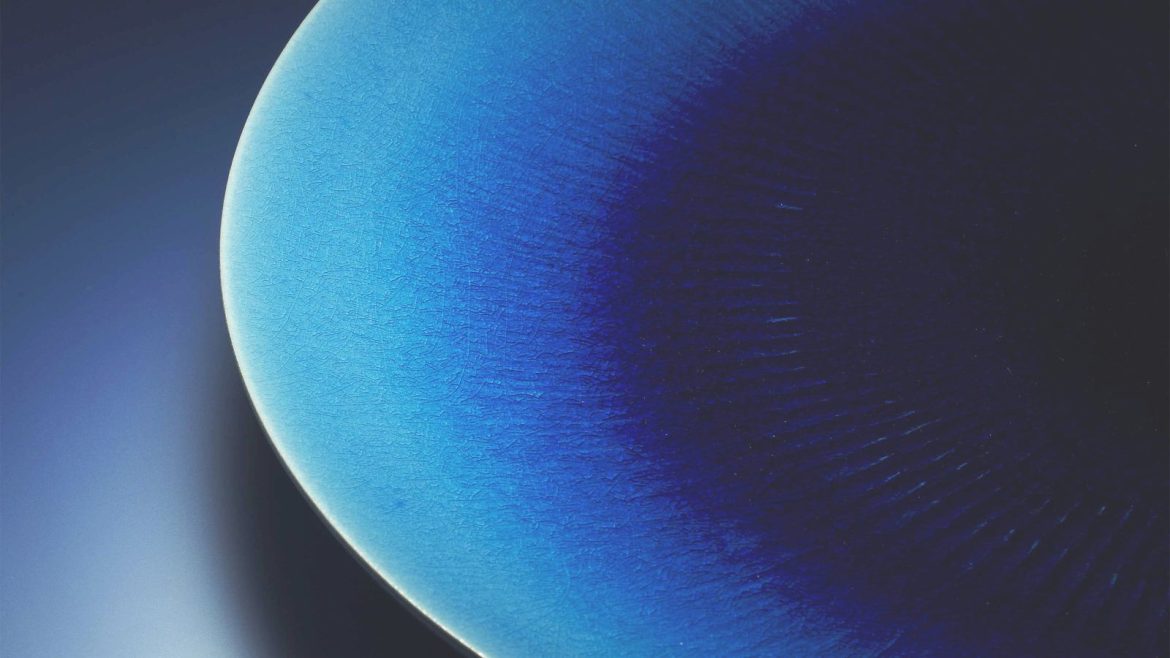
Porcelain. Half a world away, in an entirely different material and tradition, Yoshiro Kimura solved the identical problem. His hekiyu blue glaze runs from pale aquamarine at a vessel's rim to deep cobalt toward its center — built through several layers of glaze and multiple separate firings, not a single wet application. As his gallery describes it: "Kimura has been able to mature and develop the colours to its current, mesmerising depths, created with multiple layers and consecutive firings of great difficulty." The darkest zone isn't a stronger pigment; it's the same base glaze, struck with additional passes concentrated toward the center and fused in the kiln between each one. His gradient is a literal record of how many times a given area was glazed and fired again — Rothko's layer count, translated into firing cycles instead of drying intervals. Downing Designs' own glazed lava stone process, PyroArch™, is a direct cousin of this — a fired-enamel surface built through the same family of heat-driven color development.
Glass, twice over — and by two artists who never compared notes. Niyoko Ikuta found the law in Kyoto. Since 1980, she has laminated sheets of plate glass together with adhesive, then cut into the resulting block to expose the cross-sections — a practice she describes as an exploration of light's capacity to reflect, refract, and pass through broken sections of stacked glass. Where Rothko built depth from repeated washes and Kimura built it from repeated firings, Ikuta builds hers from repeated lamination: sheet bonded to sheet, then sliced through at an angle so the interior of the stack becomes the visible, structural surface. The spiraling, geometric forms that result are a direct record of how many sheets of glass a given sightline has to cross. In 2019 she became the first woman ever commissioned by the Metropolitan Museum of Art to create a glass sculpture for its permanent collection; her work also sits in the Victoria and Albert Museum, the Corning Museum of Glass, the Seattle Art Museum, and the Detroit Institute of Arts.
Jiyong Lee arrived at the same law inside the same material through an almost opposite process. Korean-born and based in Carbondale, Illinois, where he has headed Southern Illinois University's glass program since 2005, Lee builds his Segmentation series entirely through cold working — no blowing, no kiln forming, just cutting, sanding, color-laminating, and carving solid blocks of glass into faceted forms drawn from cell division, embryos, and molecular structure. Where Ikuta's cut exposes a fixed stack of sheets, Lee's carving reshapes the exterior angles of an already-laminated solid — so the same internal color layer can read as nearly opaque from one facet and glassy and deep from another, purely as a function of how steeply that facet crosses the laminate underneath. He describes the material itself in terms this essay could have written: working with transparency and translucency, he says, gives him "perfect metaphors for what is known and unknown" — Downing's Law wearing a lab coat instead of a wetsuit. Lee is a 2021 Loewe Foundation Craft Prize finalist, his work sits in the permanent collection of the Corning Museum of Glass, and new work is showing in Homo Faber: An Island of Light in Venice in 2026. Kyoto and Illinois, lamination-and-cut and lamination-and-carve — two artists, no shared notes, the same law.
Medieval stained glass makers found the same law eight centuries before any of the above, in colored window panels: hundreds of small, differently-hued, differently-thick pieces of glass, assembled so that shifting daylight and a moving viewer inside the cathedral produced an experience that was never the same twice and never fully capturable by standing still.
Painter, potter, and two glassmakers working an ocean apart from each other, and a cathedral builder before all of them — none of them read each other's notes. All five ended up in the same place.
IV The Cross-Pollination
This is the part none of the traditions above did on their own, because none of them needed to: each was working in a single material. Building deliberately layered, low-iron glass means the discipline can actually be assembled from more than one lineage at once — taking the specific move each tradition perfected and translating it into a single build protocol.
From Rothko: the three-stage structure, and the final temperature-shift glaze. His foundation / chromatic-build / optical-glaze sequence maps directly onto a glass build — pale base coat, mid-density color development, and a final ultra-thin pass whose entire job is to shift warmth rather than add pigment. In glass, that's the layer that decides whether the finished piece reads as cool and oceanic or warm and sunlit, independent of everything underneath it.
From Kimura: concentration by zone, not by coat. His gradient isn't built by applying different colors — it's built by applying the same material more times in a smaller and smaller area. Translated into a stacked-glass or frit process, that means the darkest zone of a piece should be thought of as "how many times was this specific radius hit again," not "which stronger color goes here." That reframing alone changes how a build sequence gets planned.
From Ikuta: the cut as the reveal, not the flaw. Her method treats the cross-section — the cut, ground edge where the lamination is exposed — as the actual subject of the piece, not incidental damage to be polished away. Translated into stacked low-iron glass work, that reframes how an edge or a cut face gets finished: instead of grinding every seam invisible, a deliberately exposed cross-section can become the place where a viewer actually sees the layer count and the light's path.
From Lee: depth as a function of facet angle, not just layer count. His carving proves something the first three moves don't quite say outright — it isn't only how many layers light crosses, it's at what angle it crosses them. A facet ground steeply against the laminate boundary sends light through more material per millimeter of surface than a shallow facet over that same stack. That means depth in a finished laminated piece can be sculpted a second time, after the color layup is already built and fused, purely by where and how steeply a face is cut. Translated here, that's a fourth and final move: once the glaze, firing, and lamination stages are done, the cut angles and facets of the finished form become an independent, second control over how deep or shallow any given zone reads — a knob the color layers alone don't give you.
Combine those four moves — Rothko's temperature-shift finish, Kimura's radius-limited repetition, Ikuta's cut-as-reveal, and Lee's facet-angle control — and the result isn't a copy of any one of them. It's a synthesized method that didn't exist in any single tradition, because no single tradition needed to borrow from the other three. That synthesis, done deliberately and documented honestly, is the actual intellectual contribution of this piece — not "glass inspired by Rothko," but a named cross-disciplinary protocol built by taking the sharpest tool from four unrelated traditions and applying all four to one material at once.
V Downing's Law of Optical Depth
The apparent depth of a transparent color is proportional not to pigment concentration, but to the number of translucent interactions light experiences before it leaves the material.
A photograph can record color and shape. It cannot record the journey light took to reach your eye. That's why collectors cross continents to stand in front of a single Rothko. That's why deep ocean water can never quite be explained by a postcard. And it's why color, built this way, eventually stops being something applied to a surface and becomes something constructed — layer by layer, cut by cut — until light itself is doing the work.
VI Why the Eye Believes It
Josef Albers spent a career proving that color is never perceived as it physically is — it's read entirely relative to what surrounds it. Central to his teaching was the deliberate construction of the illusion of transparency: arranging flat, opaque materials so the eye reads one shape as showing through another, even when nothing is actually transparent at all. What that proves is that human perception is already primed to search for exactly this kind of layered evidence and reward it with a strong response. When real transparency and real optical path length are present — as in a Rothko glaze stack, a Kimura firing sequence, an Ikuta laminated cross-section, or a Lee carved facet — the effect isn't fighting the eye's instincts. It's finally giving them something true to work with.
VII Four Voices, One Discipline
Rothko, Kimura, Ikuta, and Lee are each remembered, correctly, as singular artists — a painter, a potter, and two glassmakers working in complete isolation from one another. But set their solutions side by side and a shared discipline comes into view: layer count, translucency, firing interval, cut angle — four different vocabularies for the same underlying fact of physics. Depth was never a stronger color. It was always a longer path for light to travel.
Niyoko Ikuta's laminated glass sculptures sit in the permanent collections of the Metropolitan Museum of Art, the Victoria and Albert Museum, and the Corning Museum of Glass — institutional proof that cut-and-laminated glass can carry the same weight as a painted canvas. Jiyong Lee, a 2021 Loewe Foundation Craft Prize finalist whose work is also held by the Corning Museum of Glass, is showing new pieces at Homo Faber: An Island of Light in Venice in 2026. Neither artist set out to prove a shared law. Their work simply couldn't have turned out the way it did without one.
A bench, a countertop, a bar top — like this full-home white glass installation in Palm Coast — a functional object built this way carries the same law those museum pieces do. The difference is what a glass bar top will do for your entire room at 10pm on a Friday night: physical proof that a real, independently-discovered discipline can be built into something you live with every day.
FAQ Frequently Asked Questions
What is "optical path length," and why does it matter for layered glass art?
Optical path length is the total distance light travels through a translucent material before it reaches the eye, including every internal reflection and refraction along the way. In layered glass, more optical path length means more accumulated color and depth — which is why stacking translucent layers reads as deeper than a single pigment-saturated layer, even at the same overall thickness.
Why can't a photograph capture the depth of a layered glass or painted piece?
Depth of this kind depends on two things a single photograph cannot hold: binocular vision, where two eyes receive slightly different reflections that the brain fuses into dimensionality, and movement, where highlights, internal reflections, and refractions shift as a viewer changes position. A photograph freezes one angle from one lens, so it can record color and shape but not the layered, moving optical relationship that produces the sense of depth in person.
What is Downing's Law of Optical Depth?
It states that the apparent depth of a transparent color is proportional not to pigment concentration, but to the number of translucent interactions light experiences before it leaves the material. In practice, that means depth is built by layering and light, not by using a stronger or darker color.
How is this layered glass method different from resin or epoxy art?
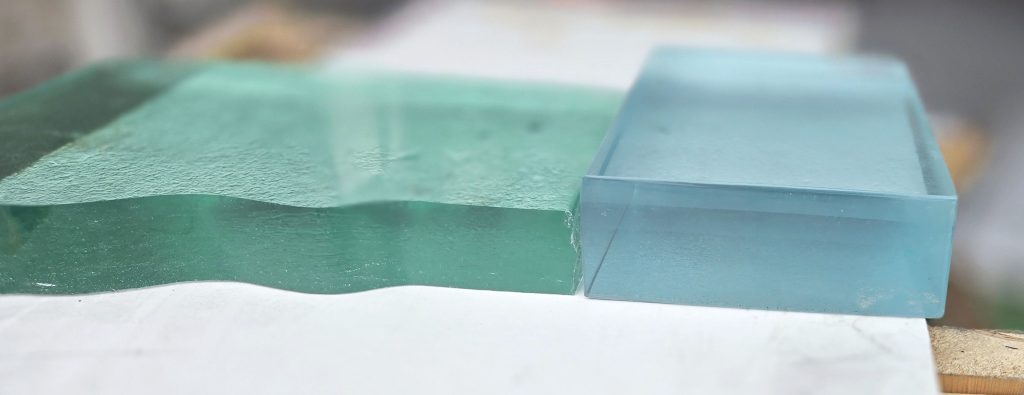
Both aim for a similar visual effect — colorful, oceanic depth — but the mechanism differs. Epoxy artists build depth through poured, wet layers of pigmented resin. This method builds it through kiln-fired, fused layers of transparent frit and low-iron glass, drawing on techniques adapted from oil glazing, porcelain glaze firing, and laminated glass sculpture rather than a resin pour process. This is most evident in a direct comparison of 2" thick low-iron fused glass against 1.5" thick fused clear glass.
Which artists or traditions influenced this method?
Four independent traditions: Mark Rothko's multi-layer oil glazing, Yoshiro Kimura's multi-firing hekiyu porcelain glaze, Niyoko Ikuta's laminated and cut glass sculpture, and Jiyong Lee's cold-worked, faceted laminated glass. Each arrived separately at the same underlying optical principle, which this method deliberately combines into a single glass-building protocol.
— Glossary
- Optical path length
- The total distance light travels through a medium before it exits toward the eye, counting internal reflection and refraction, not just straight-line material thickness.
- Hekiyu
- Yoshiro Kimura's signature blue porcelain glaze, built through repeated layered firings rather than a single application.
- Cold working
- Shaping glass through cutting, grinding, and polishing after it has cooled, rather than through blowing or kiln forming.
- Lamination
- Bonding sheets of glass together, typically with a clear adhesive interlayer, to build a single solid block from multiple layers.
- Optical glaze
- An ultra-thin, transparent layer of paint applied over a fully dried layer beneath it, shifting color or temperature without adding opacity.
— Selected Sources
- Diving-depth color loss figures: standard marine science and scuba training references on light attenuation by wavelength in water.
- Rothko layer analysis: published conservation and cross-section studies of the Seagram Murals and related Rothko canvases.
- Kimura hekiyu glaze: artist and gallery statements on multi-firing porcelain glaze technique.
- Niyoko Ikuta: museum collection records (Metropolitan Museum of Art, Victoria and Albert Museum, Corning Museum of Glass) and gallery (A Lighthouse Called Kanata) materials.
- Jiyong Lee: artist statements, Corning Museum of Glass collection records, Loewe Foundation Craft Prize materials, Homo Faber 2026 exhibition listings.
- James Turrell / Rothko Chapel: published visitor and critical accounts of both sites' photography policies and viewer experience.
- Josef Albers: Interaction of Color and associated teaching materials on the illusion of transparency.
- Vermeer glazing technique: published technical art-history sources on historical oil glazing practice.

Jeff Downing
Founder, Lead Designer & Custom Glass Countertop Expert
Jeff Downing of Downing Designs, is a Tampa Florida–based design studio specializing in custom Glass Countertops, Glass Bar Tops, Glass Vanity tops and Glass Stair Treads. With decades of hands-on experience, Jeff is widely recognized for delivering textured glass surfaces integrated with LED lighting to create dazzling abstract statement pieces.
"Glass. Lights. Ambiance".