
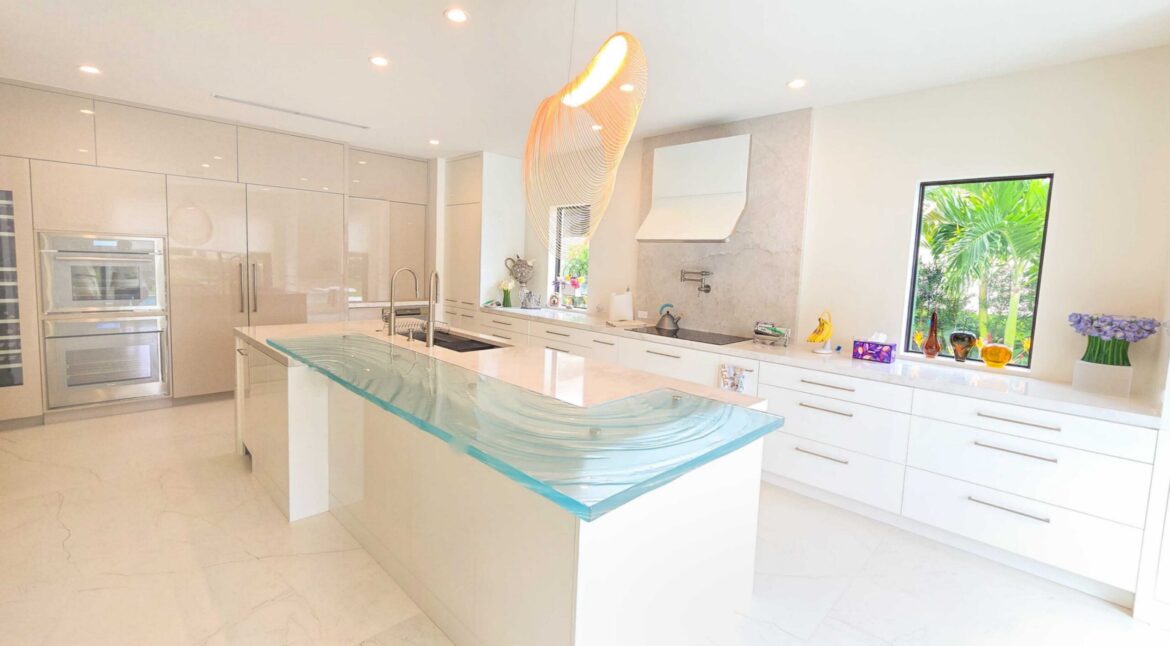
In Florida, where light is abundant and luxury residential and hospitality design sets a high bar, the glass countertop
ambiance conversation starts with a single question…Glass is the only countertop material that doesn’t just sit in a room.
It participates in it.
Stone reflects light from its surface. Wood absorbs it. Glass does something fundamentally different — it bends it, refracts it, filters it, and redirects it into the space around it. A well-designed glass countertop or bar top doesn’t just occupy a position in a room. It changes the emotional tone of the entire space.
That relationship between glass, light, and atmosphere is what we call The Ambiance Machine™ — our proprietary approach to designing glass surfaces and lighting as one unified system. It is the foundation of every custom glass countertop, bar top, and architectural glass installation Downing Designs has fabricated over the past 25 years.
This page is for architects, interior designers, builders, and homeowners who want to understand how that system works — and how to specify or design for it intentionally rather than hoping it happens by accident.
Because the difference between a glass countertop that looks beautiful in a showroom and one that transforms a room at 9:30pm is not luck. It is design.
The Three Lights Every Glass Surface Lives In
Every glass countertop or bar top exists in three distinct lighting environments across the course of a single day. Understanding all three — and designing for all three simultaneously — is what separates a surface that performs from one that merely exists.
The three lights are natural ambient light, ceiling spotlights, and integrated LED illumination. Each interacts with glass differently. Each produces a different atmospheric result. And when all three are designed to work together, the glass surface becomes something that no other material can replicate — a surface that is genuinely alive from sunrise to midnight.
Most designers and specifiers think about one of the three. The best results come from thinking about all of them at once, from the very first conversation about the project.
Natural Ambient Light — The Free Ambiance of Florida
Florida is one of the most naturally lit environments in the world. That is not a detail to work around. It is an asset to design toward.
The way natural light moves through a glass surface across the course of a Florida day is unlike anything you can replicate artificially. Morning light comes in at a low angle and casts long, warm shadows through the carved texture of the glass onto adjacent walls and floors. Midday light is direct and bright — the surface sparkles, edges refract prismatic color, the room feels energized. Late afternoon light turns amber and raking, catching the texture from the side and producing depth and shadow that makes the surface appear almost sculptural.
And the seasons change it further. Living with my own glass pieces in Tampa is a constant reminder of this. The sun angle in December is completely different from the sun angle in July. The shadows shift. The refraction patterns change. The surface I installed looks different today than it did six months ago — and it will look different again in six more months.
This is not a problem. This is theater.
For architects and designers specifying glass surfaces for Florida homes, the first question should always be: where does the natural light come from, and what time of day does this room get its best light? Orient the glass to that light. Design the texture to interact with it. Let Florida do the heavy lifting for free before a single LED is ever switched on.
A glass surface in a south-facing kitchen in Naples or a west-facing bar in a Boca Raton home will produce stunning ambient light effects with zero supplemental lighting whatsoever. We have built installations specifically designed to operate on natural light alone — and they are extraordinary.

Tampa Florida glass countertop bar top with natural lighting for ambiance
Ceiling Spotlights — Precision Light, Museum Quality
When natural light fades, the question becomes how to replace it — not just in quantity, but in quality.
Most residential and commercial lighting contractors default to warm white recessed LEDs. They are adequate. They are not exceptional. And on a kiln-carved glass surface, the difference between adequate and exceptional lighting is the difference between a countertop that looks nice and one that casts moving shadow patterns across your floor.
At Downing Designs, we specify SORAA bulbs for ceiling spotlight applications — the same lighting technology used by major museums to illuminate irreplaceable artwork. SORAA produces a clean, warm light with a precisely defined arc. The beam edges are sharp rather than diffuse. The color rendering index is exceptional. And on textured glass, a SORAA spotlight does something no standard recessed fixture can: it casts the carved texture of the glass as shadow art onto the surrounding surfaces.
The floor beneath a spotted glass bar top becomes part of the installation. The ceiling above it reflects the glow. The walls adjacent to it catch the edge light. A single well-placed ceiling spotlight transforms a glass surface from a countertop into the light source for the entire room.
We assist lighting contractors in determining exact fixture placement and quantity for every project. The positioning of ceiling spotlights relative to the glass surface — angle, distance, beam spread — is as important as any other specification on the project. Get it right and the glass does extraordinary things. Get it wrong and you have an expensive countertop that looks like granite after dark.
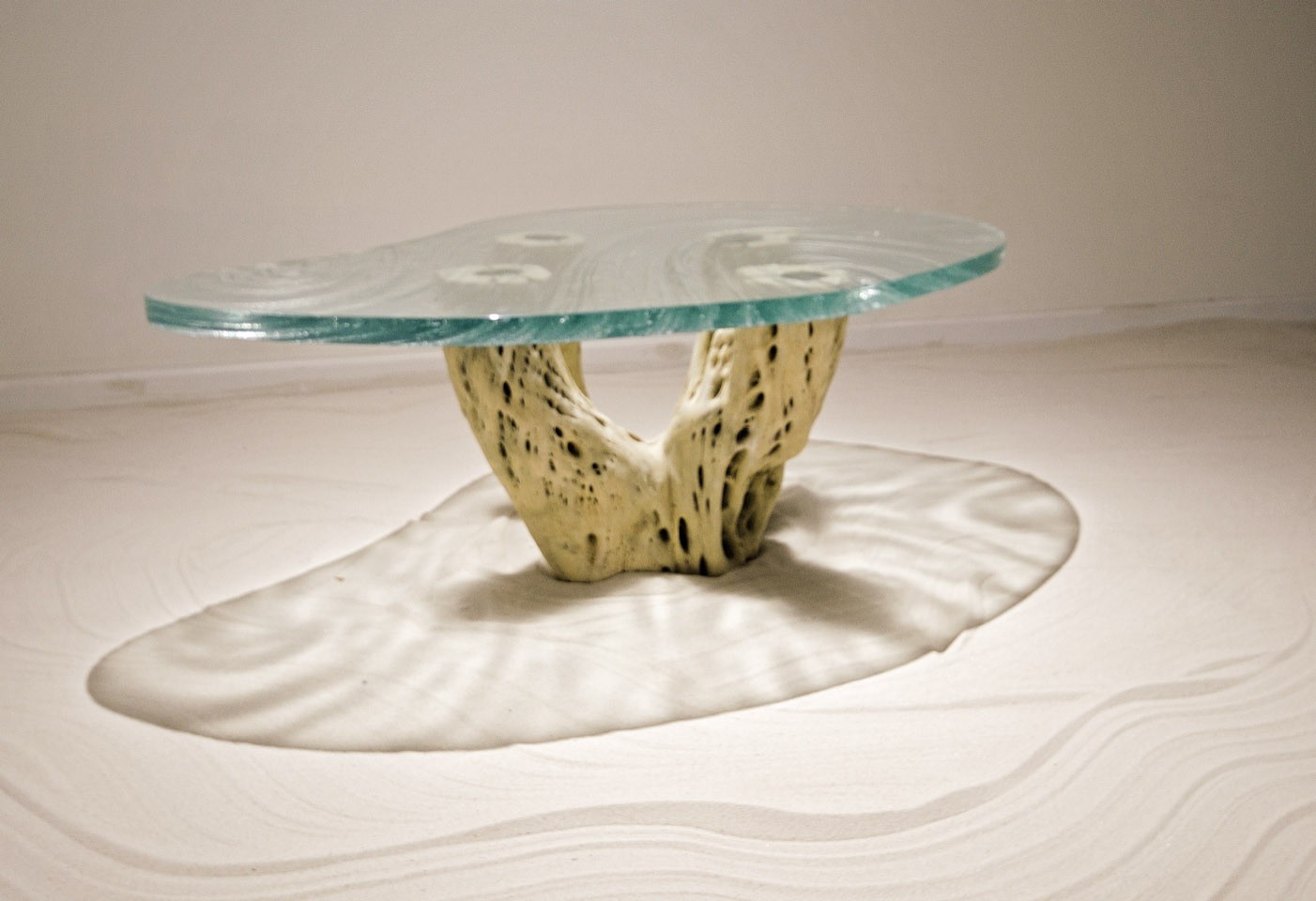
Glass table top with SORAA downlighting casting shadows onto floor
LED Edge Lighting — The Ambiance Machine™ at Full Power
This is where glass does something no other material can do.
When a precision LED system is integrated into the edge of a kiln-carved glass surface, the light doesn’t just illuminate the glass from outside — it enters the glass and travels through it, shaped and filtered by every carved texture it passes through on the way. The result is not a glowing surface. It is a three-dimensional light sculpture that happens to also be a countertop.
Our dot-less LED edge lighting transforms thick glass into a horizontal sculpture radiating light from 360 degrees. The carved textures inside the glass bend and scatter the light in every direction simultaneously — illuminating walls, ceilings, floors, and most importantly the faces of the people seated at the bar. That last detail is not incidental. Flattering light on people’s faces is what makes a space feel warm and inviting rather than cold and institutional. It is why candlelit restaurants feel more intimate than brightly lit ones. The physics are the same. The glass does it better.
Our Ambiance Machine™ RGB LED systems offer over 8 million color possibilities, fully adjustable in real time. The same bar top that runs at a cool architectural white during a Sunday brunch can shift to deep cobalt blue for a dinner party, then transition to warm amber as the evening winds down — all with a single adjustment. Operators and homeowners control the mood of their space the way a director controls the lighting on a stage.
For commercial hospitality applications — restaurants, bars, hotel lobbies — this capability is not a luxury. It is a revenue tool. A bar that looks dramatically different at 9pm than it did at noon creates a reason to stay, a reason to order another drink, and a reason to come back.
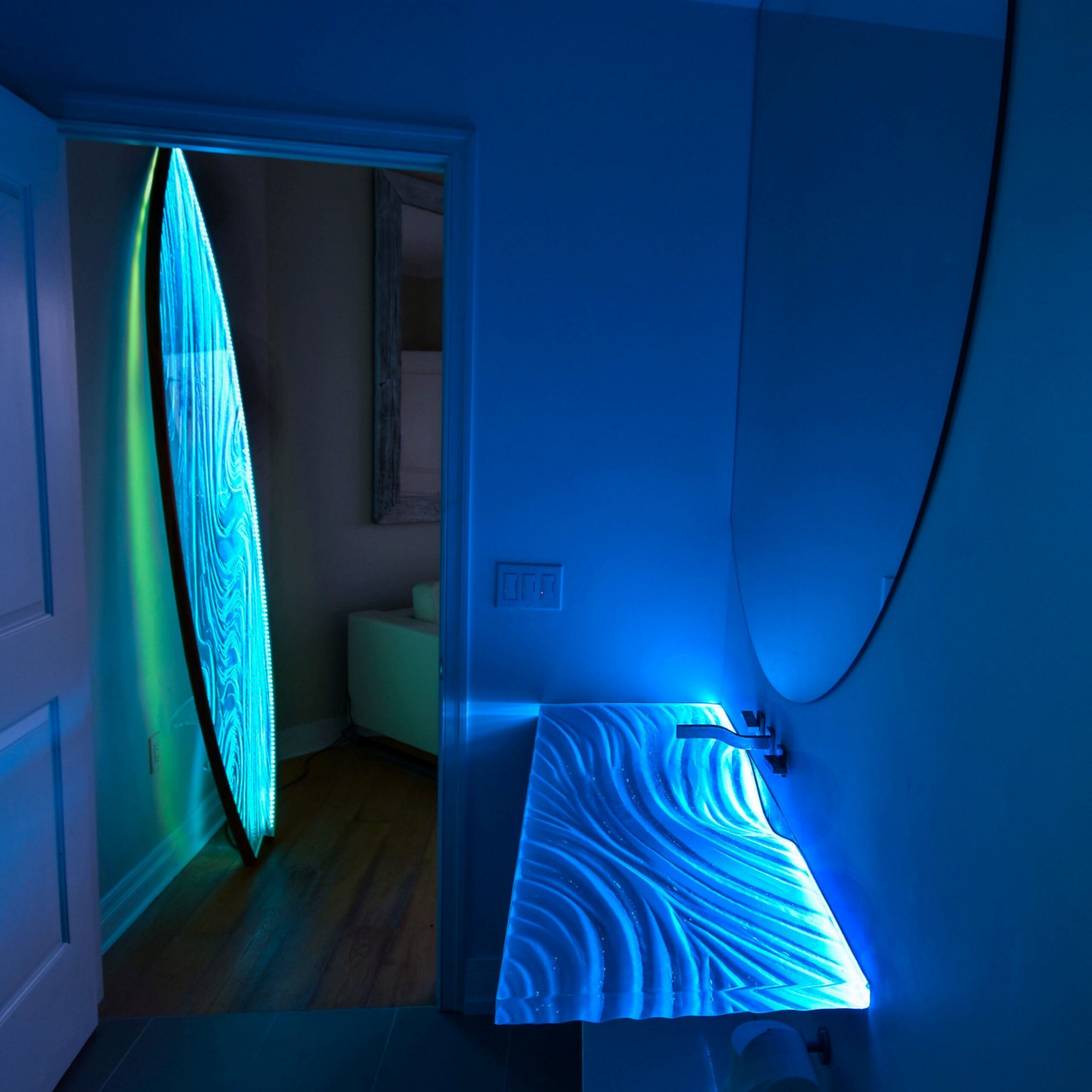
Glass Bathroom Vanity with Ambiance Machine LED lights floating sink
The Three Lights Working Together — Designing the Full 24 Hours
The most sophisticated glass installations are designed to perform across all three lighting environments simultaneously — not as separate modes but as a continuous experience that evolves naturally across the day.
Morning: Florida sun rakes through the carved texture at a low angle, casting warm shadows across the kitchen floor. The LED system is off. The glass does the work alone.
Afternoon: Direct overhead light makes the polished edges sparkle and the low-iron glass read with perfect color clarity. The SORAA spotlights supplement the natural light without competing with it.
Evening: As natural light fades, the SORAA spots take over — casting the texture as shadow art onto adjacent surfaces. The room shifts from bright and energized to warm and directional.
Night: The Ambiance Machine™ LED system activates. The glass transforms. The bar top becomes the light source for the room rather than a surface illuminated by it. Guests migrate toward it. Conversation happens at it. The space becomes what it was designed to be.
This is not an accident. It is a choreographed sequence of light and atmosphere designed from the very first conversation about the project. The texture of the glass, the placement of the ceiling fixtures, the specification of the LED system, the orientation of the surface to the natural light — all of it is decided together, not in isolation.
That is The Ambiance Machine™. That is what 25 years of designing glass and light as one system looks like in practice.
Designing for Ambiance — What Architects and Designers Need to Know
If you are specifying a custom glass countertop or bar top for a residential or commercial project, here are the practical decisions that determine how well the installation performs atmospherically:
Specify low-iron glass for any illuminated application. Standard float glass has a greenish tint that distorts LED color rendering and dulls natural light transmission. Low-iron glass is optically clear. Every illuminated installation we produce uses low-iron glass exclusively.
Texture is a light-interaction decision, not a surface decision. The carved pattern in the glass determines how it interacts with every light source in the room — natural, spot, and LED. Texture should be selected after the lighting plan is established, not before. We design both together.
Engage us during design development, not at finish schedule. Lighting decisions — ceiling fixture placement, LED system specification, surface orientation — affect the structural and electrical rough-in of the space. Changes made after framing is complete are expensive. Changes made at the design stage are free.
Consider the full 24-hour performance of the space. A glass surface that looks extraordinary at noon and disappears at night is a missed opportunity. Design for the evening — when the room is at its most atmospheric — and the daytime performance will follow naturally.
The edge profile affects light behavior. A hand-polished flat edge refracts light differently than a beveled or scalloped profile. Thick edges sparkle with brilliant refraction. Custom edge profiles interact with spotlights in ways that can become signature design moments in the space. Specify edge profiles as part of the lighting design, not as an afterthought.
Real Installations — The Ambiance Machine™ in Practice
Acqua Café — Palm Beach, Florida. A 20-foot L-shaped illuminated glass bar top in a coastal Italian restaurant. Deep blue LED illumination filtered through hand-carved kiln-fired texture. Light moves across the surface like water and bathes nearby guests in a soft filtered glow. The bar is the visual centerpiece of the restaurant and the first thing every new guest moves toward.
The Towers of Channelside — Tampa, Florida. A floating 126-inch residential bar top with integrated RGB LED illumination and hand-carved wave texture designed to flow directionally from the entry through the open-plan space. Clean and architectural by day. The gravitational center of every dinner party by night.
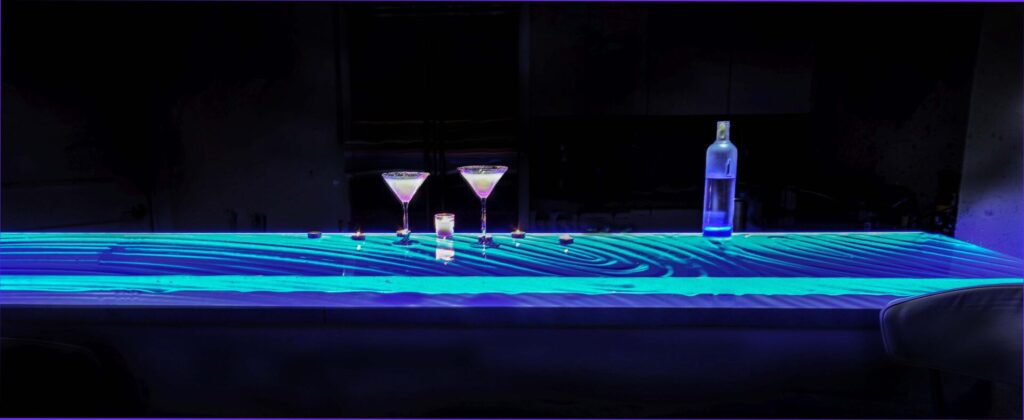
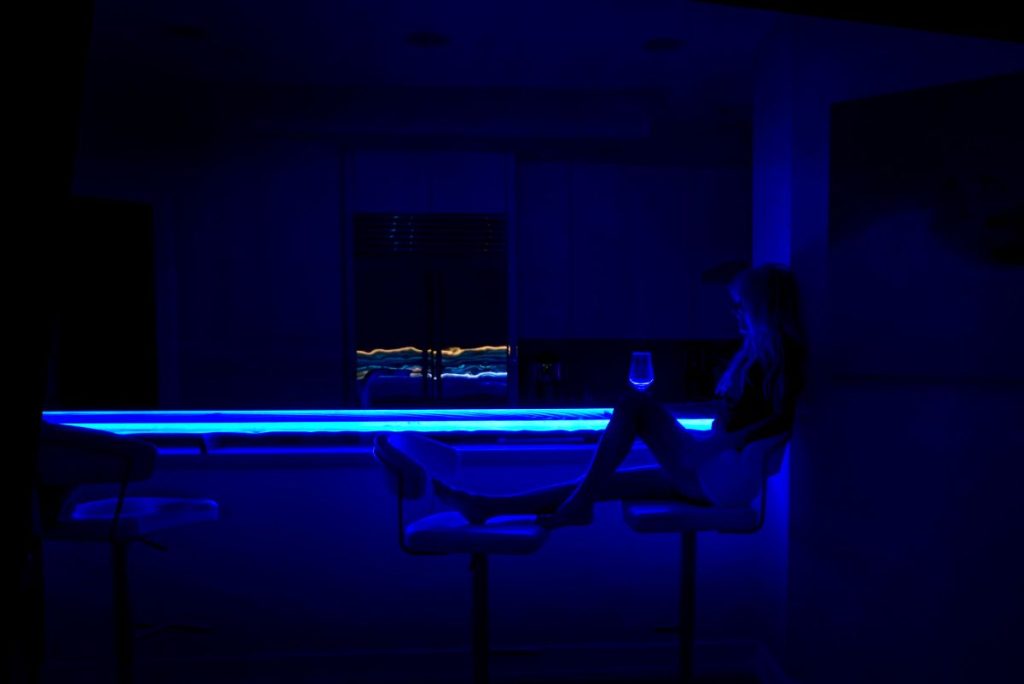
Downing Designs LED Illuminated Glass Bar Tampa
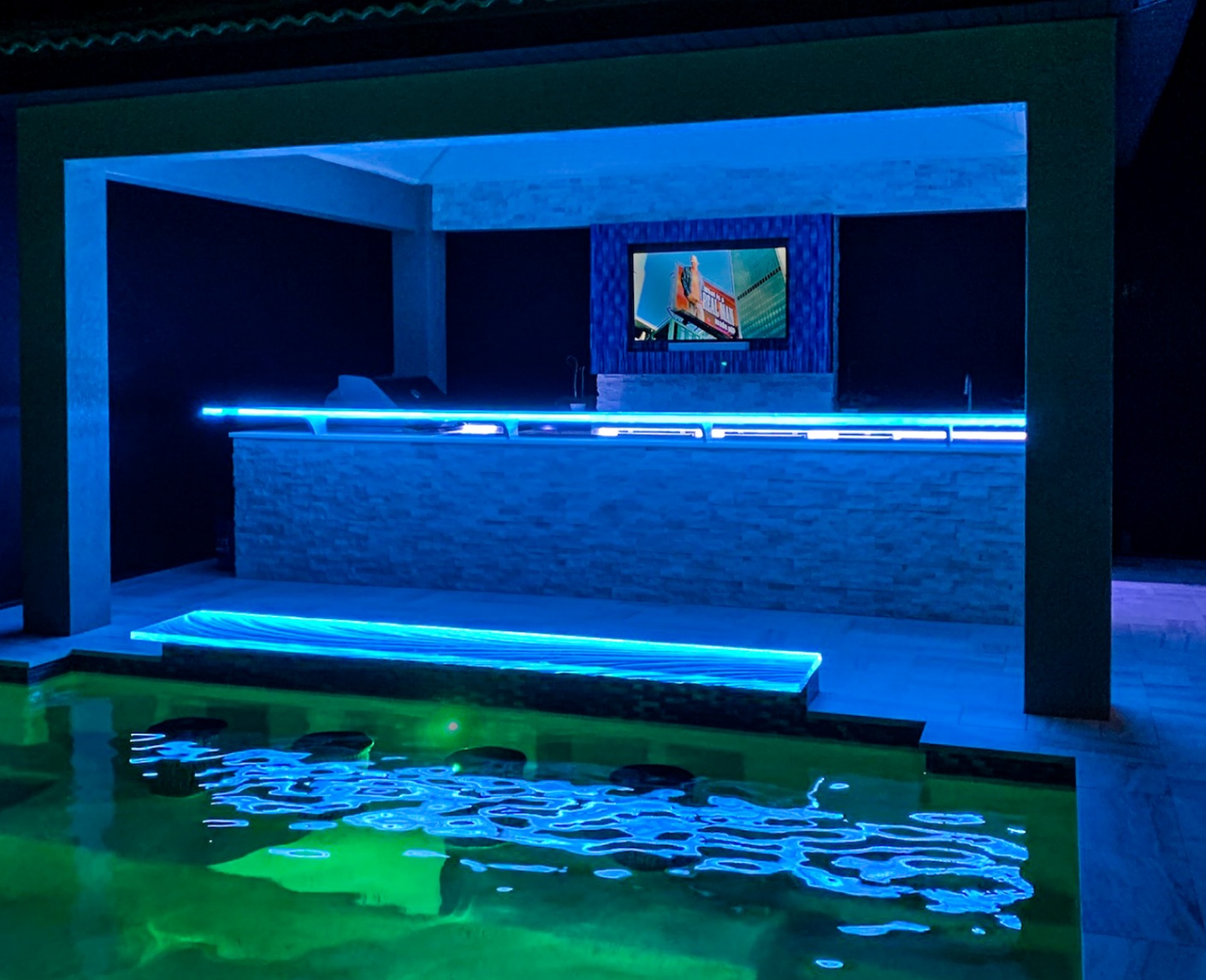
Naples swim-up pool bar. An outdoor installation using IP-68 rated waterproof LEDs and stainless steel fittings. A single 12-volt LED attached to the rear edge of the glass bar top radiates outward at all angles — making the ceiling above it alive with reflected light both day and night.
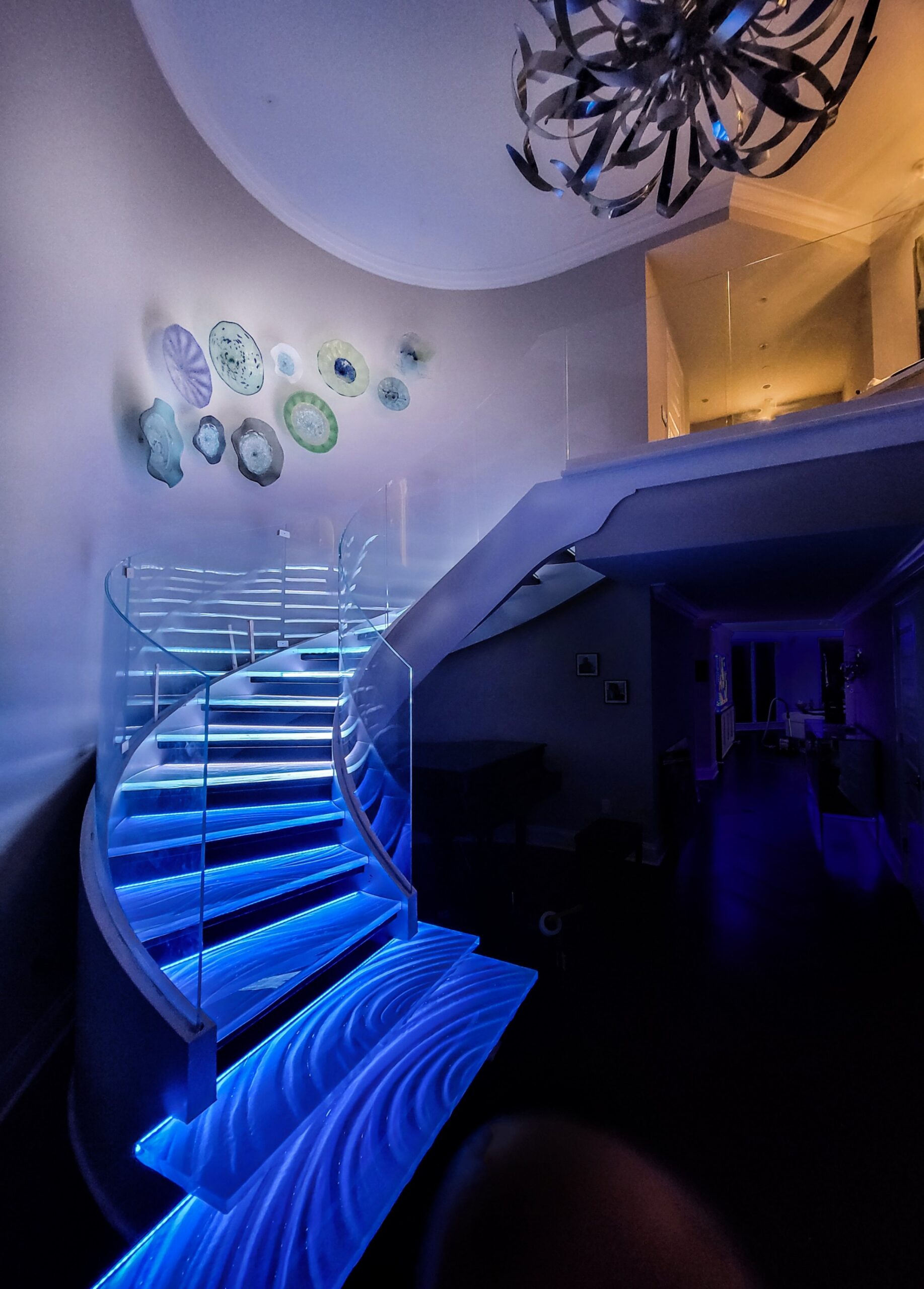
St Petersburg glass stair treads. LED-illuminated stair treads in a luxury condo that bathe the entire stairwell in uplifting light. Imagine coming home and letting only those lights guide your way upstairs.
Jupiter luxury home bar. A raised bar top in a south-facing entertainment space — no LEDs, no spotlights. Designed entirely around the powerful ambient light from the south. The custom low-iron glass bar top glows from within using nothing but Florida sunshine.
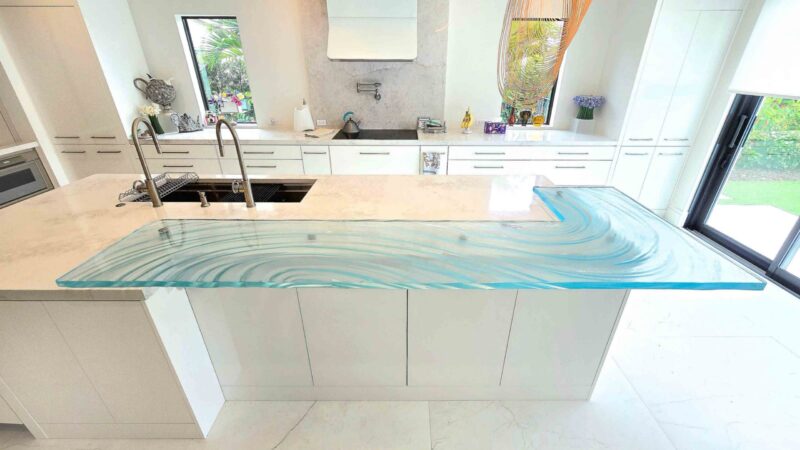
Jupiter Florida glass countertop no LED light ambiance by Downing Designs
Sarasota glass coffee table. A small LED-edged coffee table that proves scale is irrelevant to atmosphere. A glowing aura that transforms an entire sitting room.
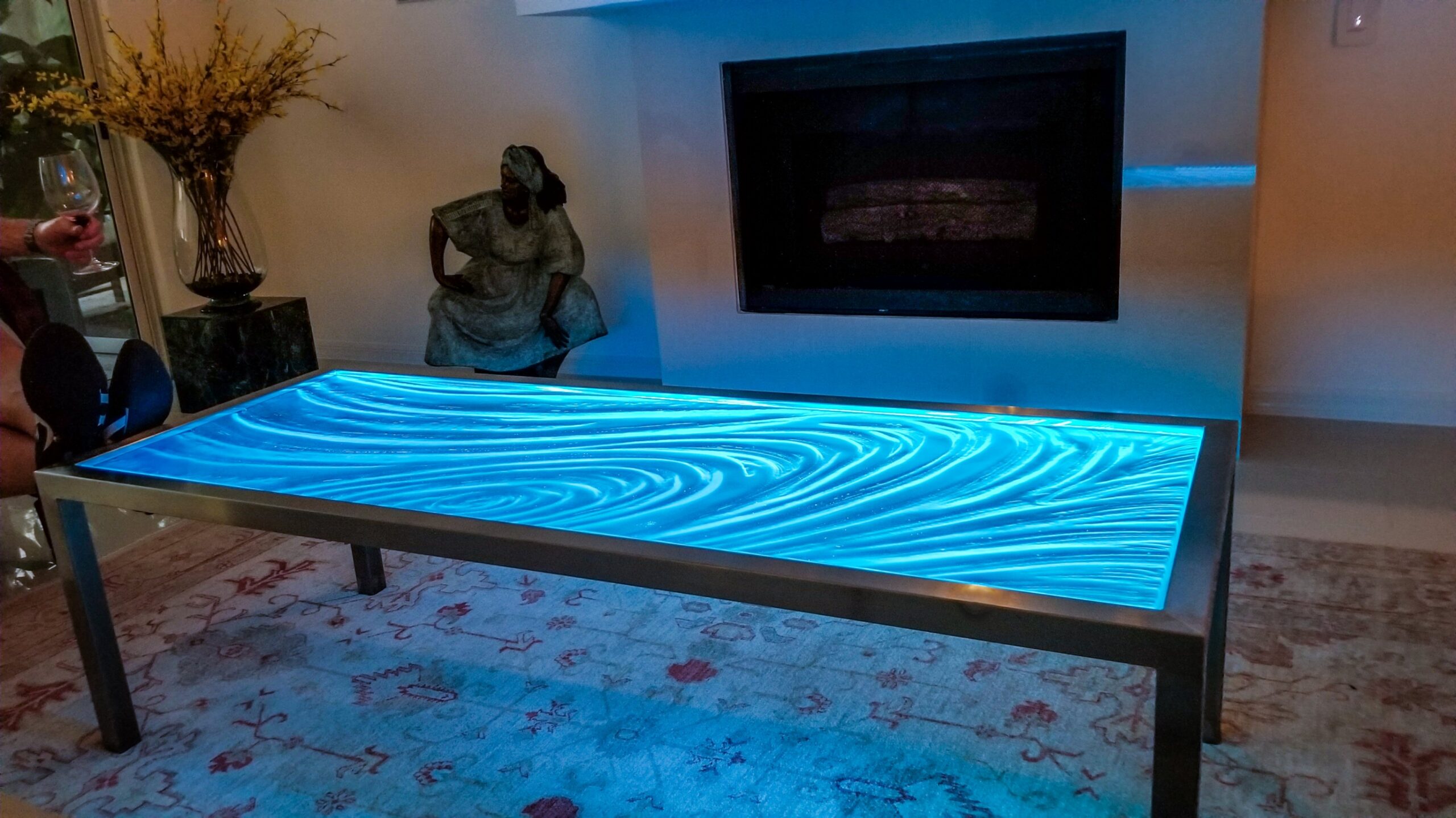
Sarasota Glass Table top with LEDs and custom stainless base
Pro Tips for Creating Ambiance with Glass
Start with the desired mood, not the material. Calm? Dramatic? Intimate? Energized? The answer determines every material and lighting decision that follows. This is the Feel stage of The Ambiance Machine™ process — and it happens before a single dimension is measured.
You do not need a large piece of glass to make a dramatic statement. A small coffee table with an LED edge system creates more atmosphere than a granite island three times its size. Scale matters less than design intention.
Blend natural and artificial light. Design for the full 24 hours — not just the evening showpiece or the daytime functionality. The most successful installations perform beautifully in both.
Use glass strategically throughout the space. Countertops, bar tops, vanities, sinks, backsplashes, stair treads, partitions — each application multiplies the atmospheric effect of the others. A home with coordinated glass surfaces reads as a designed environment, not a collection of individual pieces.
Invest in quality lighting fixtures. We specify SORAA bulbs for all ceiling spotlight applications. The difference between a SORAA spot and a standard recessed LED on a kiln-carved glass surface is not subtle. It is the difference between a countertop and an installation.
Frequently Asked Questions
What are the three types of lighting that affect a glass countertop or bar top?
Every glass surface lives in three distinct lighting environments: natural ambient light, ceiling spotlights, and integrated LED edge lighting. Natural ambient light — particularly Florida’s abundant sunlight — interacts with kiln-carved glass textures throughout the day, casting shifting shadows and refracting prismatic color as the sun angle changes. Ceiling spotlights, when properly specified and positioned, cast the carved texture of the glass as shadow art onto surrounding floors, walls, and ceilings — transforming the glass from a surface into a light source for the room. Integrated LED edge lighting enters the glass itself, traveling through the kiln-carved texture and emerging as a three-dimensional illuminated sculpture. The most sophisticated installations are designed to perform across all three environments simultaneously — a continuous atmospheric experience that evolves naturally from sunrise to midnight.
How does glass texture affect the way a countertop or bar top interacts with light?
Texture is fundamentally a light-interaction decision, not a surface decision. The pattern carved into the glass determines how every light source in the room — natural, spotlight, and LED — is bent, scattered, and redirected. A deep wave texture produces dramatic shadow lines under raking natural light and rich three-dimensional depth under LED illumination. A finer texture produces a softer, more diffuse glow. A directional texture can be oriented to guide the eye through a room, creating a sense of flow and movement that extends beyond the glass surface itself. Texture should always be selected after the lighting plan for the space is established. At Downing Designs, we design texture and lighting together as one decision — never in isolation.
What ceiling spotlight fixtures do you recommend for illuminated glass countertops and bar tops?
We specify SORAA bulbs for all ceiling spotlight applications — the same lighting technology used by major museums to illuminate irreplaceable artwork. SORAA produces a clean, warm light with a precisely defined arc and an exceptionally high color rendering index. On kiln-carved glass, a SORAA spotlight casts the texture as shadow art onto adjacent surfaces in a way no standard recessed LED can replicate. We assist lighting contractors in determining exact fixture quantity, placement, and beam angle for every project — ceiling spotlight positioning relative to the glass surface is as consequential as any other specification on the job.
How do RGB LED systems work on glass countertops and bar tops, and how are they controlled?
Our Ambiance Machine™ RGB LED systems integrate directly into the edge of the glass surface, allowing light to travel through the material and be shaped by the kiln-carved texture within it. RGB systems offer over 8 million color possibilities, fully adjustable in real time. For commercial hospitality environments, the same bar top can run at cool white during lunch, shift to deep blue for dinner, and transition to vivid color during peak bar hours. For residential applications, preset mood settings allow instant transitions between atmospheres. Control systems can be integrated with smart home platforms for automated scheduling.
Can illuminated glass bar tops and countertops be used in outdoor and pool applications?
Yes — with the correct LED specification. Outdoor and pool applications require IP-68 rated LED systems and stainless steel fittings, which provide complete waterproof protection. The Naples swim-up pool bar in our portfolio demonstrates this — a single 12-volt LED attached to the rear edge of the glass bar top radiates outward at all angles, making the ceiling above it alive with reflected light both day and night. For covered outdoor kitchens, pool bars, and patio installations throughout Florida, the Ambiance Machine™ extends beyond interior spaces with the same design principles and atmospheric results.
Why does low-iron glass perform better than standard float glass for illuminated countertops?
Standard float glass contains iron in its composition, which gives it a greenish tint visible particularly at the edges and through the thickness of the material. Under integrated LED illumination — particularly in warm amber, deep blue, and full-spectrum color ranges — the green cast distorts the color output of the lighting system. The color you program into the LED system is not the color your guests see. Low-iron glass is optically clear with no color cast at any thickness or viewing angle. For any glass surface where integrated lighting is part of the design, low-iron is not a premium option. It is the correct specification.
How do I engage Downing Designs for a custom glass countertop or bar top project in Florida?
The best starting point is a direct conversation. Call us at (813) 784-5211 or email [email protected] with a brief description of your project — the space, the application, and the atmosphere you’re trying to create. For architects and interior designers, we recommend engaging us during design development. Lighting, texture, and structural decisions made early in the process produce significantly better results than specifications added at the finish schedule stage. We work directly with design teams, assist with lighting contractor coordination, and are available for consultations at our Tampa design center. Every project begins with a conversation about Feel — the emotional atmosphere the space needs to produce — before a single dimension is discussed.
Key Highlights
- Glass countertops and bar tops interact with light in ways no other material can replicate — bending, refracting, filtering, and redirecting it into the surrounding space
- The Ambiance Machine™ is Downing Designs’ proprietary methodology for designing glass, texture, and light as one unified system — Feel, Form, and Light
- Three distinct light sources define how a glass surface performs: natural ambient light, ceiling spotlights, and integrated LED illumination
- Florida’s abundant natural light is a design asset — specify glass orientation and texture to exploit it before any artificial lighting is added
- SORAA ceiling spotlights cast kiln-carved glass textures as shadow art onto surrounding floors, walls, and ceilings
- RGB LED edge lighting systems offer over 8 million color possibilities — fully adjustable for time of day, event type, or mood
- Low-iron glass is the correct specification for any illuminated application — standard float glass distorts LED color rendering
- Texture is a light-interaction decision, not a surface decision — always select texture after the lighting plan is established
- Downing Designs serves architects, interior designers, builders, and homeowners throughout Florida — Tampa, Sarasota, Naples, Miami, Fort Lauderdale, Boca Raton, West Palm Beach, Palm Beach, and Jupiter
Ready to design a glass surface that transforms your space?
Call (813) 784-5211 or email [email protected] to start the conversation.

Jeff Downing
Founder, Lead Designer & Custom Glass Countertop Expert
Jeff Downing of Downing Designs, is a Tampa Florida–based design studio specializing in custom Glass Countertops, Glass Bar Tops, Glass Vanity tops and Glass Stair Treads. With decades of hands-on experience, Jeff is widely recognized for delivering textured glass surfaces integrated with LED lighting to create dazzling abstract statement pieces.
"Glass. Lights. Ambiance".