
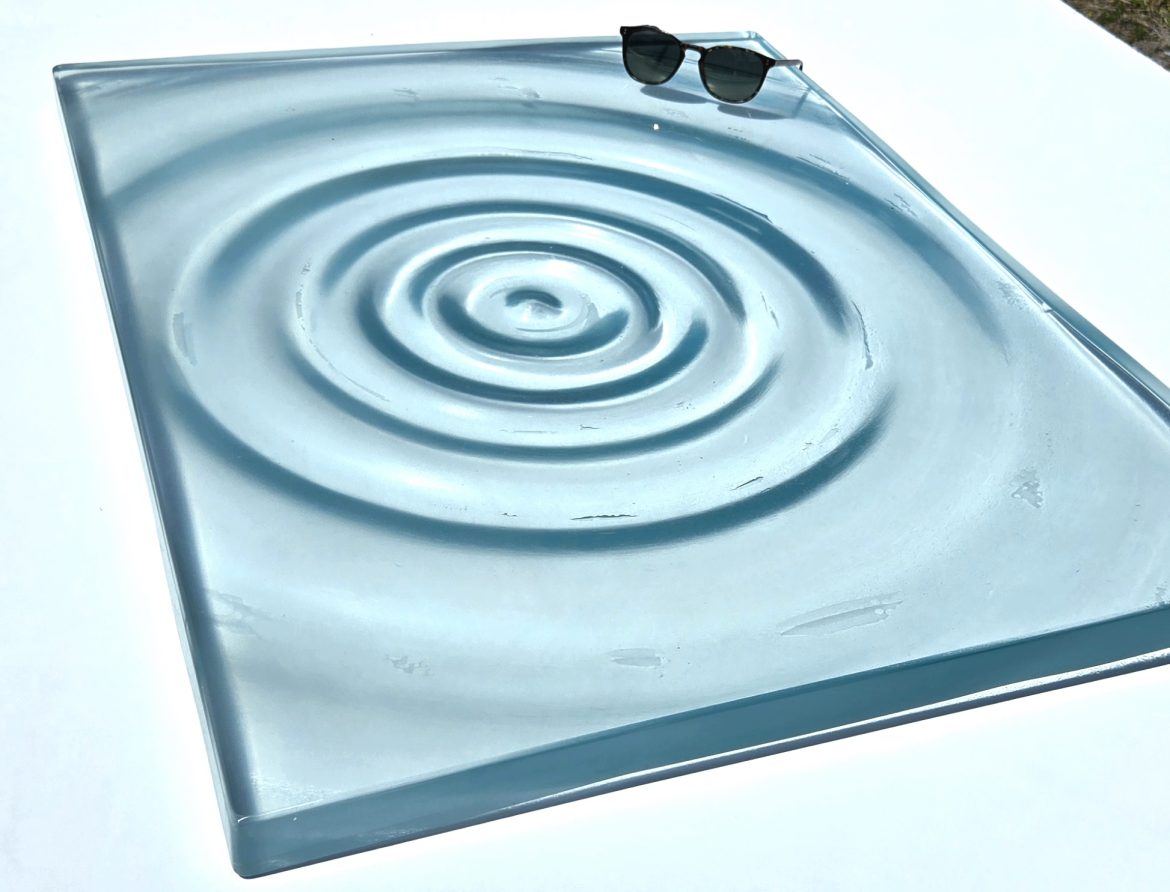
Search “glass countertops” and you get two completely different materials. Recycled glass composite is crushed glass bound in cement or resin and sold as slabs, like quartz. Solid kiln-formed glass is thick, translucent glass with the texture formed into it, made to order and lit from within. Both are good at different jobs. Search results mostly show the first kind. I make the second.
Glass countertops are not all the same
Search for “glass countertops” and you will usually find two very different materials.
One is recycled glass countertop composite: crushed glass chips bound together with cement or resin and manufactured into slabs, much like quartz or other engineered surfaces.
The other is solid kiln-formed glass: thick architectural glass that is heated, fused, thermoformed, annealed, textured and finished specifically for a project.
They share the words “glass countertop.” That is about where the similarity ends. Recycled glass composite is a slab product. Solid kiln-formed glass is a custom architectural material.
Nobody explains the split, so I will.
Recycled glass countertops: what you’re buying
Recycled glass countertops, such as Curava, IceStone and Vetrazzo, are composite slabs. They are crushed glass bound in cement or resin and sold in standard-size slabs, typically 3 cm (about 1.18 inches) thick, like granite. The surface is the manufacturer’s pattern, with no customization.
You buy the whole slab whether you need all of it or not, and often much of it is wasted. Premium recycled glass slabs run into the thousands of dollars each. As of October 2026, retailer Green Goods USA lists Vetrazzo from $4,272 to about $9,125 per slab, before template, fabrication and installation.
Solid kiln-formed glass: what you’re buying
Solid glass countertops are 100% glass: thick, kiln-formed, typically 1.5 to 4 inches, with the texture formed into the glass and made to order. The finished piece can be illuminated from within with our LED Ambiance Machine™.
Type “glass countertops” into Google and you mostly get recycled glass. It’s a legitimate product with a real sustainability story. It is also not what’s in my photos. Same two words, completely different material, completely different result in the room.
That is why I call the combination of textured glass and integrated light the Ambiance Machine™. The countertop stops being merely a place to put things and becomes part of the room’s atmosphere.
Every solid glass countertop is made for the space
This is the other fundamental difference. You are not simply choosing a slab from a warehouse and cutting it to fit. The shape, thickness, texture, edge treatment, lighting and support system are designed together as part of the room.
At Downing Designs, textures are hand-carved into a sand bed before the glass enters the kiln. That means the surface can be designed around the architecture and the way people move through the space.
For larger installations, texture sequencing becomes particularly important. A flowing pattern can continue visually from one piece to the next, rather than looking like unrelated slabs placed side by side.
Single-piece fabrication is available up to approximately 130 inches, depending on the geometry and specification.
Side by side
| Recycled glass composite | Solid kiln-formed glass | |
|---|---|---|
| What it is | Crushed glass chips bound in cement or resin and cast into slabs. | Thick solid glass shaped and textured in a kiln, then slowly cooled and hand-finished. |
| Thickness | Typically 3 cm (about 1.18 inches). | Typically 1.5 to 4 inches. |
| What it looks like | A speckled, terrazzo-style stone look. | Depth, texture and refraction. It looks like ice, water or sculpture. |
| Light | Opaque. It reflects light but does not pass it through. | Translucent. Light travels through it, which is why LED lighting is so dramatic. |
| Customization | Choose from the manufacturer’s patterns. | Texture, shape, edge and lighting designed for each project. |
| How it’s sold | By the slab, like stone, through showrooms and retailers. | Made to order, one per project, designed to your space. |
| Best for | Eco-minded kitchens, a stone alternative, practical everyday surfaces. | Statement kitchens, bars, islands and hospitality, anywhere the surface is the centerpiece. |
| Watch out for | It looks like a composite, because it is one. Care varies by binder, so ask for the maintenance sheet. Resin-bound surfaces are generally not recommended outdoors because of UV degradation. | It’s a custom, fabricated product. Edges and supports matter, and it is priced accordingly. |
Recycled glass countertops: where they shine
I’ll say this plainly: recycled glass is a good product for the right buyer. It’s sustainable, it’s easy to find, and it gives you a durable, patterned surface without the stone quarry. If you want a workhorse kitchen counter with an eco story and a terrazzo look, it’s a sensible choice.
Care depends on what holds the glass together. Cement-based surfaces typically want sealing. Resin-based surfaces usually don’t. Whichever you pick, get the maintenance sheet before you buy.
If that’s what you’re after, you don’t need me. If you want the surface to be the room, keep reading.
Solid kiln-formed glass: where it becomes something different
Light transmission. That’s the whole argument.
Every other countertop material stops light. Solid glass is the only one that moves it. Put thick, textured glass over a warm LED and the surface stops being a place to set things down and becomes the thing people look at, gather around and photograph. It reads as ice, water or sculpture, never as “a countertop.”
At Downing Designs, glass is typically fused and thermoformed at temperatures above 1,400°F over a hand-built texture. The glass is then slowly annealed to relieve internal stress before it is cut, polished and finished. The result is a thick architectural surface with genuine depth.
Put textured glass over a carefully designed LED system and the countertop can begin to look like:
- Ice
- Water
- A sculptural surface
- A glowing architectural element
- Something that changes character with the lighting
It’s also one of the most hygienic surfaces you can put in a kitchen. Glass is non-porous, so it never absorbs liquids, oils or odors, and there is nothing to seal or reseal.
And it’s made for your room. Every top is designed to your layout, your light and your finishes, with the texture placed on purpose instead of scattered at random. Lengths up to 130 inches are available in a single piece. See the glass countertops gallery or our white glass countertops.
Glass vs. quartz: the honest comparison
Quartz is engineered stone: crushed quartz bound in resin. It is excellent. It’s tough, consistent, widely available and built for a family kitchen that gets hard daily use. If you want the most practical prep surface, quartz is a great answer, and I’ll tell you so.
Solid glass is a different category. It’s translucent, textured and lit, and it does something quartz can’t do at all: glow. People choose glass when they want the kitchen to have an atmosphere, not just a surface.
So: quartz for the workhorse, glass for the statement. Many of my clients do both. A quartz perimeter with a glass island or bar top is one of the best-looking combinations in a kitchen. For the bar side, see our guide to glass bar tops.
The honest drawbacks of solid glass
Three things deserve respect.
Edges. A hard, pointed impact on an edge or corner is how glass gets damaged. We offer only hand-polished, well-rounded edges, and properly engineered supports make all the difference.
Heat and cutting. Use a trivet for hot pans and a cutting board for knives. Both are good habits on any surface, and glass rewards them.
Cost and lead time. It’s custom work. It is priced like furniture-grade art, not by the square foot at a retailer, and it is made to order.
Which one should you buy?
Choose recycled glass composite if you want a durable, sustainable, stone-style surface and your priority is value and availability.
Choose solid kiln-formed glass if you want the surface to be the centerpiece, with depth, light and texture that no stone or composite can give you.
If you are not sure, send me photos of your space. I’ll tell you honestly which direction fits, even if the honest answer isn’t glass.
Care in thirty seconds
- Daily: soft microfiber cloth and standard glass cleaner.
- Avoid: abrasive pads and powders.
- Use: a trivet for hot pans and a cutting board for knives.
No sealing, no polishing, no special products.
Keep reading
Glass Countertops Gallery
Solid kiln-formed glass, lit and textured, in real rooms.
Glass countertop questions, answered straight
Are glass countertops good?
It depends which kind you mean. Recycled glass composite is a durable, sustainable, stone-style surface that suits an eco-minded, practical kitchen. Solid kiln-formed glass is a statement surface: translucent, textured and made to be lit. Both are good at different jobs. The right choice depends on whether you want a workhorse surface or a centerpiece.
How much do glass countertops cost?
Recycled glass composite is sold by the slab, much like stone. As of October 2026, retailer Green Goods USA lists Vetrazzo from $4,272 to about $9,125 per slab, before template, fabrication and installation. Solid glass countertops are custom fabricated, so there is no single price. Size, thickness, texture, geometry, edge work, lighting, support requirements, fabrication complexity, delivery and installation all affect the final cost. For current Florida pricing ranges, see our 2026 Cost of Glass Countertops in Florida guide. You are not simply buying a slab by the square foot. You are commissioning a finished architectural piece.
What is “bio glass” and where can I buy it?
“Bio glass” is a term shoppers use for eco-friendly recycled glass countertops, which are typically crushed glass bound in cement or resin and sold through stone showrooms and home retailers. That is a different product from solid kiln-formed glass, which we make to order at Downing Designs in Tampa.
Are glass countertops better than quartz countertops?
They solve different problems. Quartz is the tougher, more practical everyday surface. Solid glass is translucent, textured and lit, which quartz can never be. Quartz for the workhorse, glass for the statement. Many clients combine them, with quartz around the perimeter and a glass island or bar top.
Do glass countertops scratch or chip?
Glass is harder than almost anything that touches a countertop, so ordinary use does not wear it down. Dragging rough-bottomed items can leave marks, and a hard, pointed impact on an edge or corner is the real risk. Hand-polished edges and an engineered support system are what keep a glass countertop looking right for decades.
Can I put hot pans or cut on a glass countertop?
Use a trivet for hot pans, because sudden temperature shock is hard on any thick glass. Use a cutting board for knives to protect both your blades and the surface. Both are good habits on any countertop.
Are glass countertops hygienic?
Very. Glass is non-porous, so it does not absorb liquids, oils or odors, and it needs no sealing. A cloth and glass cleaner is the whole routine. It shows fingerprints, which textured glass hides far better than smooth, clear glass.
Can glass countertops have LED lighting?
Yes. This is one of the defining advantages of solid glass. Because the material can transmit light, LEDs can be integrated beneath or around the glass to create illumination through the textured surface. Downing Designs uses integrated LED systems as part of its Ambiance Machine™ approach, treating the glass and lighting as one architectural system rather than adding lighting as an afterthought. Lighting should be considered during the original design, because texture, thickness, edge treatment and support all affect how the finished piece distributes light.
Can glass countertops be custom textured?
Yes. At Downing Designs, textures are hand-carved into the forming bed before the glass is fired. That allows the texture to be designed specifically for the project rather than selected from a limited collection of manufactured patterns. Because the texture is created individually, no two hand-textured pieces are exactly alike.
Do you ship and install glass countertops nationwide?
Yes. We build every countertop in our Ybor City, Tampa studio and handle delivery and installation nationwide. Florida is our home market, and we also ship and install across the country.
Glass. Lights. Ambiance.
Start your glass countertop
Tell us about your space and we will tell you honestly whether solid glass is right for it.
Call 813.784.5211. We don’t have office hours. We have phones.

Jeff Downing
Founder, Lead Designer & Custom Glass Countertop Expert
Jeff Downing of Downing Designs, is a Tampa Florida–based design studio specializing in custom Glass Countertops, Glass Bar Tops, Glass Vanity tops and Glass Stair Treads. With decades of hands-on experience, Jeff is widely recognized for delivering textured glass surfaces integrated with LED lighting to create dazzling abstract statement pieces.
"Glass. Lights. Ambiance".