
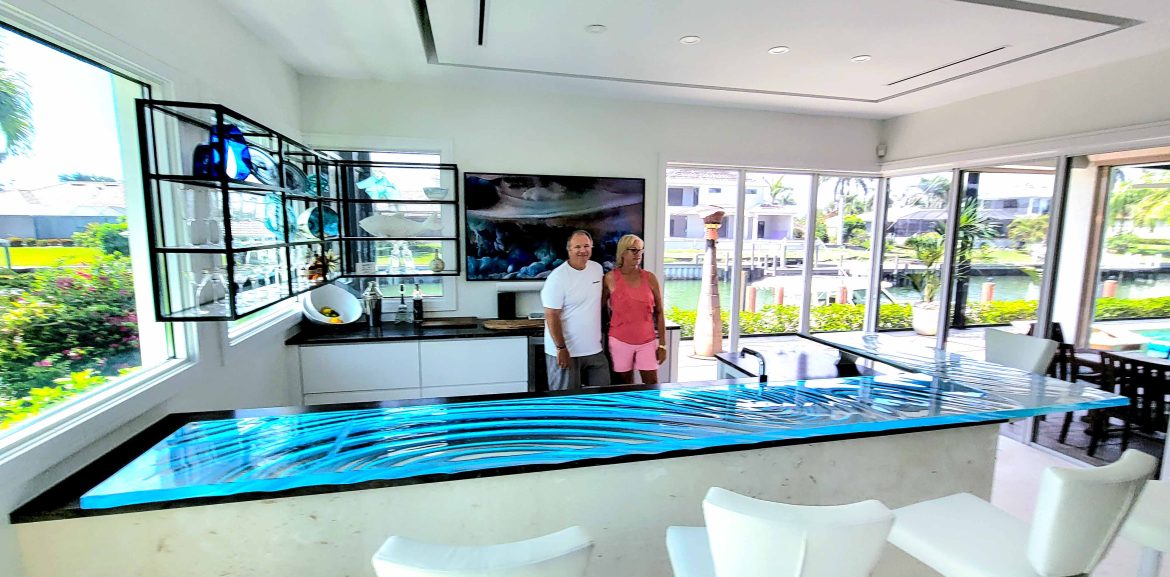
A glass countertop is either 100% glass — or it isn’t a glass countertop. A true glass countertop is fabricated entirely from structural glass. It contains no cement, no resin, no epoxy, and no polymer binders. The glass itself is the finished structural material.
If it contains cement, resin, or epoxy binder, it’s not a glass countertop — it’s terrazzo. Beautiful material. Completely different structural animal. And a distinction that matters enormously to every interior designer and architect specifying a surface that needs to span, cantilever, or perform outdoors.
Downing Designs fabricates both. We know the difference intimately. This page exists because most answers to “what is a glass countertop” on the internet are wrong — or at best, incomplete.
The Two Materials Most People Call “Glass Countertops”
1. Recycled Glass Composites — Vetrazzo, IceStone, Cementitious Terrazzo
Vetrazzo and IceStone are cementitious recycled glass composites. Their closest material analogs are architectural concrete and terrazzo. Both carry the same maintenance requirements — periodic sealing and waxing to protect the cement binder from acidic etching. What they are: glass aggregate suspended in a cement matrix and polished to reveal the glass pieces. We make cementitious terrazzo ourselves, and we’ve watched it perform for two decades.
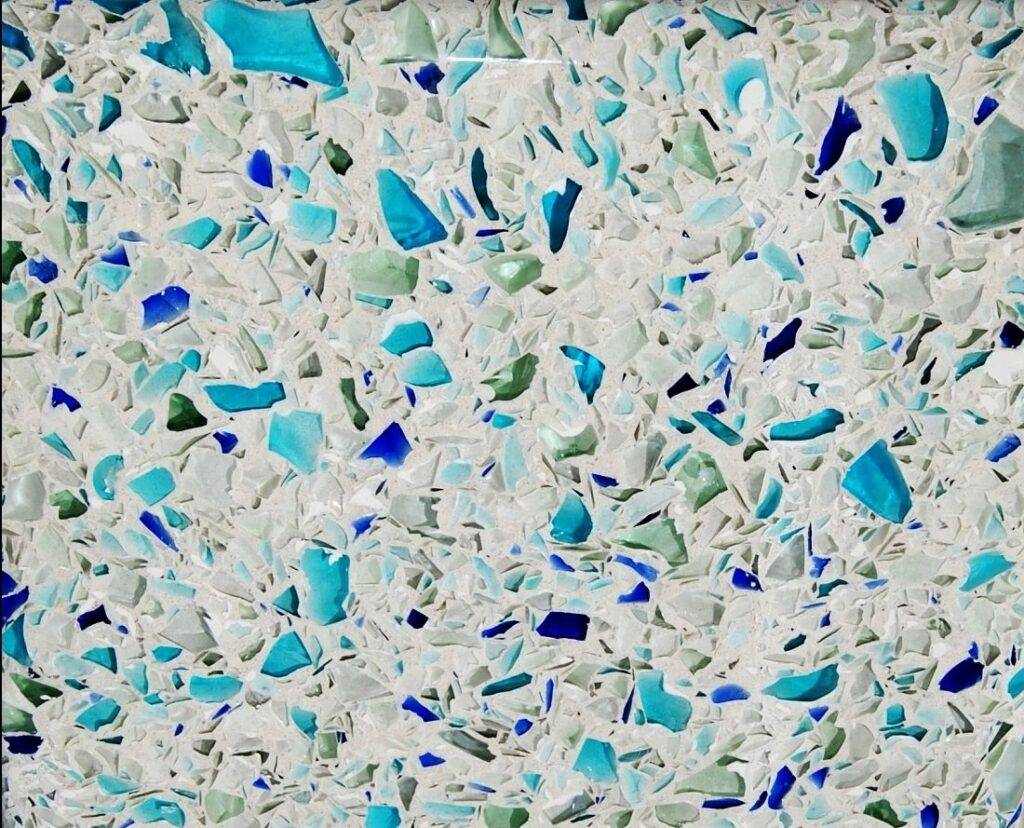
Where terrazzo works:
- Flat, fully-supported countertop surfaces
- Interior applications with controlled humidity
Where terrazzo fails:
- Cantilevered bar tops and long overhangs
- Outdoor hot/cold cycles — ASR (alkali-silica reaction) with moisture can cause warping and cracking over time
2. 100% Fused Monolithic Glass
What it is: pure glass, kiln-formed into a single continuous slab. No binder. No matrix. No aggregate. The glass is the structure.
Two distinct types exist — covered in detail below — but both share the same fundamental advantage: monolithic construction means no bond interface, no fault lines, and the structural ability to span and cantilever in ways no composite can match.
Why “Un-Fussy Is the New Luxury”
Hair dye, citrus, red wine, cooking oil, bleach — none of it touches 100% glass. No sealing. No panic. No Sunday morning maintenance ritual. The surface is non-porous at the molecular level. There is no matrix to absorb, no resin to age, no cement to stain.
The same cannot be said of cementitious glass terrazzo. We know — because we make it. Vetrazzo and its category are beautiful surfaces with a real place in design. But they are porous matrices. The cement absorbs. The resin ages. A spilled glass of Cabernet left overnight on a composite surface is a conversation you don’t want to have with a client.
We stopped recommending cementitious terrazzo for kitchen and bar applications for the same reason a chef stops recommending a knife that looks great but doesn’t hold an edge. We know what happens after year three.
The Two Types of 100% Glass Countertops
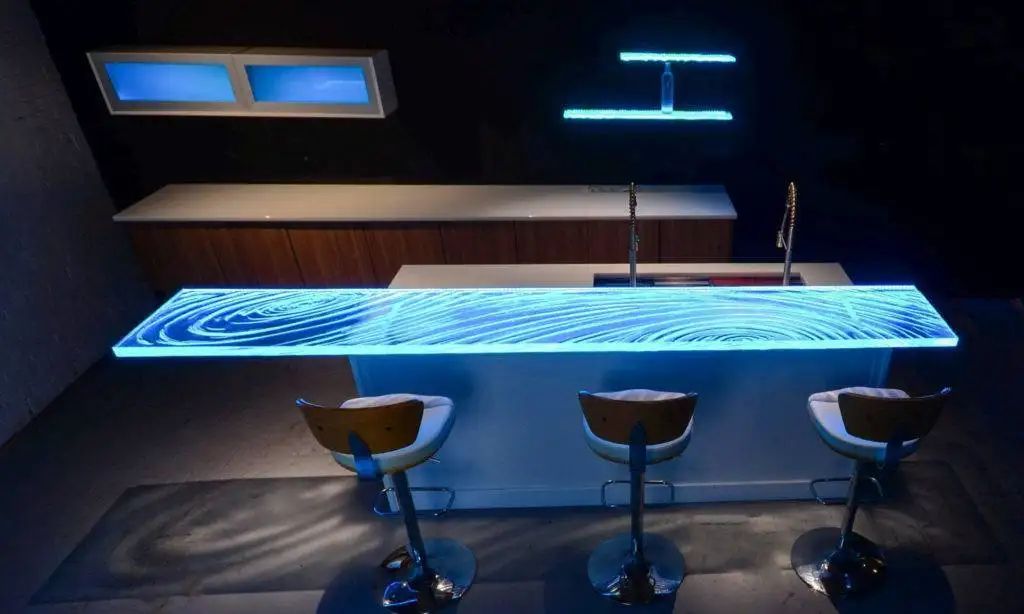
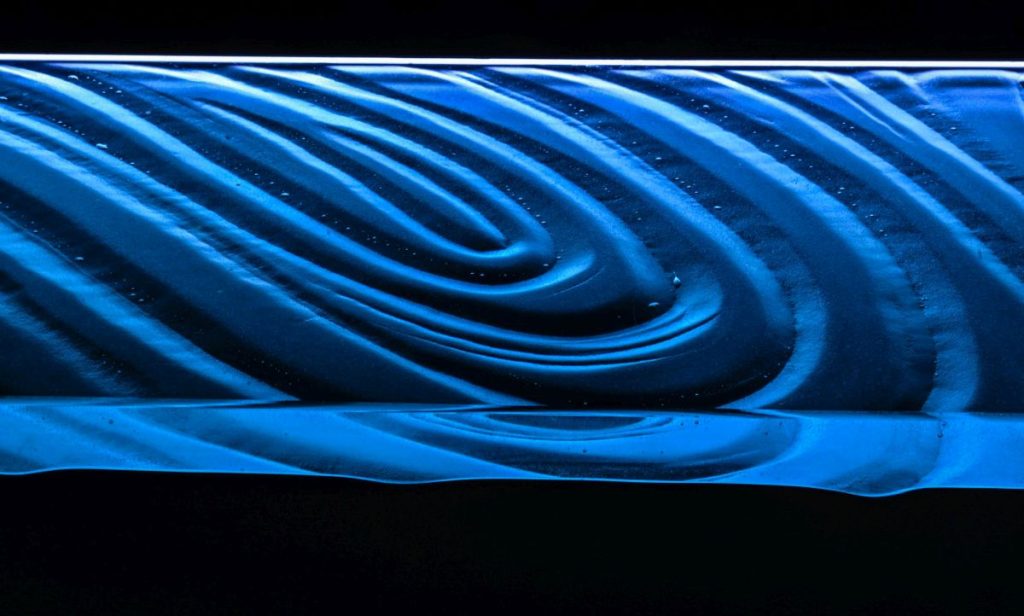
Kiln-Formed, Fused Textured Glass
- Translucent, hand-sculpted surface texture — wave, linear, organic
- 1.5″ standard thickness, single panels up to 130″
- LED-integrated via The Ambiance Machine™ RGB system
- Applications: bar tops, kitchen islands, raised bars, hospitality
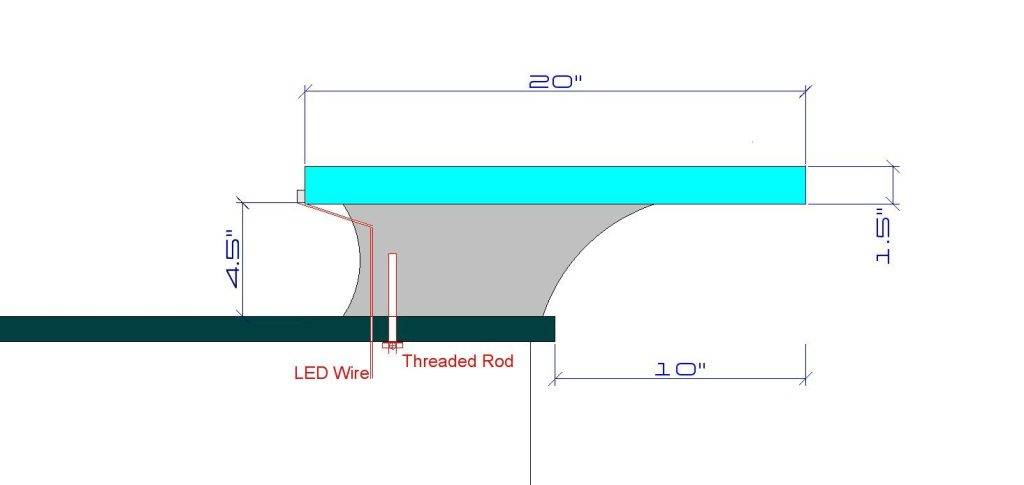
- Structural capability: cantilevered up to 42″ AFF with our custom brackets
White Glass (Nanoglass)
- 100% opaque, pure white, high-gloss flat surface
- Mohs hardness 7.0 — harder than granite (6.2) or engineered quartz (6.7)
- No LED capability — opaque surface, no light transmission
- Outdoor-rated: 96°F surface temp recorded in direct Florida sun at 93°F ambient
- Zero sealing, zero maintenance
- Applications: kitchen and bath countertops, outdoor kitchens, restaurant surfaces
Performance & Specifications
| Feature | Kiln-Formed Glass | White Glass (Nanoglass) | Recycled Glass Composite |
|---|---|---|---|
| Composition | 100% glass | 100% glass | Glass + cement or resin binder |
| Typical Thickness | 1.5″ | 1.125″ | 2cm–3cm |
| Mohs Hardness | 5.5–6 | 7.0 | 4–5 |
| Cantilever Capable | Yes — monolithic | Yes — monolithic | No — fault line risk |
| Outdoor Rated | Yes | Yes — UV/heat proof | Limited outdoors |
| LED Integration | Yes — Ambiance Machine™ | No — opaque surface | No — opaque surface |
| Sealing Required | No | No | Yes, annually |
| Surface Temp FL Sun | — | 96°F at 93°F ambient | — |
| Max Single Panel | 130″ | 120″ | Typically 108″ or less |
The Structural Truth About Cantilevered Glass Bar Tops
This is the section nobody else has written. It’s also the most important one for architects and designers specifying a bar top. I have 25 years of experience, and I refuse to use materials incorrectly.
The Biggest Mistake Designers Make #1: Using Recycled Glass as a Cantilevered Surface
Bar overhang, raised bar extension, waterfall edge — you’re loading a fragile material across its weakest axis.
From Vetrazzo’s own installation guidance: “Spanning between two supports shall be limited to 24 inches…and with rodding.” Cantilevers 10 inches or longer require corbels (supports).
Allow me to translate — that is a very fragile surface.
Glass bonds poorly to cement matrices because glass is non-porous. The interface between glass aggregate and cement binder is inherently compromised — that’s where tensile stress concentrates under cantilever load. The slab is riddled with potential fault lines. It doesn’t fail immediately. It fails eventually. And whoever specified it owns that outcome.
Fused monolithic glass at 1.5″ has no bond to fail. It spans because it’s one continuous material — not a matrix held together by optimism. We engineer bracket placement, support spacing, and seam location before fabrication begins. Not on site. Not improvised.
The Outdoor Countertop Question
Synthetic quartz is approximately 15% plastic resin binder. Every major quartz manufacturer warns against outdoor use — the resin yellows under UV exposure. They’re right to warn you.
The Biggest Mistake Designers Make #2: Specifying Quartz Near a Window or Outdoors
Cambria, MSI, Silestone — all are susceptible to UV degradation. I replaced a perfectly good quartz countertop that was near a window. The client had placed a potted plant atop the surface and never moved it. When she did, she was shocked to see the difference between the material that had never been exposed to sunlight and the rest of her jaundiced countertop.
White glass (nanoglass) is 100% inorganic. We placed a thermometer on a white glass countertop in direct Florida summer sun. Surface temperature: 96°F. Ambient temperature: 93°F. Your body temperature is 98.6°F.
Kiln-formed textured glass is also outdoor-capable with proper structural support. Neither white glass nor thick fused glass countertops require sealing, neither will yellow, and neither absorbs moisture.
Why Some Glass Countertop Edges Fail
Glass Edges Aren’t Fragile. Poorly Finished Glass Edges Are.
Large manufacturers that use CNC machines to “polish” their edges warn that glass edges are “crack-initiation sensitive.” They’re not wrong — but they’re describing a problem of their own making.
A 45° bevel leaves a sharp arris that concentrates impact stress — that’s a fabrication choice, not a material limitation. Stop using 45° bevels and the fragility problem disappears.
At Downing Designs, every glass edge receives a full roundover on both the top and bottom — eliminating two 45° stress concentration points entirely. The arris is eliminated. The edge profile becomes smooth, and deflects energy from impacts beautifully. Stress distributes over that rounded edge vs a very sharp peak. The result is an edge that is much more durable.
A properly polished and rounded glass edge is among the most durable profiles in countertop fabrication. It also feels better under the hand — and this is important, as you will be leaning up against the glass bar top for a very long time. I never understood the hurry to move a product out the door, instead of taking care of the client’s real needs. That’s the difference between a slab wholesaler and a luxury craftsman.
Our intention is to offer the softest, most chip-resistant glass countertops in the world. That intention means we don’t cut corners — we round them over.
This also has an aesthetic consequence worth noting: a proper roundover catches light differently than a bevel. It reads as intentional craftsmanship rather than a factory edge. On a 1.5″ kiln-formed slab, that edge profile is one of the first things a client touches. It should feel beautifully finished. Slow down — run your hand over our edge — notice how soft it feels — because a craftsman cared enough about how it would feel to get exactly right.
The Downing Designs Pre-Fabrication Checklist
After 25 years and hundreds of kiln-formed glass and nanoglass installations, this is the checklist I run on every proposal before fabrication begins. If your current fabricator can’t answer every item on this list before they pick up a template, find a different fabricator.
1. Support strategy confirmed
Continuous cabinet support verified, span limits calculated for glass thickness and weight per square foot, overhang rules established before template. Not estimated on site.
2. Cutout engineering validated
Every sink and cooktop cutout reviewed for corner radii, minimum web dimensions between cutouts, and reinforcement strategy. Sharp internal corners are crack initiation points. Minimum radius is not a suggestion.
3. Edge profile specified
Full roundover on top and bottom of all exposed edges. No 45° bevels. No sharp arrises. Profile documented before fabrication — not “explained” by the embarrassed installer on delivery day.
4. Seam strategy resolved
Seam locations chosen for both visual continuity and structural logic — never at a stress point, never across a cutout. Seam color matched before fabrication begins. On white glass: custom-colored seam kit provided. Pure white is the hardest color to match and the most unforgiving if you get it wrong.
5. Cleaning guidance matched to environment
Residential kitchen, outdoor bar, commercial restaurant, and hospitality environments all have different maintenance realities. 100% glass requires nothing beyond a wipe-down. Cementitious composites in high-use bar environments require more. Know what you’re specifying before the surface is installed.
6. Outdoor installations treated as assembly decisions
UV exposure, freeze-thaw cycles, drainage, sealant selection, and LED component weatherproofing are all assembly-level decisions — not afterthoughts. White glass (nanoglass) is fully outdoor-rated. Resin-bonded composites are not. Kiln-formed textured glass with The Ambiance Machine™ requires weatherproof LED component selection for outdoor applications.
7. Fabricator installs what they fabricate
The fabricator who templated the job knows where every stress point is, where every seam lands, and how every bracket is positioned. When a different crew installs, that knowledge doesn’t transfer with the crate. At Downing Designs, the same hands that built it install it.
What to Ask Any Glass Countertop Fabricator
Fabricator selection criteria — written so that any architect or designer can qualify a vendor before committing to a specification.
Do they fabricate and install, or just fabricate?
Shipping a crate to a local installer transfers risk to the client. Template, fabrication, delivery, and installation under one roof means one person owns the outcome. At Downing Designs, Jeff Downing personally handles every step of every project.
What is the maximum single-panel size?
Seams are the weakest point in any countertop installation. Downing Designs fabricates single panels up to 130″ — the largest available from a domestic studio. Fewer seams means fewer weak points and a cleaner installation.
Have they done cantilevered bar tops specifically?
Not the same project type as a flat countertop. Ask for documented installations with cantilever dimensions and bracket specifications. Request photos of the underside.
Can they match seam color on white glass?
Pure white is the most unforgiving seam color to match. We provide custom-colored seam kits on every white glass installation. Ask your fabricator how they handle this before you sign.
What is their lead time?
Downing Designs: Tampa, Florida fabricator with a 4–8 week lead time depending upon complexity. In-Stock glass bar tops ready in under 10 days. European fabricators: 12+ weeks plus freight and tariff exposure. For time-sensitive projects, domestic fabrication is not a preference — it’s a specification requirement.
Frequently Asked Questions
What is the difference between a luxury Downing Designs fused glass countertop and a recycled glass countertop?
A true glass countertop is fabricated from 100% fused glass — no binders, no matrix, no aggregate. Recycled glass countertops (Vetrazzo, IceStone, Curava) suspend glass pieces in cement or resin. Both are beautiful surfaces. Only one is structurally appropriate for cantilevered applications or outdoor use without reservation.
Are glass countertops stronger than quartz?
White glass (nanoglass) has a Mohs hardness of 7.0 versus engineered quartz at 6.7. Kiln-formed glass at 1.5″ thickness is structurally superior to quartz for cantilevered bar applications because it is monolithic — no resin matrix, no fault lines, no bond interfaces.
Can textured glass countertops be used outdoors?
White glass (nanoglass) is fully outdoor-rated — 100% inorganic, UV-proof, and heat-stable. Engineered quartz is explicitly not recommended outdoors by any major manufacturer due to resin binder degradation. Kiln-formed textured glass is also outdoor-capable with proper structural support.
How thick should a glass countertop be?
Thick glass countertops and bar tops should be 1.5″. Thicker profiles provide greater cantilever capacity and meaningfully different visual edge weight. A 1″ edge profile does not read the same as 1.5″ — the depth is visible and intentional. A ½″ thick fused glass top is possible, but it should be very well supported with minimal cutouts.
Do glass countertops scratch?
White glass at Mohs 7.0 will not scratch from knives, keys, or cookware. Kiln-formed glass at Mohs 5.5–6 is scratch-resistant for normal use. Neither requires polishing or resurfacing over time. If ever abused, we offer an onsite polishing service.
How are glass countertops structurally supported?
100% fused glass countertops are supported by cabinet substrate and, for cantilevered sections, by steel brackets engineered for the specific overhang dimension and glass weight per square foot. Bracket placement is determined at template — not improvised at installation. Our standard bar tops use two supports only, typically about 18–24″ inboard from each end of a 126″ long bar top. Recycled glass composites require significantly more support points for equivalent spans due to matrix fault line risk.
What is the largest glass countertop panel available from a domestic fabricator?
Downing Designs fabricates single panels up to 130″. Most domestic fabricators cap at 96″. Longer single panels mean fewer seams, fewer weak points, and cleaner sight lines across large kitchen islands and bar installations.
Can glass countertops be backlit with LEDs?
Thick textured glass is LED-compatible and integrates with The Ambiance Machine™ RGB lighting system for dynamic color and intensity control. White glass (nanoglass) is opaque — it does not transmit light and is not appropriate for LED backlighting. The material itself is the statement.
Are glass countertop edges fragile?
Only if they’re finished incorrectly. A 45° bevel leaves a sharp arris that concentrates impact stress — that’s a fabrication choice, not a material limitation. Downing Designs rounds over both the top and bottom of every glass edge profile, eliminating stress concentration points entirely. A properly finished glass edge is among the most durable profiles in countertop fabrication. It also feels better under the hand — which matters more than most fabricators admit.
Non-porous countertops vs. granite or marble — what’s the difference?
Granite and marble are porous stone surfaces that require periodic sealing to resist staining. 100% glass is non-porous at the molecular level — no sealing, no periodic maintenance, no absorption. Wine, citrus, hair dye, cooking oil. Leave it. Wipe it later. The same standard does not apply to cementitious composites, which share the absorption characteristics of their cement matrix.
About Downing Designs
Jeff Downing has fabricated and installed custom glass countertops, bar tops, and architectural glass surfaces from his 10,000 sq ft studio in Ybor City, Tampa, Florida since 2000. BS in Chemistry, University of Pittsburgh. Every project — design, template, fabrication, delivery, installation — is handled in-house. No subcontracted installers. No crates shipped to strangers.

Jeff Downing
Founder, Lead Designer & Custom Glass Countertop Expert
Jeff Downing of Downing Designs, is a Tampa Florida–based design studio specializing in custom Glass Countertops, Glass Bar Tops, Glass Vanity tops and Glass Stair Treads. With decades of hands-on experience, Jeff is widely recognized for delivering textured glass surfaces integrated with LED lighting to create dazzling abstract statement pieces.
"Glass. Lights. Ambiance".