
Last updated on July 31st, 2026 at 08:05 am
A plain-language guide to what lava stone is, how it becomes a countertop, why thermal expansion matters, and how integrated sinks are made.
Quick Answer
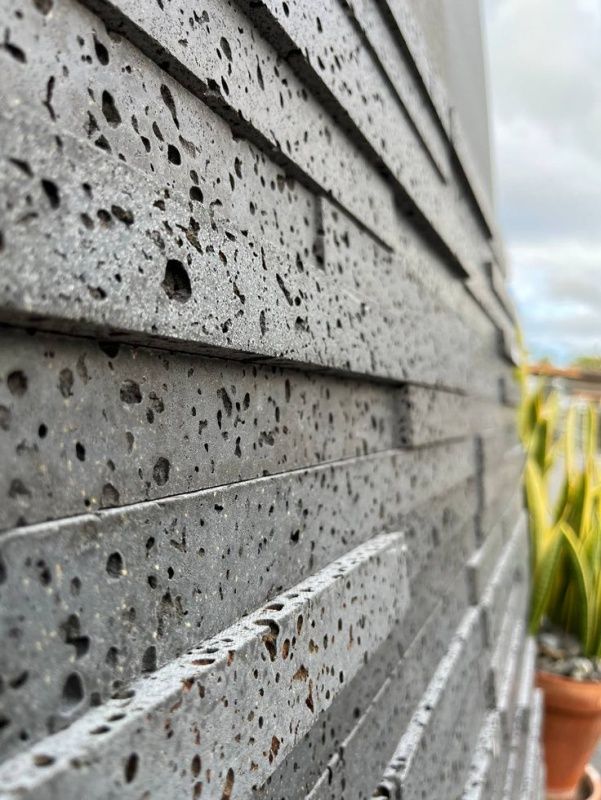
Lava stone is basalt — specifically, porous, vesicular basalt formed when molten lava cools quickly at the earth's surface. On its own, raw lava stone is grey, pitted, and structurally inconsistent from block to block. What makes a lava stone countertop beautiful and durable isn't the rock itself — it's the fabrication: the rock is cut to size, its surface is filled and smoothed, and it's sprayed with a kiln-fired ceramic enamel glaze in the final color. The rock is the carrier. The glaze is the finish that actually determines color, smoothness, and stain resistance.
1. What Lava Stone Actually Is
Lava stone and basalt are the same volcanic rock — the difference is naming convention, not chemistry. "Basalt" is the geological term for the dense, fine-grained igneous rock formed when magnesium- and iron-rich lava cools. "Lava stone" is the commercial term used when that same rock is quarried in its more porous, vesicular form, full of small air-pocket cavities left behind as gases escaped during cooling.
Two things matter for anyone shopping for a countertop:
- Lava stone is quarried, not manufactured. It comes from ancient volcanic flows, and usable deposits are increasingly limited — that scarcity is part of why raw material costs run high before any fabrication even happens.
- Raw lava stone is not countertop-ready. In its natural state it's porous and pitted — great for absorbing moisture in a landscaping bed, unusable as a kitchen surface without further work.
2. The Fabrication Process, Demystified
This is the part almost nobody explains publicly, and it's the actual value in a lava stone countertop. Here's the real sequence:
- Quarry and select — blocks are pulled from a limited basalt deposit and evaluated for size, density, and consistency.
- Cut to template — the block is cut down to the exact slab, bar top, or stair tread dimensions for the job.
- Fill and smooth — the naturally porous surface is filled with a bisque-like clay body to close the pits and even out the surface and edges.
- Base coat — the filled slab is sprayed with a white enamel base coat and kiln-fired. White creates a true, neutral foundation so the final color reads accurately rather than being muddied by the grey stone underneath.
- Color coat — the piece is resprayed in the final glaze color and fired again, fusing the enamel to the surface at high heat.
The result: the finished surface you touch, clean, and live with every day is glass-hard fired enamel — not raw stone. The basalt underneath is doing structural work, not cosmetic work.
3. Why Thermal Behavior Matters More Than the Label
"It's made from lava stone" tells you where the substrate came from. It doesn't tell you how that specific block will behave under heat. Basalt's coefficient of thermal expansion is not a fixed number — published material data puts it in a range of roughly 5 to 12 ppm per degree Celsius, depending on mineral composition and where the stone was quarried.
That range is exactly why one published spec sheet isn't treated as gospel. Every batch is fire-tested before it goes into production — checking for flatness, edge integrity, and any sign of delayed crazing after cooling — rather than assuming one quarry's numbers apply to the next. It's the same reason a stone or glass supplier's sample should always be fired before it's committed to a job, not just read off a data sheet.
How Lava Stone Compares
| Feature | Raw Basalt / "Lava Stone" | Downing Designs Glazed Enamel Slab |
|---|---|---|
| Surface | Porous, pitted, absorbs stains and moisture | Filled, smoothed, and sealed under a fired enamel glaze |
| Color | Mottled Grey to black volcanic tone only | 1000's of custom colors |
| Consistency | Natural variation; no two blocks identical | Repeatable, base color is always pure white |
| Integrated sinks | Not offered as a standard product | Available via drop-mold or bisque-shell integrated basin |
4. Integrated Lava Stone Sinks: Two Approaches
Integrated sinks are the newest frontier for this material, and there are two distinct ways to build one. Both start from the same glass-and-glaze system — they differ in how the basin itself takes shape.
| Drop-Ring Thermoform | Bisque-Fired Sink Shell | |
|---|---|---|
| Method | Heat-slumped into an drop-ring mold to form the basin in one piece | A pre-formed shell (e.g. 21" x 13") is sprayed in the countertop's final color to match. |
| Shape | Oval, starting around 3" of draw depth | Rectangle, softened corners |
| Where it shines | One continuous piece of glass, no seam between counter and basin | Precise, repeatable basin geometry independent of the thermoform process |
Which one is right for a given project?
A drop-ring thermoform basin is the choice when a seamless, one-piece look between counter and sink matters most — there's no joint to hide or match. A bisque-fired shell is the choice when the basin needs a specific rectangular footprint or when precise, repeatable geometry matters more than having zero seam. Both are still being refined in-house, and both start from the same core principle: the basin is glass and glaze, engineered the same way the countertop surface is.
Frequently Asked Questions
Is lava stone the same thing as basalt?
Yes. Lava stone is the commercial name for porous, vesicular basalt — the same volcanic rock, named differently depending on whether it's being sold for countertops (lava stone) or used in construction (basalt).
Why is lava stone so expensive?
Two separate costs stack together: the raw material is quarried from limited, naturally occurring deposits at remote bases of European mountains, and the fabrication process — filling, smoothing, base-coating, color-coating, and multiple kiln firings — is labor- and time-intensive.
Is the finished surface actually stone, or is it glass?
The finished surface is glazed ceramic enamel fused to surface at over 1500F. The basalt provides the structural core, but the surface you touch and clean is a kiln-fired ceramic enamel glaze, fused permanently to the stone at high temperature.
Does basalt's thermal expansion rate affect how a countertop is made?
Yes. Basalt's coefficient of thermal expansion varies by quarry source, generally falling in the range of about 5 to 12 ppm per degree Celsius across published material data. Because that range varies by source, each batch is fire-tested before production rather than relying on a single published number.
Can a glazed enamel countertop have a built-in sink?
Yes, using one of two methods: a thermoformed drop-ring basin slumped directly from the glass for a seamless one-piece look, or a bisque-fired sink shell that's base-coated and color-matched separately, then integrated with the countertop.
How durable is a lava stone countertop compared to granite?
Once fabricated, the fired enamel surface resists chipping, hot pans, staining, and UV fading — it doesn't require the periodic resealing that granite and other natural stones need, because the porous stone underneath is fully sealed by the glaze rather than left exposed.

Jeff Downing
Founder, Lead Designer & Custom Glass Countertop Expert
Jeff Downing of Downing Designs, is a Tampa Florida–based design studio specializing in custom Glass Countertops, Glass Bar Tops, Glass Vanity tops and Glass Stair Treads. With decades of hands-on experience, Jeff is widely recognized for delivering textured glass surfaces integrated with LED lighting to create dazzling abstract statement pieces.
"Glass. Lights. Ambiance".