
Last updated on November 12th, 2026 at 07:34 am
Glazed lava stone is volcanic basalt fused to a vitreous enamel surface: powdered glass and metallic-oxide colorants, sprayed in passes and kiln-fired at 1,400–1,650°F until it melts and bonds to the stone. The surface you touch is fired glass, so it’s UV-stable, nonporous without sealant and available in virtually any color. French lava stone runs 17–23 weeks with seams beyond about 102 x 47 in; domestic fired enamel on a nanoglass substrate runs 4–10 weeks in single pieces up to about 118 x 59 in.
The surface you’re specifying has been through fire twice. Once as geology. Once as craft.
What glazed lava stone actually is
Lava stone countertops begin as basaltic volcanic rock, quarried from the Volvic plateau in France’s Auvergne or the slopes of Mount Etna in Sicily. Basalt forms when molten rock cools from roughly 1,800–2,200°F, so it’s already one of the most thermally stable, chemically inert materials in nature before a craftsman touches it.
The second firing makes it architectural. The stone is cut, prepared and coated with vitreous enamel in several spray passes, then kiln-fired at 1,400–1,650°F. The glass melts, flows and fuses to the stone; when it cools, enamel and substrate are chemically bonded. The surface you touch isn’t stone. It’s fired glass enamel, and that matters in every performance category. For the basics, see What Is Lava Stone?
Why the enamel performs the way it does
Vitreous enamel isn’t paint, resin or a sealant that needs renewing. It’s a glass system: fired, fused, inorganic and permanent. Its colorants are metallic oxides that are stable across the full UV spectrum and every temperature a home or restaurant will see. They don’t fade, bleach or shift. Compare engineered quartz, whose resin yellows under UV and doesn’t belong outdoors.
| Oxide | Colors |
|---|---|
| Cobalt | Blues and teals |
| Chromium | Greens |
| Iron | Ambers and terra cottas |
| Manganese | Purples and blacks |
| Tin | Whites |
The track record is long. London Underground enamel signage has been in service since the late nineteenth century, and early-twentieth-century French road signs in enameled volcanic stone are still legible and color-accurate. Specify an oceanic blue for a hospitality project and it will be the same blue in twenty years.
Color: why designers find this material
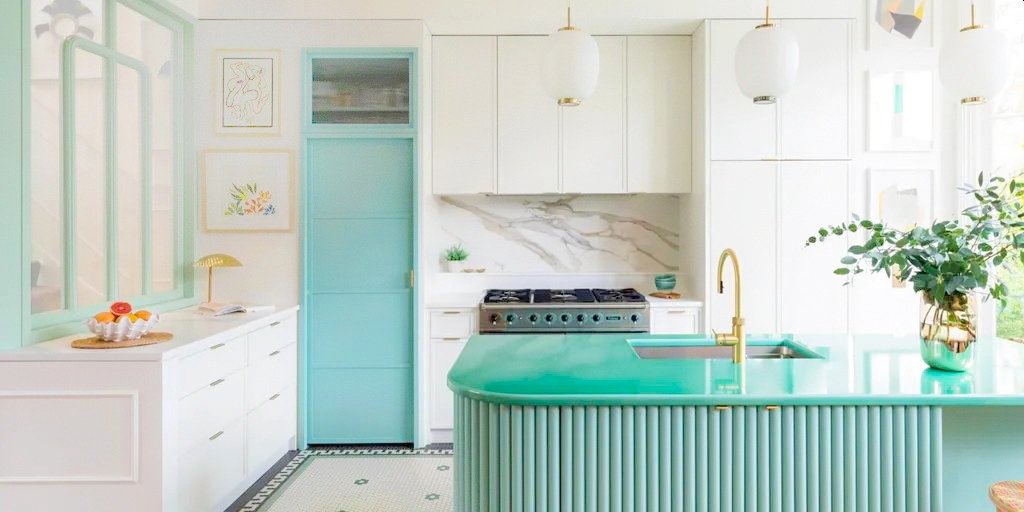
The color range is effectively unlimited. Any Pantone reference, paint chip, fabric swatch, tile or client sample can be matched and fired into the enamel. That’s chemistry, not marketing: the oxide palette is well understood and repeatable, and color builds through layered, fired passes, the same logic explored in Depth You Can’t Photograph. A precise terracotta, a forest green or a cobalt that reads right under a venue’s lighting is achievable in enamel, and impossible in granite, quartz or marble. See Your Glazed Enamel Color. Not Theirs.

The most sophisticated use of color is restraint: one deep oceanic-blue island against white perimeter counters, one vivid café table anchoring a neutral dining room, one bar top in a brand green the rest of the room whispers around. The white space makes the color stronger. Finishes: matte, satin, gloss and metallic (gold, silver, copper, bronze), specified before firing and permanent after.

What architects need to know before specifying
| French lava stone (PyroLave) | Domestic fired enamel (nanoglass substrate) | |
|---|---|---|
| Max single piece | About 102 x 47 in at 3 cm; smaller at 4–5 cm | About 118 x 59 in |
| Example: 114 in run | At least three pieces at 3 cm | One piece |
| Lead time | 17–23 weeks (12–14 fabrication plus freight and customs); August factory closure | 4–10 weeks total, ships in the continental U.S. in 4 days or less |
| Flexural strength | About 20 MPa (quarried basalt) | 50–55 MPa |
| Enamel chemistry | Vitreous enamel, 1,400–1,650°F | The same |
| Price exposure | Euro exchange rate, freight, tariffs | None |
- Size is the first filter. Seams must be planned as design elements, not accommodated. Identify them at the start.
- Lead time is the second. Compressed or summer schedules need the import timeline at the first client meeting, not the last.
- Templating is non-negotiable. Enamel surfaces can’t be adjusted in the field. Overhangs, cutouts, faucet holes, edge profile and seams are locked before fabrication.
- Outdoors is a top use. Pool decks, rooftops and restaurant terraces: enamel is UV-inert, thermally stable, nonporous and maintenance-free. Choose lighter colors for direct sun.
The energy equation: why imported lava stone costs what it does
This isn’t an argument against French lava stone. It’s the economics every designer owes a client before presenting a budget. The process is genuinely demanding: boulders lifted by crane, diamond-sawn, CNC- and waterjet-profiled, then fired repeatedly. The first firing runs about eight hours at over 1,800°F to fuse a filler coat and stress-test the slab; failures are discarded. Then grinding, a white undercoat firing and a final color firing, all in large industrial tunnel kilns that run on electricity. None of it can be shortened. And that’s before the crate goes on a ship.
| Period | Price | What happened |
|---|---|---|
| 2019 baseline | About €39 | Pre-pandemic |
| August 2022 peak | About €1,130 | Russian gas disruption; roughly 29 times the baseline |
| 2025 | About €61 | Still about 56% above 2019, and volatile |
French industrial electricity prices doubled between 2021 and 2023, and for a manufacturer running kilns through those years the impact was structural, not an adjustment. American buyers also pay in euros, which have traded between about $1.05 and $1.13 over the past two years, adding 5–10% variability with no hedge across a 12–14 week window. As one authorized distributor put it in a 2025 quote: “The exchange rate and tariffs have driven the cost up.” See Twenty Years of Glass Prices.
Domestic fired enamel: same surface, different supply chain
Enamel chemistry doesn’t change when the substrate does. Cobalt oxide fires to the same oceanic blue at 1,550°F on Volvic basalt or on a crystallized nanoglass substrate whose main constituent, silicon dioxide, is the same compound that forms basalt’s backbone. Both are silicate-dominant and thermally stable, and both take vitreous enamel at the same temperatures. PyroLave even gets its white surfaces by applying a white enamel base coat first, exactly as domestic fabrication does. The substrate is an engineering decision. The enamel surface is the specification.
If the client wants Volvic lava stone from the Auvergne and the budget and timeline support a 17–23 week import, PyroLave is the right specification, and an extraordinary material. If the project needs fired enamel performance, custom color, maintenance-free durability and domestic delivery on a real schedule, domestic fabrication isn’t a compromise. It’s the specification.
Frequently asked questions
What is glazed lava stone, and how is it different from other stone countertops?
It’s a volcanic basalt substrate permanently bonded to a vitreous enamel surface: powdered glass and metallic-oxide colorants sprayed in passes and kiln-fired at over 1,400°F until the glass fuses to the stone. You touch fired glass enamel, not stone, so it’s UV-stable, nonporous without sealant and available in unlimited custom colors, a combination granite, marble and quartz don’t offer.
What colors are available for glazed lava stone?
Effectively unlimited. Cobalt for blues and teals, chromium for greens, iron for ambers and terra cottas, manganese for purples and blacks, tin for whites, blended and fired permanently. Any Pantone, paint chip, fabric or tile can be matched. Finishes are matte, satin, gloss and metallic, all permanent once fired.
How large can a lava stone countertop be in one piece?
French PyroLave tops out around 102 x 47 inches at 3 cm, smaller at 4–5 cm, so a 114-inch run needs at least three pieces. Domestic fired enamel on nanoglass is available up to about 118 x 59 inches in a single piece with the same enamel chemistry and finishes.
Can glazed lava stone be used outdoors?
Yes, it’s one of the best outdoor specifications available: UV-stable, thermally stable, nonporous with no sealant and impervious to pool chemicals and acidic environments. Lighter colors are recommended in direct sun to reduce surface heat.
How long do glazed lava stone countertops last?
Specify them as lifetime elements. Vitreous enamel signage in the London Underground has stayed color-accurate since the 1880s, and early-twentieth-century French enameled lava stone road signs are still vibrant. There’s no sealant schedule and no renewal cycle.
What is the lead time for lava stone countertops?
French lava stone takes 17–23 weeks from approval to installation, plus a four-to-six-week August factory closure, with exchange-rate and tariff exposure. Domestic fired enamel runs 4–10 weeks total, including nationwide delivery from Tampa.
Can fired enamel surfaces be made in curved or organic shapes?
Yes. Both basalt and nanoglass substrates can be waterjet-cut at 60,000 PSI into organic, curved and fully custom shapes, such as freeform dining tables, curved bar fronts and custom café tops. Shape is locked at templating.
Why has lava stone become so expensive?
Multiple kiln firings in France, where industrial electricity doubled between 2021 and 2023 and wholesale power peaked around €1,130/MWh in August 2022, plus euro conversion, freight and tariffs. The craft isn’t more expensive; the energy to fire it and the logistics to deliver it are.
How is glazed lava stone installed?
It can’t be adjusted in the field, so edge profiles, cutouts, faucet holes, overhangs and seams are set at templating and locked before fabrication. White-glove installation is available nationally and into the Caribbean from Tampa.
What’s the relationship between lava stone and nanoglass substrates?
The substrate isn’t the specification; the enamel is. Lava stone uses quarried basalt under the enamel; domestic fired enamel uses crystallized nanoglass, mainly silicon dioxide. Both take the same enamel and produce the same UV-stable, nonporous, color-permanent surface, with nanoglass offering higher flexural strength and larger slabs.
Keep reading
Glass. Lights. Ambiance.
Born of fire, and fire doesn’t negotiate. Start with dimensions, a color reference and a timeline.
We don’t have office hours. We have phones.

Jeff Downing
Founder, Lead Designer & Custom Glass Countertop Expert
Jeff Downing of Downing Designs, is a Tampa Florida–based design studio specializing in custom Glass Countertops, Glass Bar Tops, Glass Vanity tops and Glass Stair Treads. With decades of hands-on experience, Jeff is widely recognized for delivering textured glass surfaces integrated with LED lighting to create dazzling abstract statement pieces.
"Glass. Lights. Ambiance".