
Last updated on July 1st, 2026 at 05:51 am
Insights · Downing Designs
10 Questions Architects and Designers Need to Ask Upfront
Ten questions that separate a real glass craftsman from everyone pretending to be one. Ask them in order. Watch what happens.
Most glass bar top companies tell you why their glass is the best. I'd rather hand you the questions that expose whether it actually is.
I've spent 25 years designing, fabricating, and personally installing custom glass bar tops for luxury homes, restaurants, yachts, and private clubs. I still answer my own phone. I've seen the best and the worst — and the difference is rarely price. It's standards of quality.
These ten questions are what I'd ask if I were buying a glass bar top from someone other than me. Each one sounds reasonable. Each one opens a trapdoor under a fabricator who isn't ready for it.
At the end you'll find our standard quote. Every item on this checklist is already on it — included, not optional, not an upsell.
Question 1
"Are you specifying clear glass — or low-iron glass?"
Most buyers assume "clear glass" is clear. It isn't. Standard float glass contains iron impurities that give it a green tint. The thicker the glass, the greener it gets. Under LED illumination, that tint corrupts every color in the system — whites shift, blues muddy, RGB settings never quite produce what was promised.
Low-iron glass removes most of this coloration. The edges go crystal clear. The LEDs become more vibrant. The entire piece reads as more luxurious — because it is. If you are back-painting the glass, what is the warranty on that paint? What does it look like with your glass?
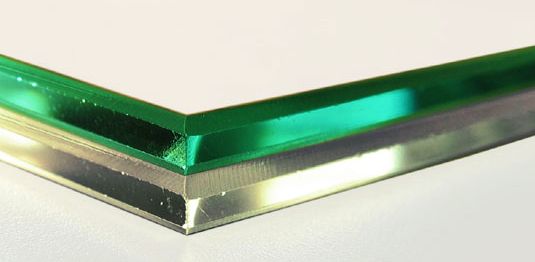
Clear Glass vs Low-Iron Glass — Downing Designs
Why this question works: Any fabricator worth trusting will have both samples on hand and will show you the difference immediately. A fabricator who hesitates is either using standard glass or doesn't know what you're talking about. Either way — you have your answer.
Question 2
"Show me your cantilevered support system."
The support system is the structural foundation of the entire installation. Make sure you are not buying a Flintstones-era support system with many through-holes — each one a stress-fracture waiting to happen — secured with ugly hockey pucks atop your bar. It feels cluttered before you even have your first cocktail.
The support system should be designed and specified with the same precision as the glass itself: bracket type, finish, 4.5 inches in height, placement, and hidden LED wiring. The result is a bar top that floats — visually and literally — with no visible hardware interrupting the topside and no exposed wiring.
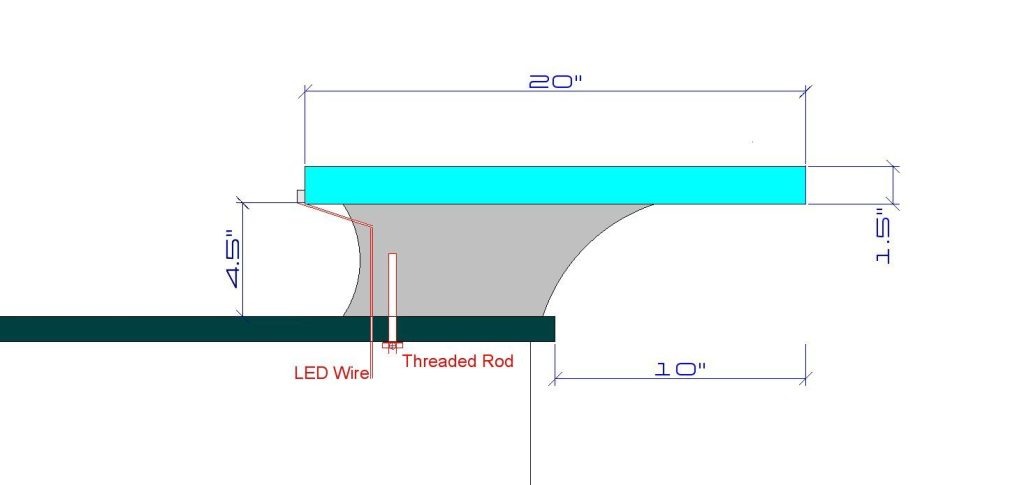
High Bar Top Overhang Diagram — Downing Designs
Why this question works: Supports which cantilever the glass bar top over an island, and LED wires that are forever visually apparent, must be done correctly. See their support and wiring system before you commit.
Question 3
"Can I hold a sample of the finished edge?"
You will touch this edge thousands of times over the life of this installation. It should feel like nothing else in the room — silky smooth, optically clear, polished to the point where you stop thinking about it and just enjoy it.
Lens polish is the highest optical edge finish available on glass. A matte or machine-ground edge looks scratchy and machine-marked. A lens-polished edge looks like a brand new pair of glasses. From across the room, a 1.5-inch thick glass bar top looks inviting. Sitting at the bar, the refraction is impressive to behold. The difference is immediately obvious in your hand — not in a photograph, not in a description. In your hand. See below for "The Good, The Bad, and The Ugly."
Close-Up Edge Polish, 1.5" Glass Bar Top — Downing Designs
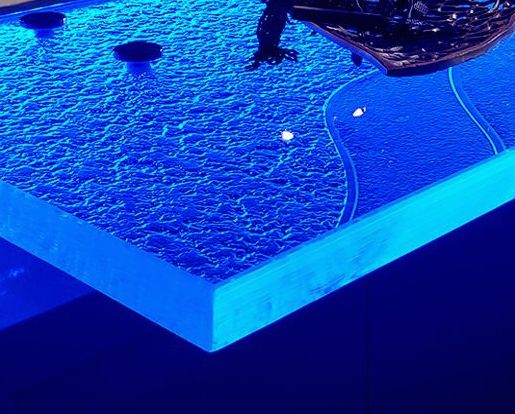
CNC Edge Polish Ruins an Otherwise Beautiful Glass Piece
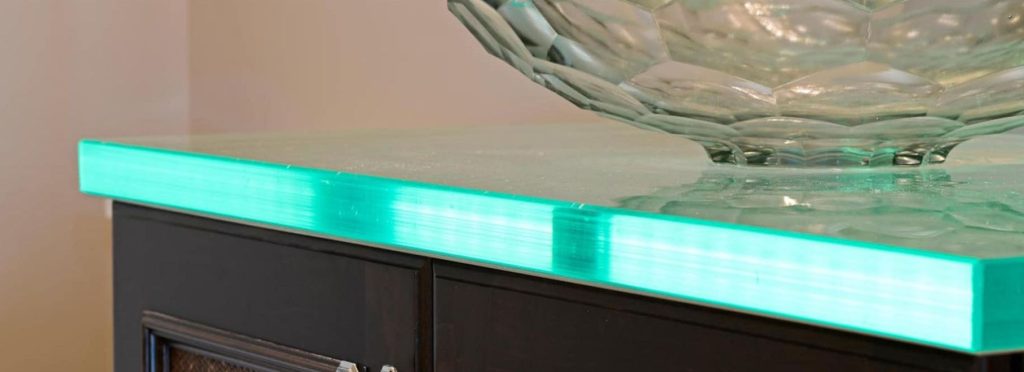
CNC Lines on the Face — Not Polished, Just Rough
For a highly visual blog showing edge polish quality, click here.
Why this question works: A fabricator without samples doesn't want you touching the product before you've committed. That tells you something important about their confidence in what they make.
Question 4
"Is the texture hand-crafted or stamped — and can you show me two pieces to prove it doesn't repeat?"
Many textures in this market come from stamped molds. Stamped glass repeats — like wallpaper. Under certain lighting conditions the tile pattern becomes visible and the illusion collapses. You paid for art and got a pattern.
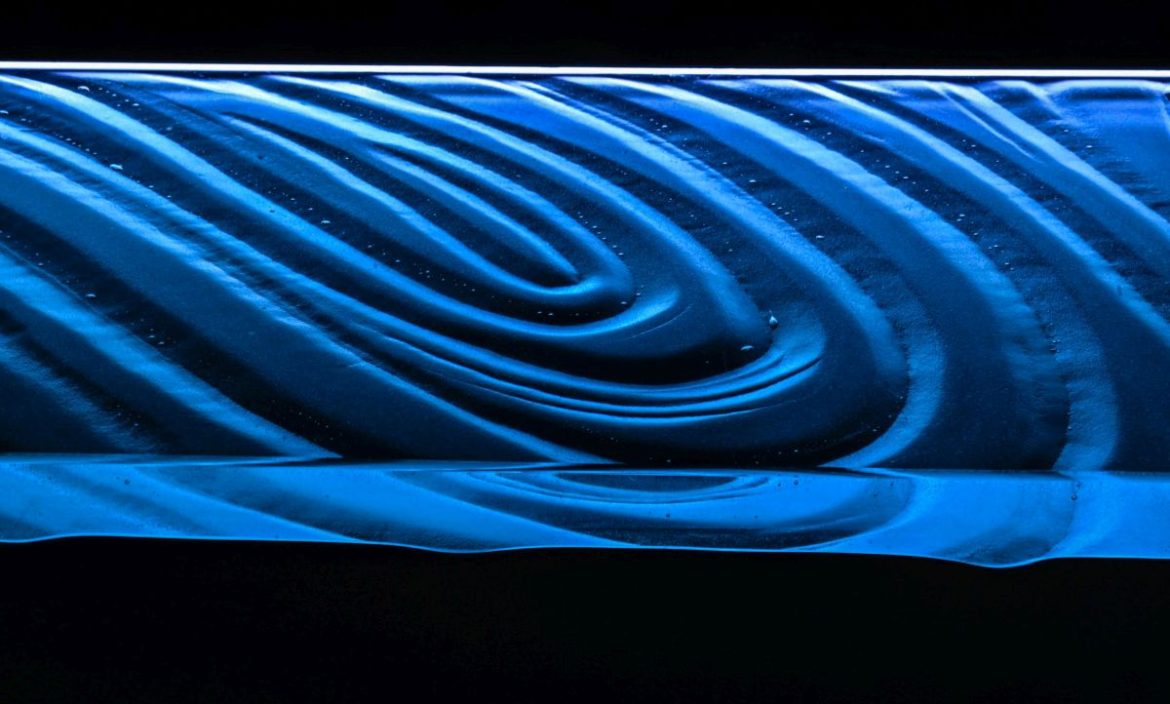
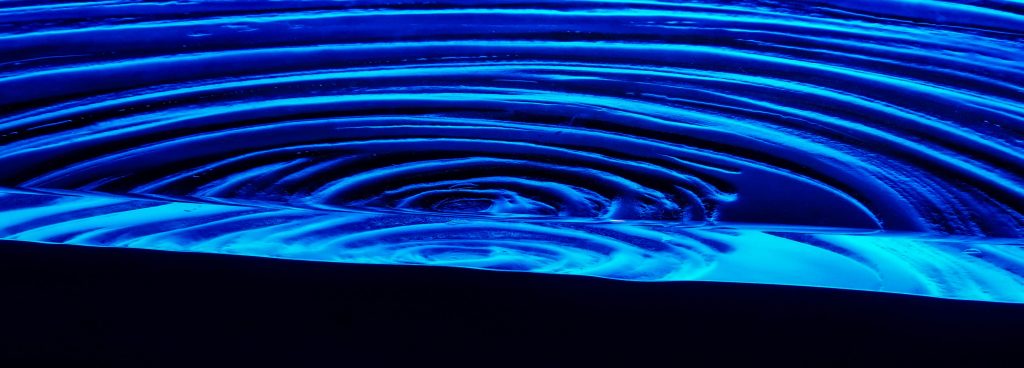
Hand-crafted glass evolves. Every texture is carved by hand into a kiln bed before the glass is fired — organic, directional, impossible to duplicate exactly. No two oceans make the same wave. No two windstorms carve the same sand. Your bar top shouldn't repeat either. We create "Singularities" for long bars.
For our blog on kiln-carving with clients at the helm: click here.
For an interesting video showing the hand-crafted texturing process, click here.
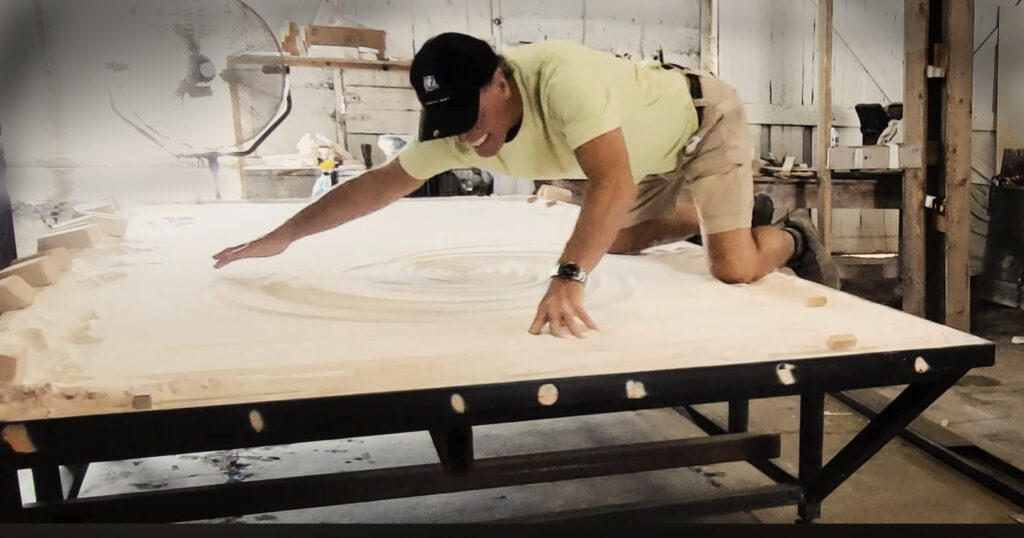
Jeff Downing Hand-Carving a Glass Bar Top — Tampa, FL Studio
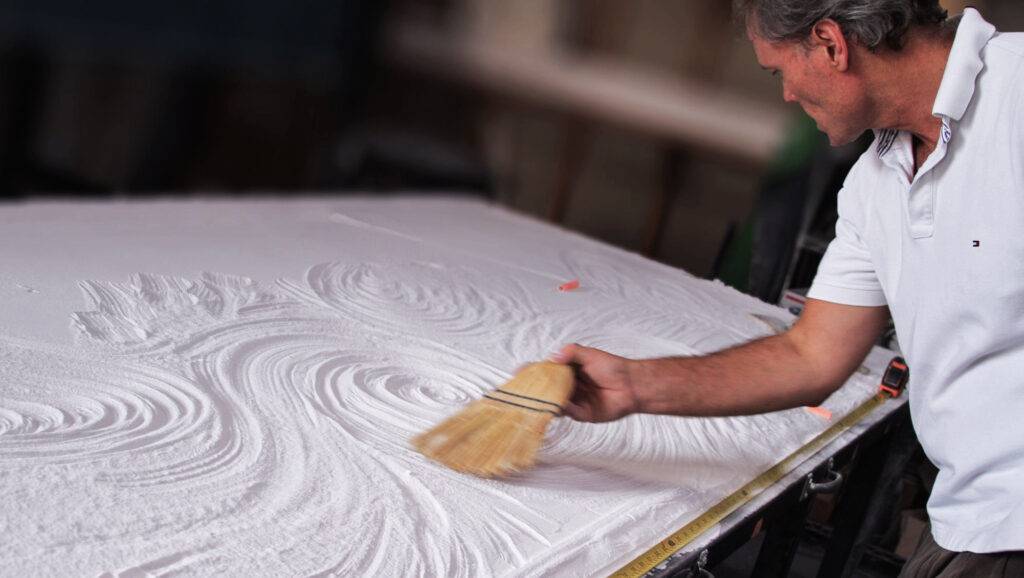
Glass Countertops Made by Jeff Downing
Why this question works: Ask them to place two pieces side by side. Stamped glass will match. Hand-crafted glass will not. The proof is immediate and irrefutable.
Question 5
"For a multi-piece installation, how do you handle textural continuity across the seams?"
Any bar longer than what a single kiln can produce — 126 inches long by 60 inches wide — requires multiple pieces. How those pieces meet is where most fabricators quietly fail. The standard approach: fabricate each piece independently and hope nobody looks too closely at the seam. The texture restarts. The pattern breaks. The bar reads as assembled rather than conceived. You can see it. Your guests can see it. Nobody says anything — but everyone notices.
The correct approach: sequence the pieces the way the Old Masters composed diptychs and triptychs — each panel hand-carved in reference to the one before it, so the texture flows as a single unbroken continuum from end to end. A three-piece installation reads as one work of art. The seam disappears. The surface reads as one thought.
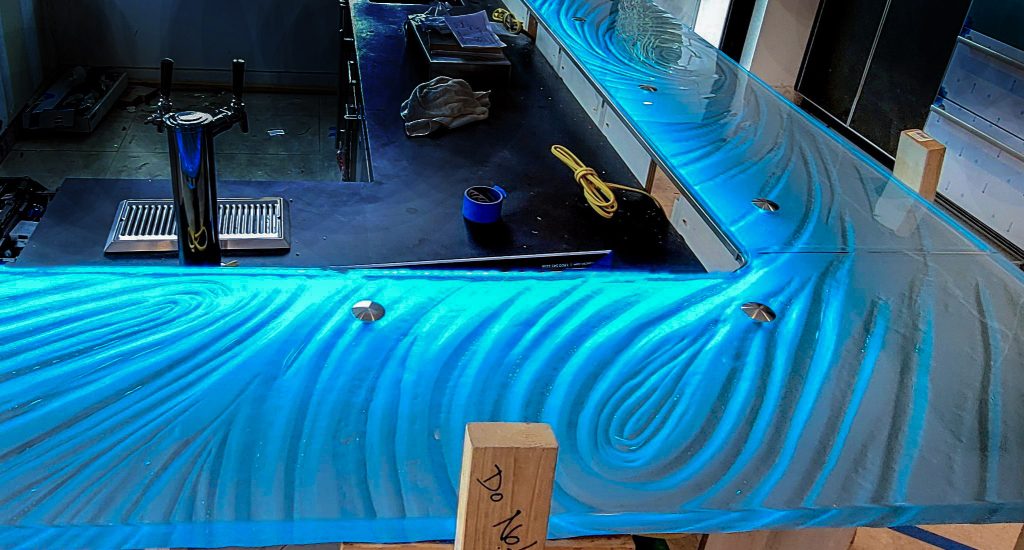
Sequenced Seam — L-Shaped Glass Bar Top — St. Petersburg FL
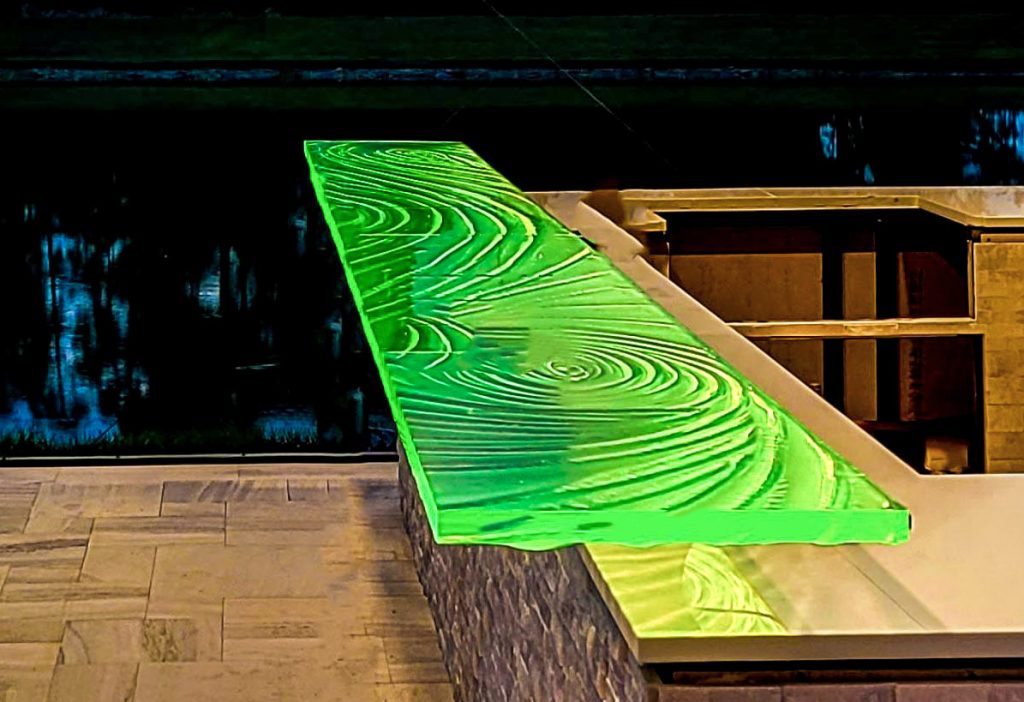
Sequenced Glass Bar Top — Fort Myers FL — Downing Designs
Why this question works: Most fabricators have never been asked this. The ones who have — and who do it correctly — will light up explaining it. The ones who haven't will change the subject. Pay attention to which one happens.
Question 6
"Are the LEDs dotless COB — and where exactly do the wires go?"
People think they're buying glass. They're not. They're buying atmosphere. The glass is the medium. The LED system is what activates it — and not all LED systems are created equal.
Standard diode LED strips produce visible dots along the edge of the glass. These are less expensive. Dotless COB strips use a continuous phosphor emitter that produces a seamless, unbroken band of light — no hotspots, no dot pattern, no visible technology. Just light moving through glass the way it was designed to. The difference is immediately visible. Once you've seen dotless, you can't unsee it.
The wire question is equally important. If the answer is "they run along the back of the bar" or "we tuck them behind the base" — that's not a solution, that's a deferral. The wires should be hidden inside the support bracket itself, from the moment the bracket is designed. Ours are.
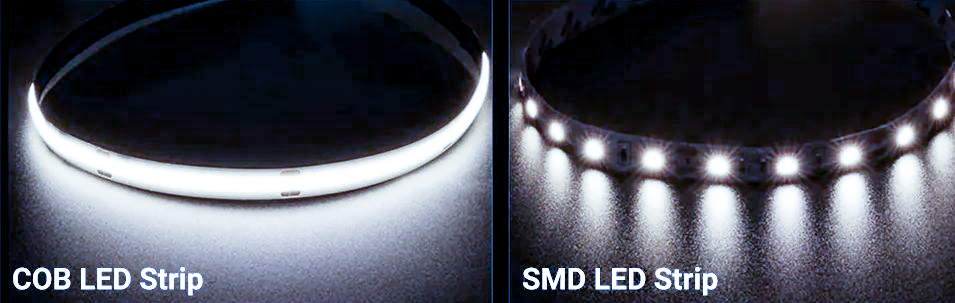
COB vs SMD 5050 LED Strips — Downing Designs
Why this question works: Two parts, two trapdoors. Most fabricators can answer one. Very few can answer both with confidence and show you the hardware to prove it.
Question 7
"Does this fabricator actually understand how I'll live with this installation?"
Two questions that sound minor but aren't — ask them both.
Controller: Bluetooth is right for private residences — secure, locked, controlled from a single paired device. Nobody walks in and changes your atmosphere at 9:30pm on a Saturday. Wall-mounted is right for restaurants, clubs, and rental properties — anywhere multiple staff members need to operate the system without a smartphone, or where the owner isn't always present. A fabricator who recommends the same controller to everyone doesn't understand their clients.
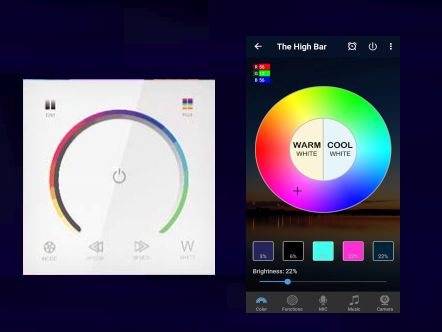
RGB LED Controller Options — Downing Designs
Templating: A glass bar top is only as good as the measurements it was built from. Most fabricators work from dimensions sent by the client, the contractor, or a template service that has never seen the space. The result arrives close — and close is the beginning of a field modification conversation nobody wants to have on installation day. At Downing Designs, Jeff Downing personally templates every project — in the actual space, at the actual cabinets, with the actual sight lines in front of him. The finished piece arrives ready to set. No field cuts. No shimming. No adjustment.
Why this question works: A fabricator who gives the same controller recommendation to a homeowner and a restaurant owner — or who templates by mail — is operating on autopilot. You deserve someone paying attention to your specific situation.
Question 8
"How long does it take — and what are my timeline options?"
Standard fabrication for fully custom commissions — interactive design session, custom texture, specific dimensions, specific LED specification — runs four to eight weeks from signed agreement depending on complexity.
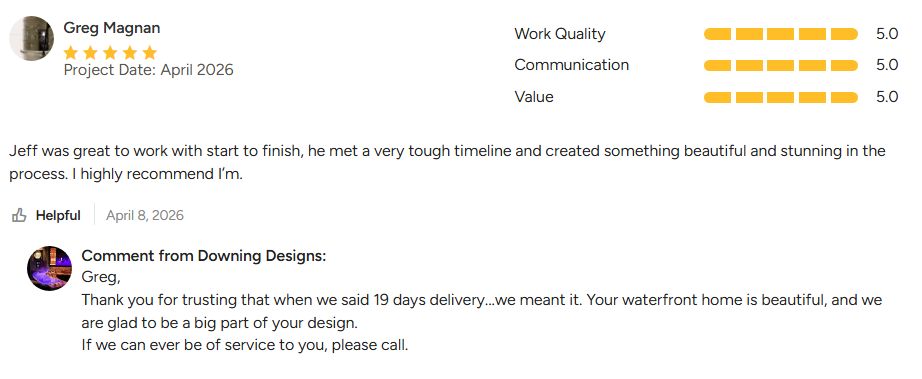
Expedited fabrication is available when shop capacity allows and the project is prioritized. The St. Petersburg waterfront installation was contracted November 22nd and installed December 10th — eighteen days start to finish including crane lift and full LED integration. That is not our standard timeline. But it demonstrates what is possible when a project is prioritized correctly and executed without margin for error.
In-stock glass bar tops at 126 inches × 20 inches × 1.5 inches are available for immediate delivery. Cut to your dimension, Ambiance Machine™ LED fitted, and shipped within 7 days. If your timeline is urgent and your dimension is close to standard, this is the fastest path to a finished installation.
From a Houzz review:
Magnan Houzz Review — Downing Designs
Why this question works: Most fabricators quote one timeline and it's always optimistic. A fabricator who offers three distinct paths — custom, expedited, and in-stock — has actually thought about your problem, not just their production schedule.
Question 9
"Is this a White Glove service from first call to final installation?"
A glass bar top commission should feel effortless on your end. One point of contact. One craftsman who knows every detail of your project from the first conversation to the moment the LED controller is handed to you. No handoffs, no subcontractors appearing unannounced, no surprises on installation day.
At Downing Designs, White Glove service means the same person who takes your call designs the piece, fabricates the piece, and is available to personally travel to your site to install it. Every step is coordinated by the craftsman responsible for the outcome — not managed through layers of intermediaries who have never seen your space.
This also matters legally. If something goes wrong in transit, during installation, or after completion, there is one accountable party — not a chain of subcontractors whose attorneys will spend the next six months deciding whose fault it was.
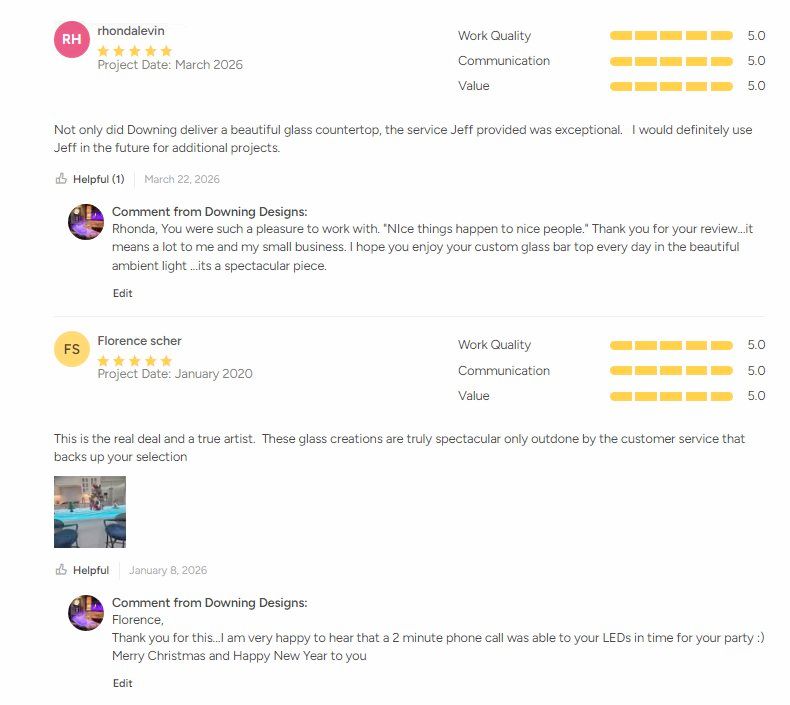
You have to put your trust somewhere. Here is a link to see what my scorecard reads: Houzz Reviews page.
Why this question works: Most fabricators ship glass and hope for the best. White Glove service is not a marketing term — it is a commitment to accountability at every stage. Ask them to define what it means for your specific project. Then listen carefully.
Question 10
"If I have a problem six months after installation — who do I call, and will I reach the person who built it?"
Nobody asks this question until they need the answer at 9pm on a Friday. By then it's too late to wish they had.
The answer at Downing Designs: Jeff Downing. Same number on the business card. Same person who took the template, built the piece, and either installed it personally or supervised the crew that did. Not a support ticket. Not a regional representative. The craftsman who made it. Our glass edge roundover prevents many of these calls — but it is glass. If you chip it, we can fix it.
Houzz Reviews — Downing Designs
Why this question works: Silence is the answer you're listening for. Or the sound of someone describing a customer service system. Either way — the conversation ends there.
What a Complete Quote Looks Like
Every item on this checklist appears on a Downing Designs quote as a standard included line item. Not an upsell. Not a surprise. This is what complete looks like.
| Line Item | Qty | Value |
|---|---|---|
| 1.5″ Thick Textured Low-Iron Glass — Interactive Design or In-Stock (126″ × 20″) | 1 | $ |
| Lens Polish and Roundover — Top/Bottom of All Exposed Edges | 1 | included |
| Textural Continuity — Piece to Piece for 2 or More Sections | 1 | included |
| Pair of Matte-Polished Cantilever Support Brackets — 4.5″ Tall with Hidden LED Wire Channel | 1 | included |
| "Dot-Less" COB RGB LED Strips — Waterproof IP-67 — Stainless Cover | 1 | included |
| Bluetooth or Wall-Mounted Controller | 1 | included |
| 1 Template Trip — On-Site by Jeff Downing | 1 | included |
| 1 Installation Charge — All Drilling, Wiring, Glass Placement | 1 | included |
| Custom Crating, Shipping, Insurance | 1 | included |
| 5-Star Phone and/or Text Service — 7 Days a Week | 1 | Always |
| Options | ||
| Jeff Downing On-Site to Conduct Installation — Air, Car, Hotel | 1 | TBD |
| Expedited Fabrication or In-Stock Glass Bar Top — Ships in 7 Days | 1 | TBD |
| Back-Paint Metallic Silver — Permanent Two-Part Catalyzed Urethane — 30-Year Warranty Required only when bar sits atop an unattractive base. Not required for floating cantilever installations. |
1 | included |
| Total | $ | |
| Down Payment | ||
| Payment Upon Completion of Fabrication | ||
Years later — when the house is quiet, when the guests have gone home, when you pour yourself one last drink and lean against the bar — you still smile. You still run your hand across the edge. You still dim the lights just a little. And you admire it exactly the same way you did on the day it was installed.
That is the standard worth aiming for. Not because it's expensive. Not because it's fashionable. But because beautiful things quietly improve our lives — and atmosphere may be one of the few luxuries that becomes more valuable with time.
That's why I wrote this checklist. And that's why I'll keep answering my own phone.
The Mission
I don't want to be known as the company
that makes the finest glass bar tops.
I want to become the company that taught
America how to buy one.
Because once buyers understand excellence —
they never settle for less.
Ready to Start the Conversation?
Bring your questions. Bring this checklist. We welcome both.
Get in Touch (813) 784-5211Quick Reference
Frequently Asked Questions
Should I specify clear glass or low-iron glass for a glass bar top?
Always specify low-iron glass for an illuminated bar top. Standard "clear" float glass contains iron impurities that produce a visible green tint, which becomes more pronounced as thickness increases and is unmistakable under LED illumination — it shifts whites, muddies blues, and prevents RGB lighting from producing its intended color. Low-iron glass removes most of this coloration, producing crystal-clear edges and more vibrant LED output.
What should I look for in a cantilevered support system for a glass bar top?
The support system should be engineered with the same precision as the glass itself, including bracket type, finish, standard 4.5-inch height, placement, and fully hidden LED wiring. Avoid support systems that use multiple through-holes secured by surface-mounted standoffs, as each hole is a stress point and an aesthetic compromise. A properly engineered cantilever system allows the bar top to float with no visible hardware and no exposed wiring.
Why does the edge polish on a glass bar top matter?
The edge of a glass bar top is touched constantly over the life of the installation and should be lens-polished — the highest optical edge finish available on glass. A matte or CNC-machined edge that has not been hand-polished will show visible lines and a rough, scratchy surface, while a true lens-polished edge is silky smooth and optically clear, producing better light refraction along a 1.5-inch thick bar top.
What is the difference between hand-crafted and stamped glass texture?
Stamped glass textures come from molds and repeat in a tiled pattern, which becomes visible under certain lighting and breaks the illusion of a custom surface. Hand-crafted texture is carved by hand into a kiln bed before firing, producing an organic, directional surface that is impossible to duplicate exactly — no two pieces are identical. Comparing two pieces side by side is the simplest way to verify which type of texture a fabricator is using.
How should a fabricator handle textural continuity across a multi-piece glass bar top?
Any bar top longer than a single kiln can produce — typically beyond 126 inches — requires multiple glass pieces. The correct approach sequences each panel in reference to the one before it, similar to how Old Masters composed diptychs and triptychs, so the carved texture flows as one unbroken continuum across the seams. The incorrect and far more common approach fabricates each piece independently, causing the texture to visibly restart at every seam.
What is dotless COB LED lighting and why does it matter for a glass bar top?
Standard diode LED strips produce visible individual dots of light along the glass edge. Dotless COB (chip-on-board) LED strips use a continuous phosphor emitter that produces a seamless, unbroken band of light with no hotspots or visible technology. For a glass bar top, dotless COB LEDs with fully hidden wiring routed inside the support bracket produce a cleaner, more atmospheric result than standard LED strips with exposed wiring.
Who should template the space for a custom glass bar top?
Ideally, the same person who fabricates the glass bar top personally templates the installation site in person, taking every measurement directly in the actual space. Many fabricators instead work from dimensions sent by a client, contractor, or third-party template service that has never seen the space, which often results in field modifications being required on installation day.
How long does it take to fabricate and install a custom glass bar top?
Standard fabrication for a fully custom glass bar top, including an interactive design session and custom texture, typically runs four to eight weeks from signed agreement depending on complexity. Expedited fabrication is possible when shop capacity allows. In-stock glass bar tops at 126 by 20 by 1.5 inches can be cut to dimension, fitted with LED lighting, and shipped within 7 days for urgent timelines.
What does "White Glove service" mean when commissioning a custom glass bar top?
White Glove service means the same craftsman who takes the initial call also designs, fabricates, and is available to personally install the glass bar top, rather than the project being passed through multiple subcontractors. This single point of accountability matters both for quality control and for liability — if an issue arises during transit, installation, or after completion, there is one responsible party rather than a chain of intermediaries.

Jeff Downing
Founder, Lead Designer & Custom Glass Countertop Expert
Jeff Downing of Downing Designs, is a Tampa Florida–based design studio specializing in custom Glass Countertops, Glass Bar Tops, Glass Vanity tops and Glass Stair Treads. With decades of hands-on experience, Jeff is widely recognized for delivering textured glass surfaces integrated with LED lighting to create dazzling abstract statement pieces.
"Glass. Lights. Ambiance".