
On the Difference Between a Surface That Repeats and One That Was Actually There, in the Room, Being Decided
Downing Designs
A mold repeats. A hand remembers.
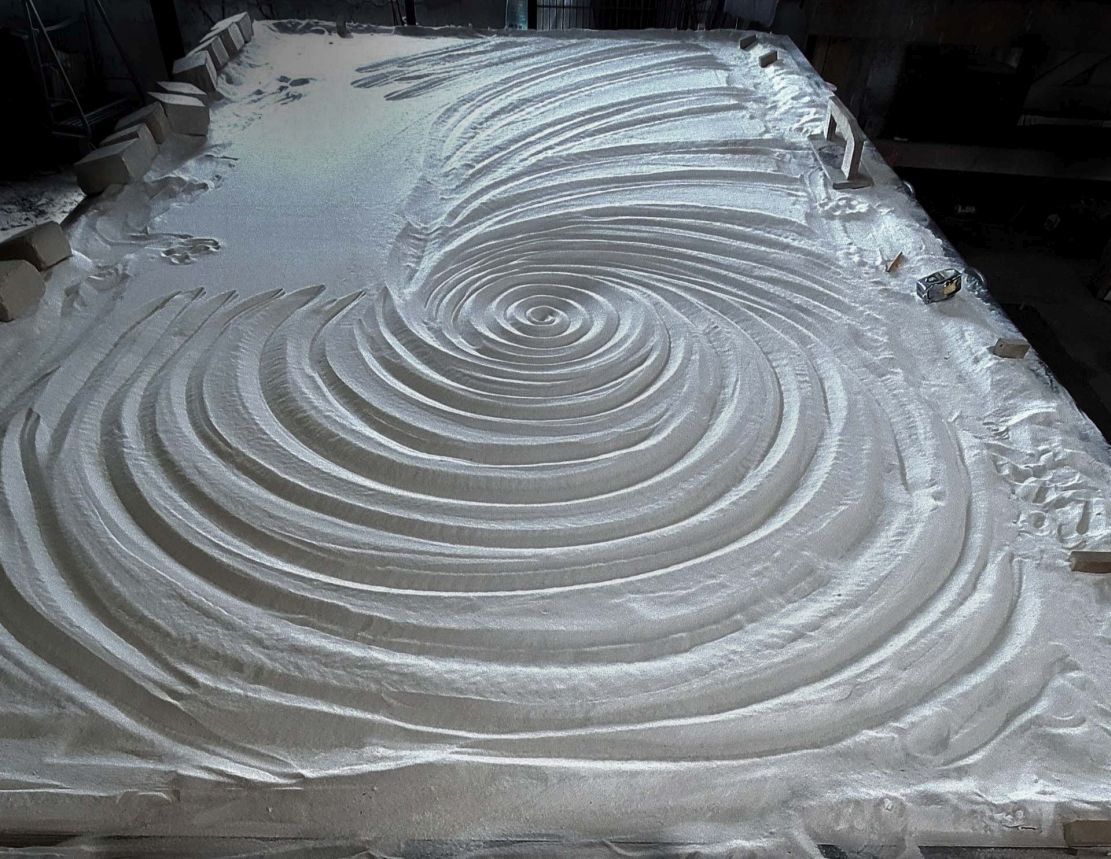
There’s a shallow notion in the world of surfaces — countertops, bar tops, anything a hand might rest on — that a mold is just a faster path to the same result you’d get by hand. It isn’t. At Downing Designs, every bar top starts as raw glass and heat, not a cast waiting to be filled. When I work a piece — layering color, pulling texture through thermal fusing, letting one pass of heat catch an edge the last pass missed — I’m not decorating a surface. I’m building one, decision by decision, the same way a potter’s coil and pinch marks end up living inside the glaze forever. Every fold, ripple, and depth variation in one of my bar tops is a record of a choice made in the moment, responding to how the glass was behaving right then, in that kiln, on that day.
I What a Mold Can’t Do
A molded countertop is engineered for repeatability. That’s its whole purpose — pour a hundred, get a hundred identical results. There’s real skill in that kind of consistency, and it has its place. But repeatability is also its ceiling. A mold can’t notice that your bar sits under a skylight that throws afternoon light sideways across the surface. It can’t respond to the fact that your space runs cool blues and warm woods and needs a piece that bridges the two. It can’t texture itself differently at the end nearest a window versus the end tucked into shadow.
Hand-fused glass can do all of that, because the process stays open the entire time it’s being made. I can push more texture into one section, ease off in another, let a color pool a little deeper where I know it’ll catch the light in your space specifically. The piece ends up synchronized to the room it’s going into — not because I measured it into submission, but because I built it while thinking about that room.
II Surface as Story, Not Just Finish
The best surfaces — in ceramics, in glass, in any material where a maker’s hand is actually present — carry information. You can look at a fused glass bar top and, if you know what you’re looking at, read the sequence: where the heat moved fastest, where a texture tool dragged through while the glass was still soft, where two colors were introduced close enough together to bleed into each other instead of staying separate. None of that is decoration applied after the fact. It’s the making, preserved.
That’s the difference I try to put in front of clients who are choosing between a bar top from a catalog and one that’s built for their bar specifically. A catalog piece is correct. A hand-fused piece is yours — shaped by decisions that accounted for your space, your light, your particular stretch of counter, in a way no mold ever could, because the mold was never in the room with you.
III Twenty Years of Working This Way
I’ve been making thermal-fused, textured glass bar and countertops since 2004. What’s changed over that time is technique — new ways to layer, new ways to coax texture out of molten glass — but not the underlying commitment: every piece gets made for the space it’s going into, not made once and sold to whoever’s counter happens to fit.
If you’re weighing a mass-produced surface against something built specifically for your bar, that’s really the question worth asking: do you want a surface that’s identical to a hundred others, or one that carries the record of having been made with your room in mind?
FAQ Frequently Asked Questions
Is hand-fused glass as durable as a molded or poured countertop surface?
Yes. Thermal fusing bonds the glass at a molecular level, producing a solid, heat- and scratch-resistant surface that holds up to daily bar use every bit as well as cast or poured alternatives. Durability comes from the process, not from whether a mold was involved.
How long does a custom glass bar top take to make?
It varies with size and texture complexity, but a custom hand-fused piece typically takes several weeks from design approval to finished install, since each firing and layering stage needs its own time in the kiln.
Can a hand-fused bar top match an existing color scheme or interior design?
Yes, this is one of the biggest advantages over a molded piece. Because color and texture are built in during the fusing process, the palette can be tuned to match existing wood tones, lighting, or accent colors in the room.
Does a textured glass surface make the bar top harder to clean?
Not meaningfully. The textures are fused into the glass itself, not applied as a coating, so the surface wipes down like any glass countertop. Deeper textural elements may catch light differently but don’t trap residue the way a porous stone surface can.
How is a thermal-fused glass bar top different from a resin or epoxy bar top?
Resin and epoxy surfaces are poured over a substrate and cured, which is a different process from thermal fusing, where the glass itself is layered and heated until it bonds into a single solid piece. Fused glass doesn’t yellow with UV exposure the way many epoxy finishes eventually do.

Jeff Downing
Founder, Lead Designer & Custom Glass Countertop Expert
Jeff Downing of Downing Designs, is a Tampa Florida–based design studio specializing in custom Glass Countertops, Glass Bar Tops, Glass Vanity tops and Glass Stair Treads. With decades of hands-on experience, Jeff is widely recognized for delivering textured glass surfaces integrated with LED lighting to create dazzling abstract statement pieces.
"Glass. Lights. Ambiance".