
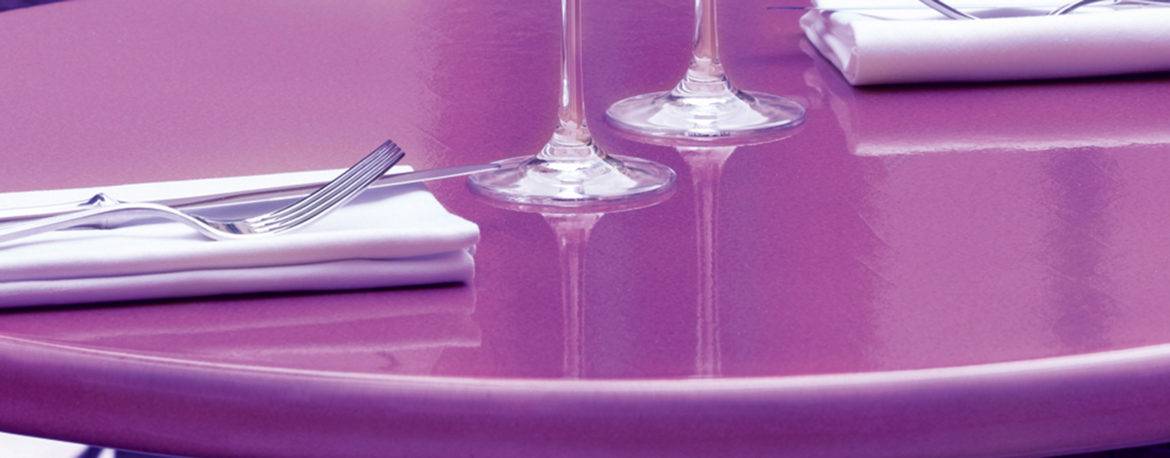
A lavastone countertop combines a natural or engineered substrate with a glass-enamel surface fired in a kiln. Understanding what lies beneath the enamel explains how the material is made, how it performs, and what designers can create with it.
A lavastone countertop has a glassy, colored surface created by melting glass enamel onto a substrate in a kiln. The color is not paint. It is glass.
But the surface is only half the story. The material beneath the enamel affects how the finished countertop is manufactured, how the enamel behaves, and what sizes and shapes are practical.
As a custom glass fabricator with a BS in Chemistry and more than 25 years of experience, I approach enameled countertops as complete material systems. The substrate, enamel chemistry, and firing process must work together to produce a successful finished surface.
1. What Is Traditional Lavastone?
Traditional lavastone is made from volcanic basalt, commonly associated with the Volvic region of France. The quarried stone is cut and prepared before colored glass enamel is applied and fired in a kiln until it melts into a smooth, glossy finish.
The result combines the character of natural volcanic rock with the color and depth of glass.
The basalt substrate provides the underlying body and influences structural behavior and fabrication.
Here is more information about the enamel substrate
The glass enamel provides the finished color, gloss, and exposed surface.
The firing process brings the materials together, making compatibility between them essential.
Basalt is porous and has its own mechanical properties and coefficient of thermal expansion (COE). These characteristics influence how the enamel must be formulated and fired.
Because traditional lavastone starts with quarried rock, available dimensions and shapes are also influenced by the stone itself and the practical limits of stone fabrication.
2. Why Does Lavastone Enamel Craze?
Crazing is a network of fine cracks that can develop in a glassy enamel surface.
One important cause is a mismatch between the coefficient of thermal expansion of the enamel and that of the substrate. During firing and cooling, both materials expand and contract. If the resulting stresses are unfavorable, the enamel can crack.
COE is not the only factor. Enamel composition, layer thickness, substrate properties, and firing conditions also influence the result.
The goal is to engineer a compatible system in which the enamel and substrate work together.
In developing our own enameled surfaces, I have examined more than 150 test samples without observing crazing. That is an encouraging result from our testing, not a guarantee that crazing cannot occur under every possible manufacturing or service condition.
The important lesson is that a beautiful sample alone does not establish the performance of a finished countertop. The substrate, enamel, and firing process must be evaluated together.
3. Why Does the Substrate Matter?
The substrate influences far more than the appearance of the finished countertop. It affects fabrication possibilities, panel dimensions, and the engineering requirements of the enamel system.
Here is our color matching process
Traditional lavastone uses volcanic basalt. Downing Designs in Tampa, Florida, uses engineered white glass instead.
Both use a sprayed, kiln-fired glass-enamel process. The important difference is the substrate.
Here is more information about the enamel substrate
| Characteristic | Traditional lavastone | Downing Designs |
|---|---|---|
| Substrate | Volcanic basalt | Engineered white nanoglass |
| Surface | Colored glass enamel, melted in a kiln | Colored glass enamel, melted in a kiln |
| Enameled in | France | Tampa, Florida, USA |
| Maximum panel length | Less than 96 inches | Up to 110 inches |
| Typical quoted lead time | 25+ weeks for the imported product | Under 8 weeks |
| Color options | Infinite | Infinite |
Actual panel dimensions depend on fabrication, handling, transportation, and installation requirements. Lead times also depend on the specific order and should be confirmed before a project is scheduled.
A different substrate does not automatically make a countertop superior in every performance category. Strength, enamel hardness, impact resistance, and thermal compatibility are separate considerations. Each should be evaluated on its own merits.
4. Can an Enameled Countertop Be Made in a Custom Color?
Yes. Custom-fired color is one of the most compelling features of an enameled surface.
The process begins with colored glass frit, a finely ground glass powder containing the ingredients needed to produce the desired color. During kiln firing, the material melts and develops its finished appearance.
Here is our color matching process
The fired result can differ from the unfired powder or a digital color sample. For that reason, a fired sample is the best way to evaluate a color before committing to a full countertop.
A paint chip, physical sample, or specified color can serve as the starting point. The objective is to achieve the closest practical match in the finished, fired enamel.
For designers coordinating a kitchen island, bar, vanity, or dining table with cabinetry and other finishes, this makes color an integral part of the material specification rather than a choice limited to standard countertop palettes.
Frequently Asked Questions
What is a lavastone countertop?
Traditional lavastone is volcanic basalt coated with colored glass enamel that is melted in a kiln. The basalt provides the base, while the fired enamel creates the finished color and glossy surface.
Is the color paint or glass?
It is glass enamel. The colored material is applied to the prepared substrate and fired until it melts into a continuous glassy finish.
Why does lavastone enamel craze?
Crazing can result from stresses associated with a mismatch in thermal expansion between the enamel and substrate. Enamel composition, thickness, and firing conditions also influence the outcome.
What is the difference between traditional French lavastone and Downing Designs?
Traditional French lavastone uses a basalt substrate. Downing Designs uses engineered white nanoglass with a comparable sprayed, kiln-fired enamel finish, manufactured in Tampa, Florida, not France.
Can an enameled countertop be made in a custom color?
Yes. Show us your target. We can text you photos of fired samples we have on hand right away, and our custom color development service matches your target precisely. Because the final color develops during firing, evaluate a fired sample before approving a full countertop.
A Fabricator’s Perspective
An enameled countertop is more than a colored surface. It is a substrate and a layer of fired glass engineered to work together.
Understanding that relationship explains why traditional lavastone behaves as it does, and why alternative substrates create new possibilities for fabrication, dimensions, and custom color.
At Downing Designs, we bring glass fabrication, enamel development, and material engineering together to create distinctive countertop surfaces.
Planning a countertop, island, vanity, or bar? Contact Downing Designs in Tampa, Florida, to discuss your dimensions, explore the glaze collection, or develop a custom color for your project.
Glass. Lights. Ambiance.
Begin a Commission
Tell us your dimensions, your space, and the color you can’t stop thinking about.
Here is a strategy for integrating this luxurious product into your budget
We don’t have office hours. We have phones.
813.784.5211

Jeff Downing
Founder, Lead Designer & Custom Glass Countertop Expert
Jeff Downing of Downing Designs, is a Tampa Florida–based design studio specializing in custom Glass Countertops, Glass Bar Tops, Glass Vanity tops and Glass Stair Treads. With decades of hands-on experience, Jeff is widely recognized for delivering textured glass surfaces integrated with LED lighting to create dazzling abstract statement pieces.
"Glass. Lights. Ambiance".