
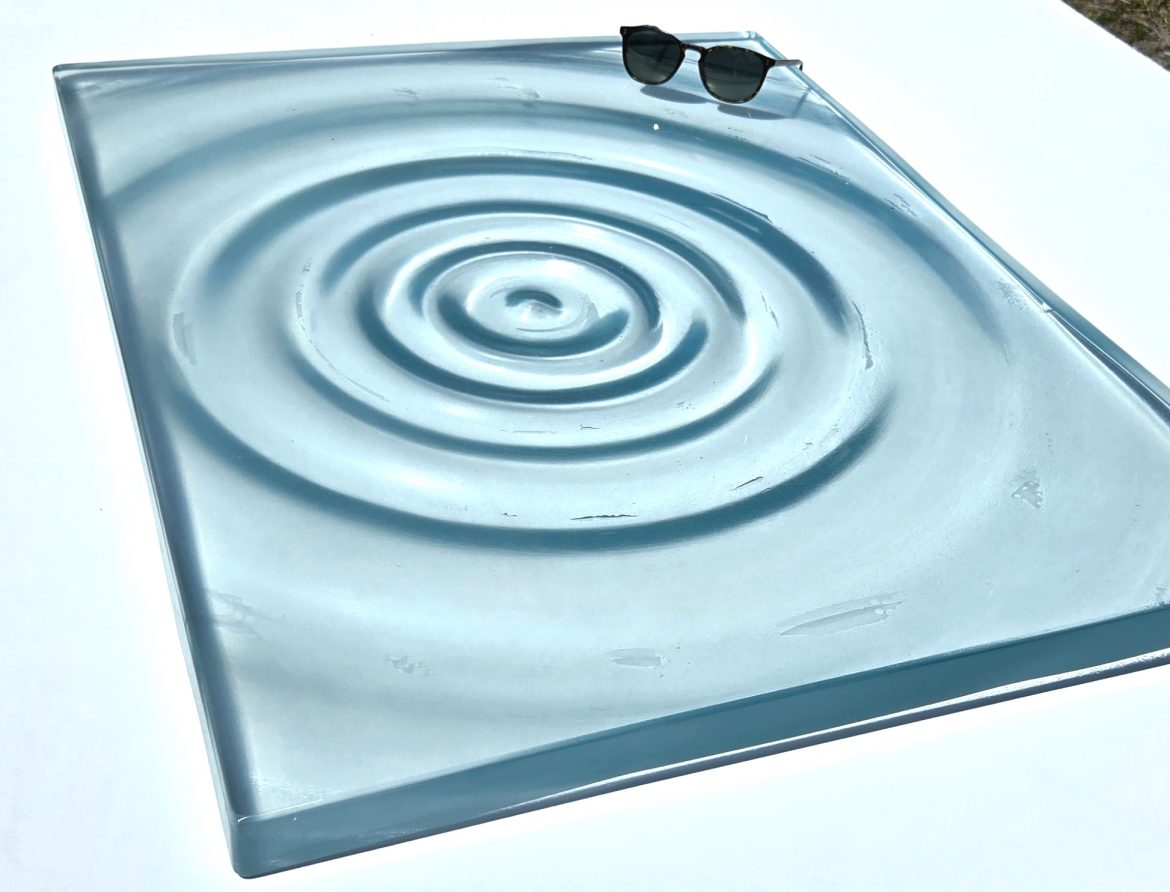
Glass. Lights. Ambiance.
Flat for a decade. Then everything moved. A fabricator’s record of what happened to the price of clear.
Flat glass prices in the United States barely moved from 2006 to 2016. Since then, the federal Producer Price Index for flat glass has climbed roughly 61%, with low-iron glass, the ultra-clear grade every glass bar top starts with, under even more pressure. Here is what happened, why, and what it means for your glass bar top or countertop.
I.The Material Nobody Tracks
Every glass bar top we have ever fired began the same way: a single sheet of half-inch, low-iron glass, so clear it reads as water standing on edge. For twenty years we have bought that sheet, crated it, fired it, and set it into kitchens, bars, and resorts across the country.
And for twenty years, nobody in our industry has talked about what that sheet costs, or what has happened to that cost.
So we will. This page is our running record of the price of glass: what the federal data shows, what the mills have told their customers, and what it means when you commission a surface made of light.
Looking for the short answer on what a glass bar top costs today? Start with our 2026 Glass Countertop Cost Guide. Want to know why it costs that? Keep reading.
II.The Decade Nothing Moved (2006–2016)
The U.S. Bureau of Labor Statistics tracks a Producer Price Index for flat glass manufacturing, the price mills charge at the furnace door. In January 2006, that index stood at 97.0. Five years later, in January 2011, it had actually fallen, to 91.1. By January 2016 it had barely crept back to 100.8.
Ten years. Essentially flat. Glass was one of the most stable materials in construction.
III.The Decade Everything Did (2016–2026)
Then the curve bent upward, and kept bending.
| Window | Change in federal flat glass price index |
|---|---|
| 2006 → 2026 | Up roughly 68% |
| 2011 → 2026 | Up roughly 78% |
| 2016 → 2026 | Up roughly 61% |
| 2021 → 2026 | Up roughly 39% |
The index hit 116.9 in January 2021, 132.0 in January 2022, 151.3 in January 2023, and 162.5 by September 2026. More than a decade of price movement compressed into five years.
Glass went ten years without moving, then packed a generation of inflation into five.
IV.The Letters From the Mills
The index tells you that prices rose. The mills’ own customer letters tell you how.
- June 2022: Guardian Glass announced increases of up to 40% on primary glass products, a one-time jump industry veterans said they had never seen. Vitro followed within weeks with a 40% increase covering clear, tinted, ultra-clear, and tempered float.
- June 2025: Vitro raised prices again, citing raw materials, logistics, electricity, and labor. Its ultra-clear Starphire® and Acuity® low-iron glasses rose 12%; clear float rose 25%.
- Every month since: energy and transportation surcharges, published separately and adjusted monthly, ride on top of the list price.
That last point matters. The price of glass is no longer a number. It is a number plus a moving surcharge.
V.Why Low-Iron Glass Lives on Its Own Curve
Low-iron glass is not window glass with a nicer name. Removing the iron that gives ordinary glass its green edge takes purer sand, tighter furnace control, and dedicated production runs. Half-inch thickness narrows the field further: it is a specialty run, heavy to ship, and expensive to break.
And there is a new buyer at the table: solar. Photovoltaic panels need the same ultra-clear glass we do, and the solar boom has pulled enormous volumes of low-iron production toward energy. Greenhouse builders reported low-iron glass prices nearly doubling as solar demand surged. Architectural buyers, including fabricators like us, now compete with the power grid for the same clarity.
That clarity is the whole point. Every Downing Designs glass bar top starts as low-iron glass because it is the only grade that lets light travel cleanly through a thick slab. You can see it in our St. Petersburg glass bar top: an L-shaped, 1.5-inch hand-textured bar, 118 and 59 inches, floating on cantilevered brackets and lit from within. Ordinary green-edged glass could never glow like that.
Architectural buyers now compete with the power grid for the same clarity.
VI.It’s Not Just Sheet Glass: Enamel Is Glass Too
Our glazed enamel surfaces follow the same curve, because chemically, enamel is glass.
Vitreous enamel begins as frit: glass that is melted once, quenched, and ground into powder. Fired onto a surface, that powder fuses back into a continuous layer of glass. Frit recipes are built on the same backbone as sheet glass (silica, boron, soda, alumina), tuned to melt lower. Pigment brings the color. Glass carries everything else.
That means enamel inherits glass economics. Frit is melted in furnaces running above 1500°C. Industry analysis puts raw materials and energy at roughly 50% to 70% of what a standard glaze costs to make, and European frit producers saw energy costs climb another 11% to 14% in 2025 alone.
Whether we are firing a sheet or a powder, every Downing Designs surface comes out of a furnace, and every furnace runs on the same energy bill.
See where that powdered glass ends up: our glazed lava stone countertops, where vitreous enamel is fired into a surface that takes heat, UV, and sunlight in stride, indoors or out.
VII.What This Means for a Glass Bar Top
When a homeowner asks why a glass bar top or countertop costs what it does, the honest answer starts here: the raw material itself costs meaningfully more than it did ten years ago, and it moves every month. Everything that happens after the sheet arrives (the kiln, the shop, the hands, the install) is built on top of that.
We break those layers down in our companion piece, Where Your Glass Countertop Dollar Goes. For current price ranges, see the 2026 Glass Countertop Cost Guide. And for straight answers on thickness, weight, lighting, and pricing, visit our Glass Countertop FAQ.
VIII.A Living Record
This page is updated every quarter with the latest federal index reading and any new mill announcements. If you are specifying glass for a project and want to understand where the market is heading, this is the page to bookmark.
Want to see what that glass becomes? Browse our finished Projects, explore custom glass countertops, or pull up a chair in the Ambiance Café™ for more stories from the kiln.
IX.Frequently Asked Questions
Why are glass bar tops so expensive?
A glass bar top starts with half-inch low-iron glass, a specialty grade whose price has risen sharply since 2016. On top of the material come freight and crating, days of kiln time and electricity, large studio space, skilled handwork, and installation. The federal flat glass price index alone is up roughly 61% since January 2016.
How much have glass prices increased in the last 10 years?
According to the U.S. Bureau of Labor Statistics Producer Price Index for flat glass manufacturing, prices rose from 100.8 in January 2016 to 162.5 in September 2026, an increase of roughly 61%. The same index was essentially flat from 2006 to 2016.
What is low-iron glass and why does it cost more?
Low-iron glass is ultra-clear float glass with most of the iron removed, eliminating the green tint of ordinary glass. It requires purer raw materials, tighter furnace control, and dedicated production runs. Vitro’s Starphire® and Acuity® are two well-known low-iron brands; both rose 12% in Vitro’s June 2025 price increase.
Why does the solar industry affect glass countertop prices?
Solar panels use the same ultra-clear low-iron glass as glass bar tops and countertops. As solar demand surged, it absorbed large volumes of low-iron production, and some buyers reported low-iron glass prices nearly doubling. Architectural fabricators now compete with the energy industry for the same material.
Is vitreous enamel really glass?
Yes. Vitreous enamel is made from frit, which is glass that has been melted, quenched, and ground into powder. When fired, the frit fuses back into a continuous glass layer. Its chemistry shares the same silica-based backbone as sheet glass, which is why enamel prices track the same energy and raw material pressures.
Will glass countertop prices go down?
The federal flat glass price index has not shown a sustained decline since 2016, and mills now add monthly energy and transportation surcharges on top of list prices. Downing Designs updates this page every quarter with the latest index readings and mill announcements.
How often is this glass price history updated?
Every quarter. Each update adds the newest Bureau of Labor Statistics flat glass index reading and any new price announcements from major glass mills such as Vitro and Guardian.
X.Glossary
- Low-iron glass
- Ultra-clear float glass with reduced iron content, removing the green edge tint of standard glass. The base material of every Downing Designs glass bar top.
- Starphire®
- Vitro Architectural Glass’s brand of ultra-clear low-iron glass, formerly produced by PPG.
- Producer Price Index (PPI)
- A U.S. Bureau of Labor Statistics measure of the prices domestic producers receive for their output, tracked monthly by industry.
- Frit
- Glass that has been melted, rapidly cooled, and ground into powder; the raw material of vitreous enamel and many glazes.
- Vitreous enamel
- A coating made by firing frit onto a surface until it fuses into a continuous layer of glass.
- Surcharge
- A separate fee glass mills add on top of list price for energy and transportation, adjusted monthly.
XI.Selected Sources
- U.S. Bureau of Labor Statistics via FRED: Producer Price Index, Flat Glass Manufacturing
- Glass Canada: Guardian announces unprecedented price increase (2022)
- Glass Canada: Glass suppliers announce sharp price increases (2022)
- DWM Magazine: Glass prices face multilayered pressures (2025)
- EQ Mag: Glass prices and solar demand
- U.S. Patent 2,753,271: Vitreous enamels and enameling processes
- Intel Market Research: Ceramic frit market
- Staticker: Ceramic frit energy costs, 2025
Glass. Lights. Ambiance.
Begin a Commission
We don’t have office hours. We have phones.

Jeff Downing
Founder, Lead Designer & Custom Glass Countertop Expert
Jeff Downing of Downing Designs, is a Tampa Florida–based design studio specializing in custom Glass Countertops, Glass Bar Tops, Glass Vanity tops and Glass Stair Treads. With decades of hands-on experience, Jeff is widely recognized for delivering textured glass surfaces integrated with LED lighting to create dazzling abstract statement pieces.
"Glass. Lights. Ambiance".