
Last updated on June 17th, 2026 at 05:32 am
The bar is not mere furniture.
Any superyacht interior designer worth their fee will tell you this. The bar on a Superyacht is the room’s center of gravity — the surface everything else in the salon orbits around, the object that tells guests, the moment they step aboard, what kind of evening this vessel intends to create. Marble says old money and quiet rooms. Teak says the sea got here first. Backlit stone says someone cared enough to make light part of the architecture.
And illuminated textured glass says something none of the others can: that the light itself was made by hand, in a kiln, at temperature — that the surface you are resting your champagne flute on was shaped by heat and time and somebody who understood both.
That is a different conversation entirely.
The Statement Bar
Where Superyacht Bar Design Is Heading
For the past decade, the trajectory of superyacht interior design has been moving steadily away from generic luxury toward what the industry calls signature materiality — the use of surfaces so specific, so distinctive, so tied to a particular owner’s vision, that the bar or the salon or the sky lounge becomes the photograph everyone takes and nobody forgets.
Boat International’s coverage of the 2025 design season noted it directly: backlit blue agate panels, lilac amethyst and honey onyx bar tops, Murano glass installations rising thirty feet through spiral staircases. The Lürssen superyacht Solandge specified an onyx bar finished with ornate stonework and rose-crystal chandeliers. A 112-metre charter vessel installed a speakeasy-style lounge built around backlit onyx and a cognac collection personally curated by the owner. The pattern is consistent across the fleet: the bar is where owners and designers make their most personal statement, and that statement increasingly involves light passing through a material rather than reflecting off one.
Backlit onyx is beautiful, legible as luxury, and photographs magnificently. But it is also brittle, heavy for its visual weight, limited in color range, and entirely at the mercy of its geological source. No two slabs ever match. Designers who have worked with it know the constraint: you specify it, you accept what nature gives you, and you hope the veining cooperates.
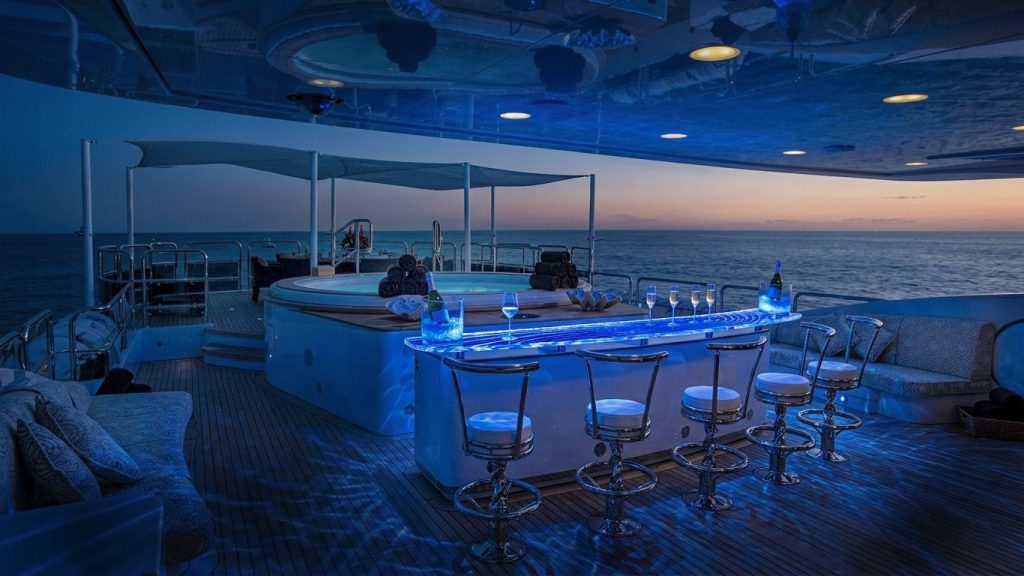
A heat-strengthened glass bar does not have this problem. Fabricated in a programmable lift-top kiln with the surface shaped by heat and texture built into the substrate by hand before firing, it offers everything backlit onyx offers aesthetically and removes every one of its practical limitations. Color is controllable to specification. Weight can be engineered to marine requirements. Surface texture — from deep oceanic turbulence to long horizontal wave forms to fine-ground matte — is designed, not accepted. And LED integration is native: the glass is fabricated for the light source, not retrofitted around it.
This is where the conversation is moving. The designers who are ahead of it are already specifying it. The owners who have seen it in person do not ask what it is — they ask who made it and how quickly it can be on their boat.
The Technical Case
Why Glass Bar Tops Works on a Superyacht
Every material that works on land requires a second evaluation before it belongs on a luxury yacht vessel. The marine environment is not merely outdoor — it is an environment in constant motion, subject to vibration, humidity, salt air, thermal cycling, and the structural dynamics of a hull that is never entirely still. Surfaces that succeed are the ones designed to move with the environment rather than resist it.
Kiln-formed glass meets this standard in ways that comparable luxury surface materials do not.
Weight
The best superyacht bar designer’s are constantly negotiating is between visual mass and actual mass. Every pound above the waterline affects stability. Kiln-formed glass can be fabricated in the ¾” to 1½” range with structural integrity appropriate to bar top application — lighter than solid stone alternatives while carrying greater visual depth. LED illumination from beneath creates the perception of far greater mass than the material actually carries. The bar reads as substantial. The hull does not know the difference.
Surface Behavior
The textured surface of kiln-formed glass — whether wave-formed, hand-tooled, or organically fired — catches and redistributes ambient light as the vessel moves. This is not a flaw; it is the feature. A polished flat surface on a moving boat produces glare and visual choppiness. A textured glass surface on a moving boat produces something closer to the surface of water itself — restless, alive, never twice the same. The material and the environment become collaborators.
LED Integration
Dot-less LED strip technology, specified correctly and installed along the bar’s lower substrate, distributes light without hotspots across the full run of the surface. Color temperature and intensity are programmable — meaning the salon that hosts a formal dinner at 7pm and a late-night cocktail hour at midnight is lit by the same surface, reading entirely differently in each context. The bar participates in the room’s transformation rather than simply occupying it.
Fabrication Precision
Unlike natural stone, kiln-formed glass is fabricated to specification. Radius, dimension, edge profile, color, texture density, and LED compatibility are designed before a single piece enters the kiln. For superyacht interiors where millimeter-level precision is required to meet joinery tolerances, this matters enormously. The fabricator and the yacht interior designer are working from the same drawing. The glass arrives ready to install.
Fort Lauderdale · Miami · West Palm Beach
The World’s Most Important Refit Corridor
This is not a theoretical market.
Fort Lauderdale is the Yachting Capital of the World — not a marketing claim, a documented economic reality. The marine industry generates $9.7 billion in annual economic impact in Broward County alone. More than 2,000 superyachts transit the city’s waters every year, pausing en route to the Caribbean or repositioning for the Mediterranean season. The Fort Lauderdale International Boat Show — FLIBS — is the largest in-water boat show on earth: 1,300 vessels, 100,000 attendees, 52 countries represented. At FLIBS 2025, 44 refit projects debuted alongside 24 new builds, and 150 yachts were listed for sale at a combined value of $1.9 billion. The world’s largest yacht builders are taking notice — Lürssen opened a dedicated Fort Lauderdale office in 2025 to service American fleet owners directly.
South of Fort Lauderdale, Miami’s concentration of ultra-high-net-worth wealth — Latin American, European, domestic — drives a parallel market: owners who keep their vessels close, who entertain aboard frequently, and who treat the yacht’s interior as a direct extension of how they present themselves to the world. West Palm Beach and Jupiter to the north have become increasingly important as second-home concentrations drive marina expansion and bring a class of owner who views a yacht refit the way they view a residential renovation: as an expression of identity, timed to ownership change or simply to the recognition that the current interior no longer reflects who they’ve become.
The most common trigger is a change of ownership — a new buyer who wants the vessel to feel like theirs from the moment guests step aboard. The second most common trigger is simpler: time has passed, the interior has aged, and the owner has not. A bar top that was bold in 2017 is unremarkable in 2025. The question is what replaces it.
For the yacht interior designer or refit project manager working in this corridor, the answer is increasingly custom fabrication — bespoke surfaces that cannot be purchased from a catalog, cannot be replicated by a competitor’s vessel, and cannot be forgotten by a guest. Backlit onyx has been that answer for a generation. Illuminated kiln-formed glass is what comes next — domestic, customizable, fabricated to marine specification, and made ninety minutes up the coast from the world’s largest refit yard.
What the Right Glass Bar Top Surface Does to an Evening
The vessel is moored somewhere between Miami and the islands. The guests have been aboard since late afternoon — cocktails on the sun deck as the city’s skyline went amber, then gold, then disappeared. Now they have moved below, and the salon is doing what a well-designed salon always does: it is holding the evening.
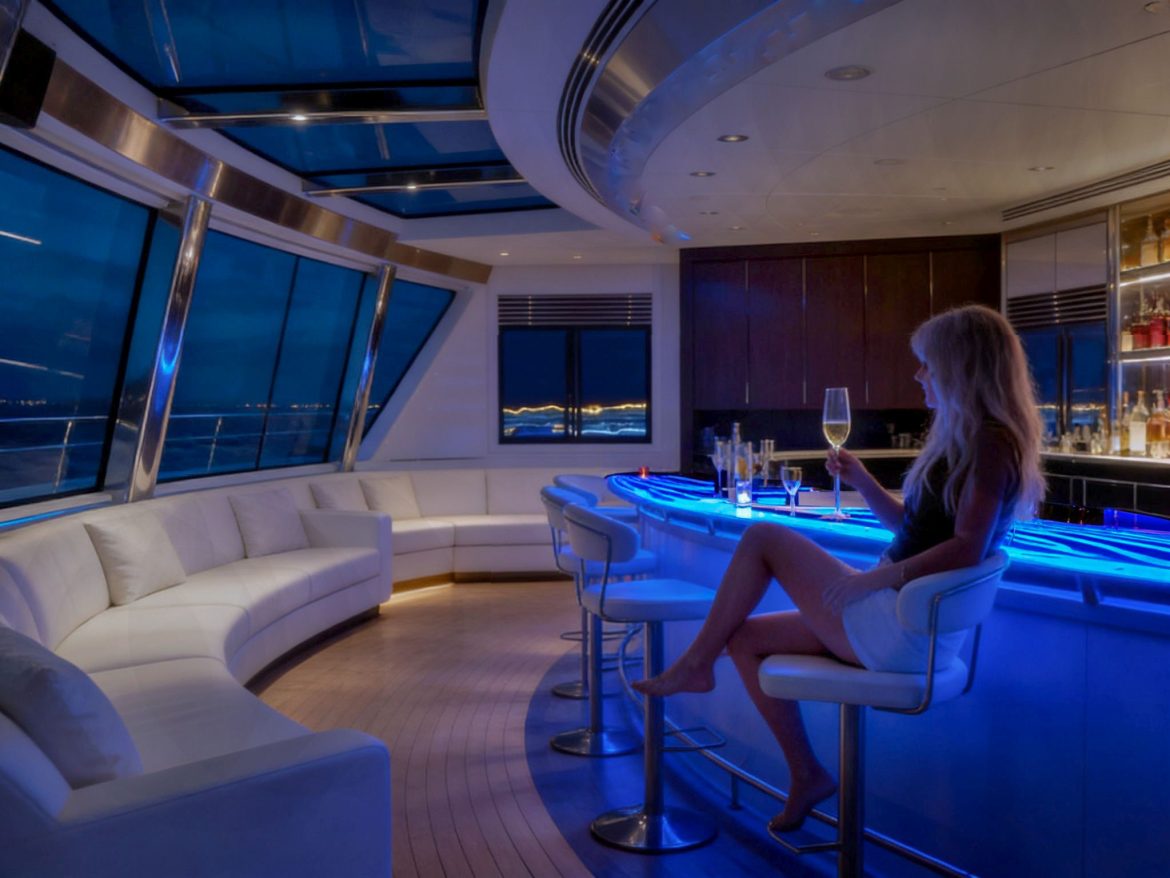
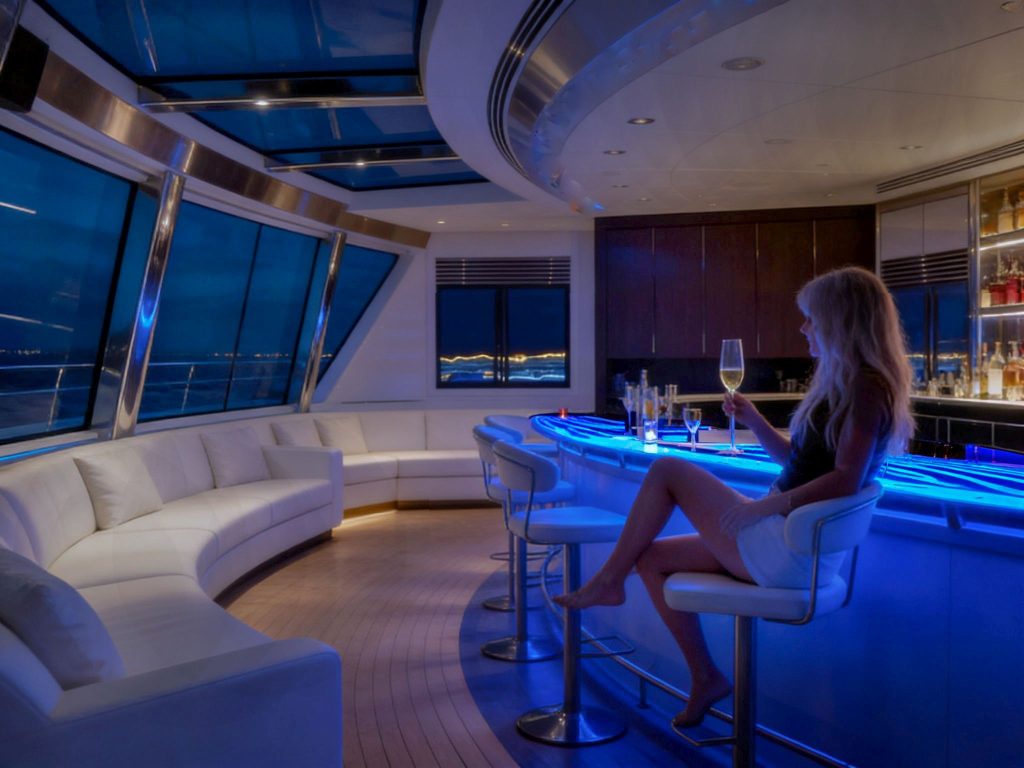
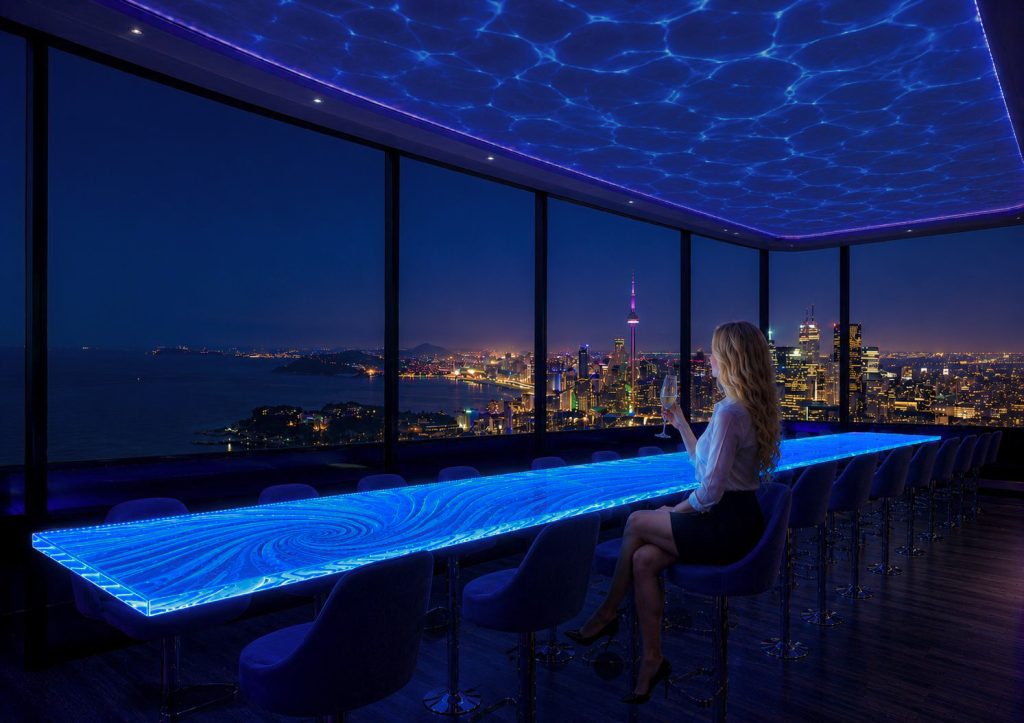
The bar runs the full length of the port side. Kiln-formed glass, aquamarine, textured in long horizontal forms that echo the water outside the panoramic windows. Illuminated from beneath with dot-less LED at a color temperature tuned to match the hour — neither the cold blue of a nightclub nor the warm amber of a dining room, but something in between, something that belongs specifically to a vessel at anchor after dark. The surface carries the light the way water carries light: not uniformly, not mechanically, but with a kind of breathing quality that changes as you move around it.
Nobody is looking at the bar. Everyone is in it.
The owner knew this was the moment that would define the refit. Not the engineered teak decking, not the new HVAC, not the master suite renovation — though all of those were necessary and all of them were done. The bar was where the vessel would declare itself. It took four weeks from design confirmation to delivery. It arrived in one piece from a studio in Tampa, Florida. It was installed by a crew of two in a single day.
That night, a guest asked the captain what the top was made of.
He went back to his drink.
So did she.
For the Designers, Architects & Refit Managers
Frequently Asked Questions
What is the best surface material for a superyacht bar top?
The most specified luxury bar surface on superyachts has historically been backlit natural stone — onyx, agate, and similar translucent minerals. These materials transmit light beautifully and photograph with authority. Their limitations are geological: color and veining are unpredictable, slabs rarely match, and the material is brittle under the vibration loads of a working vessel. Kiln-formed glass resolves each of these constraints. Color, texture, and dimension are designed to specification. The surface is fabricated for LED integration rather than retrofitted around it. And unlike natural stone, kiln-formed glass can be produced in radii, curves, and custom profiles that match the organic geometry of modern superyacht salon design.
Who makes custom illuminated glass bar tops for yacht interiors in Florida?
Downing Designs, based in Tampa, Florida, fabricates custom illuminated kiln-formed glass bar tops for residential, hospitality, and marine applications. The studio has operated for 25 years with a 10,000-square-foot production facility, a large-format programmable lift-top kiln, and direct experience delivering finished glass surfaces to installation environments with precise dimensional and weight requirements. The studio works directly with interior designers and project managers from design confirmation through delivery and installation coordination.
What glass surfaces work best in a superyacht salon refit?
Kiln-formed glass is well-suited to superyacht salon refit applications for several reasons. The textured surface diffuses LED illumination without hotspots — a critical advantage in a marine environment where vessel motion would create visual choppiness in a polished flat surface. The material can be fabricated to radii that match curved bar fronts and custom millwork. Weight can be specified in the ¾” to 1½” range to meet stability requirements. Lengths up to 126″ in one piece.
How much does a custom glass bar top cost for a yacht?
Custom kiln-formed illuminated glass bar tops for superyacht and marine applications are priced based on dimensions, thickness, edge profile, texture specification, and LED integration requirements. The fabrication process — hand-texturing, kiln-firing, grinding, and polishing — is a skilled-labor intensive process comparable to custom stone fabrication at the high end of the market. Downing Designs works from a detailed design brief to provide accurate fabrication pricing before project commitment. The appropriate starting point is a direct conversation with the studio.
What fabricators work with yacht interior designers in Florida?
The Fort Lauderdale and Miami refit corridor is served by a substantial vendor ecosystem, but custom surface fabrication — particularly illuminated glass — remains underserved by domestic producers. Most backlit glass and stone surfaces specified in superyacht interiors are sourced from European fabricators, with the attendant lead times, freight costs, and coordination complexity that implies. Downing Designs operates ninety minutes from Lauderdale Marine Center, one of the largest refit facilities in the United States, and can coordinate directly with shipyard timelines, captain schedules, and installation windows in a way that a European supplier cannot.
The vessels are already here. They fill the marinas from Palm Beach to Miami, they arrive at FLIBS every October with interiors that need updating and owners who know it. The refit cycle is not theoretical — it is a calendar event.
When that recognition arrives, the next question is who builds the new one.
Downing Designs. Tampa, Florida.
Custom kiln-formed illuminated glass surfaces for superyacht interiors, residential, and hospitality applications. Fabricated by hand since 2000.
Yacht interior designers and refit project managers: we work directly with your timeline and your yard.

Jeff Downing
Founder, Lead Designer & Custom Glass Countertop Expert
Jeff Downing of Downing Designs, is a Tampa Florida–based design studio specializing in custom Glass Countertops, Glass Bar Tops, Glass Vanity tops and Glass Stair Treads. With decades of hands-on experience, Jeff is widely recognized for delivering textured glass surfaces integrated with LED lighting to create dazzling abstract statement pieces.
"Glass. Lights. Ambiance".