
Last updated on July 1st, 2026 at 05:53 am
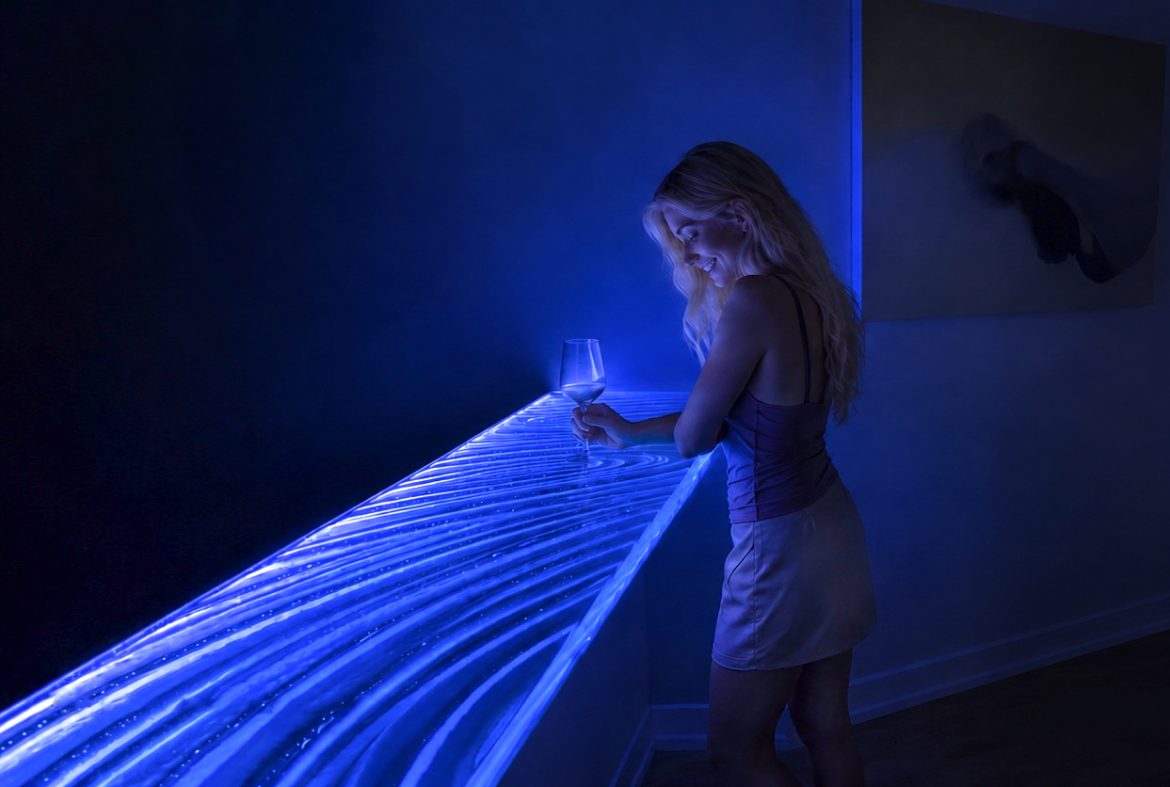
There is a moment that happens at every installation. The LED strips power on. The room dims slightly, the way rooms do when the eye recalibrates. And the bar top — which minutes ago was a slab of glass resting on brackets — becomes something else entirely. It becomes a plane of light suspended in air, with nothing beneath it but a faint amber glow bleeding down toward the floor.
That effect has a name in architecture: the cantilever. And in kiln-formed glass, it is one of the most demanding things you can ask a material to do — and one of the most rewarding things a room can contain.
This is a working guide. It covers overhang limits, bracket placement, the knee-clearance math that most designers skip, and why a raised bar top with no visible support hardware on its surface is not a trick of the eye. It is engineering made invisible on purpose. For a Downing Designs glass high bar 126″ x 20″ x 1.5″ textured glass piece that weighs 380lbs…cantilevered over and supported by 2 small brackets…no small feat indeed.
Why long glass bars and the cantilevers belong together
Stone cantilevers beautifully but occludes the light source entirely. Wood cantilevers but doesn’t transmit — the LED channel underneath becomes a glow trapped in a cabinet. Concrete can float, but it will never be translucent.
Kiln-formed low-iron glass does something no other material does at a bar-top scale: it carries the load and transmits the light. The overhang is not dead space above the floor. It is a light emitter. Every inch you extend the bar past its last support point is another inch of illuminated glass hovering in the room.
That is not an accident of the material. It is the design intent. The Ambiance Machine™ concept — the philosophy that drives every Downing Designs installation — depends on it. You are not building a bar. You are building a light source that people rest their arms on.
The number most designers get wrong: overhang depth
The standard rule for raised bar seating is a 10 to 12 inch overhang measured from the face of the island cabinet to the far edge of the glass. This is not arbitrary. It is human geometry.
At 42 inches AFF — the nominal height for bar seating — a 10 to 12 inch overhang creates adequate knee and thigh clearance for the full range of adult body proportions, including taller users in the 95th percentile. Go shorter than 10 inches and taller guests are perching rather than sitting. Go longer without additional engineering and you are moving load distribution into territory that requires calculation, not intuition.
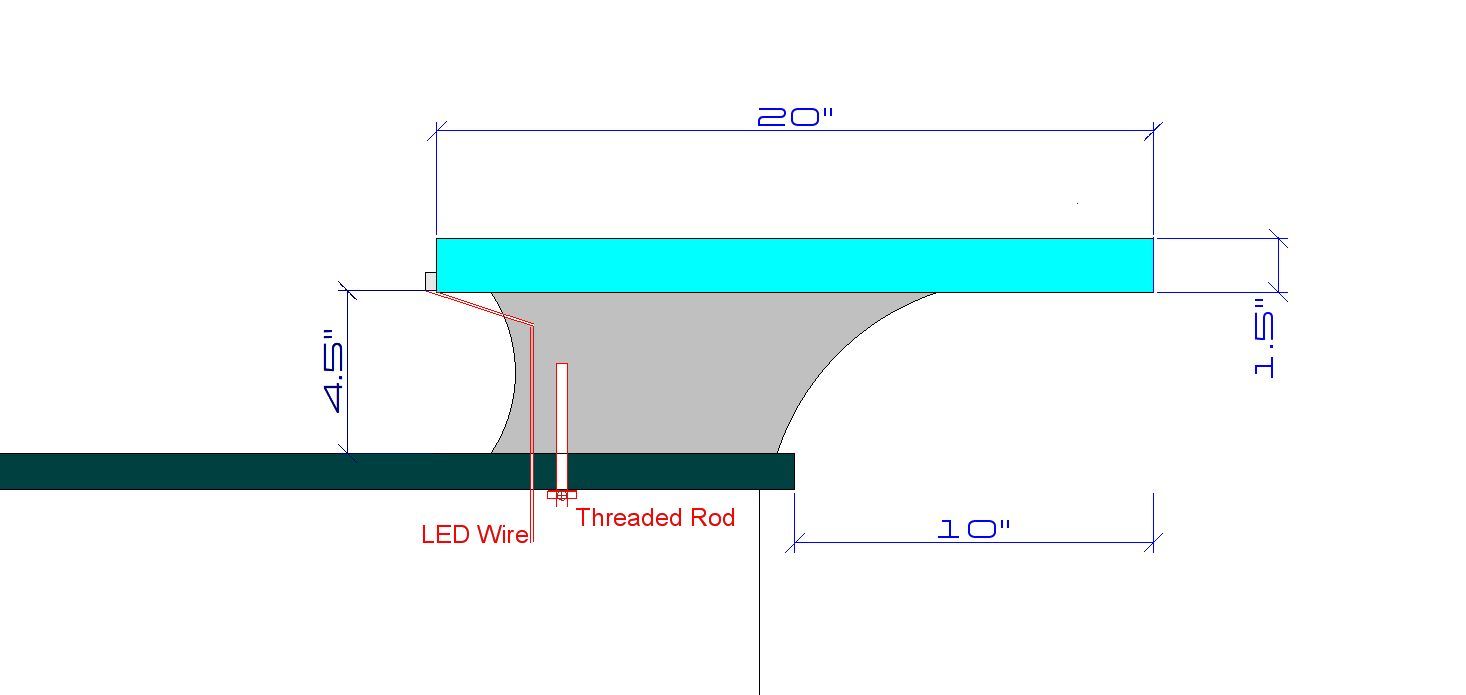
High Bar Top Overhang diagram
What shortens that window fast: drop edge profiles. A 5-inch drop edge on a 12-inch overhang leaves approximately 7 inches of functional clearance — roughly the depth of a standard dinner plate. Standard bar stools with arms will not fit. Custom chairs will be specified and then returned.
We have repaired exactly this mistake: a designer chose a dramatic vertical drop edge for visual weight, the stools couldn’t clear the profile, and the entire bar top was deconstructed and refabricated. The replacement used a 2-inch lens-polished profile. The room looked better. The physics had been respected.
10 to 12 inches of overhang. 42 inches AFF. Drop edge profile no greater than 2 inches unless seating geometry has been explicitly verified. These three numbers prevent the majority of cantilevered bar top failures we are called to repair.
Going further: engineering the deep cantilever
Ten to twelve inches is the comfort zone for a standard bracket configuration. It is not the limit.
On our St. Petersburg Project installation — an L-shaped raised bar top in 1.5-inch hand-textured low-iron glass, running 118 inches on the long leg and 59 inches on the return — the geometry required cantilevered brackets at 42 inches AFF with four attachment points. Each bracket was positioned using a laser level, sequenced across the underside of the glass to distribute torque evenly across both legs of the L. The crane lift for the primary segment was a one-shot operation: no second chance to adjust once the glass was in the air.
The result carries the load with no visible hardware on the surface and no compression pucks interrupting the plane of the glass.
That last point matters more than it might seem.
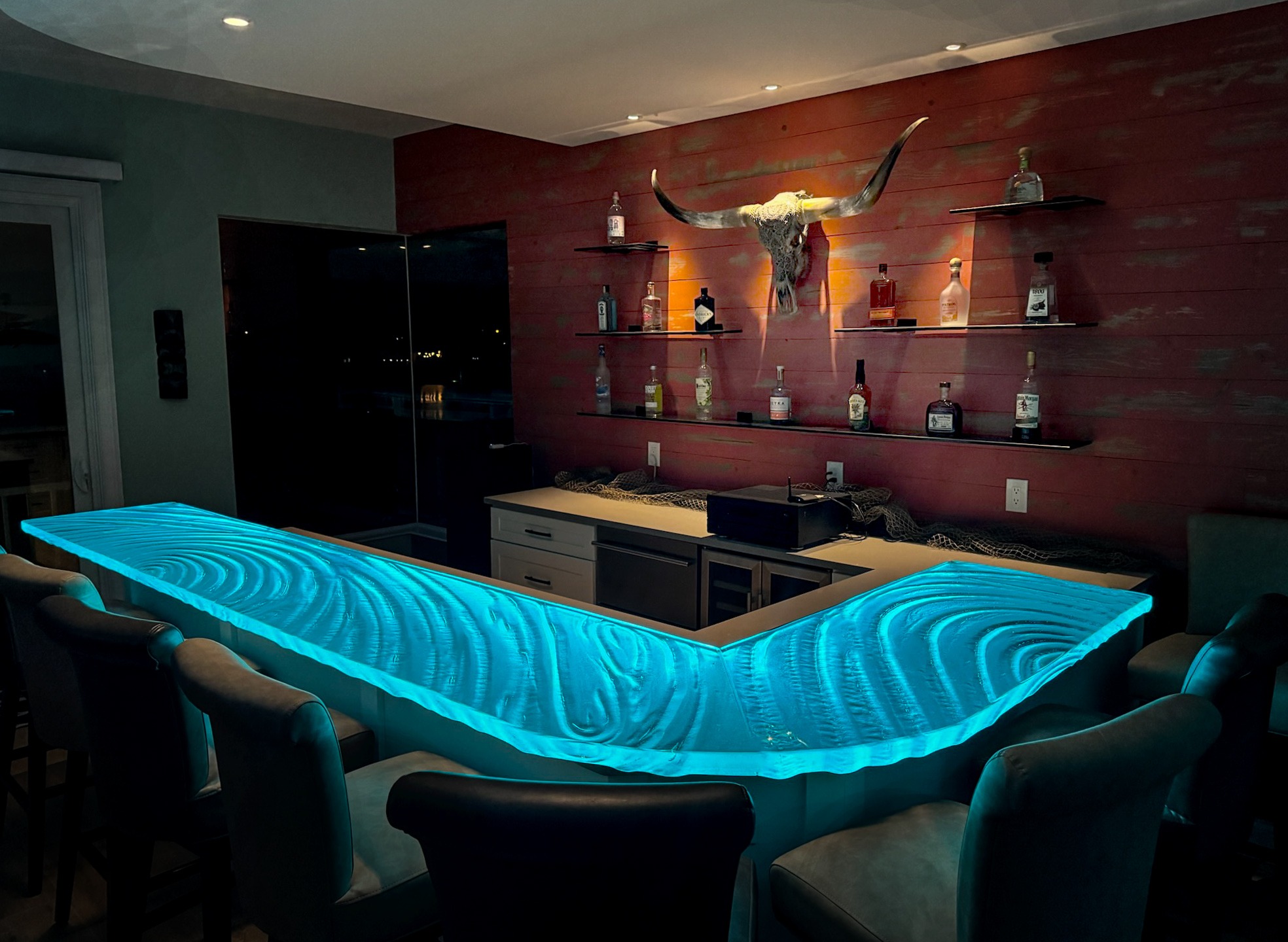
st petersburg waterfront home illuminated glass bar top cyan led
On compression pucks: a short argument against them
The compression puck — a cylindrical fastener that passes through a drilled hole in the bar top and bears the load downward — works mechanically. It is also the wrong answer for a cantilevered glass bar top, for three reasons.
The surface
A flat plane of custom kiln-formed glass with a compression puck sitting on it is a flat plane with an obstacle. Every glass, plate, cocktail shaker, and forearm must navigate around it. Imagine specifying a Carrara marble countertop and driving bolts through it at regular intervals to support the overhang. The marble would still be beautiful. The bolts would be all you see.
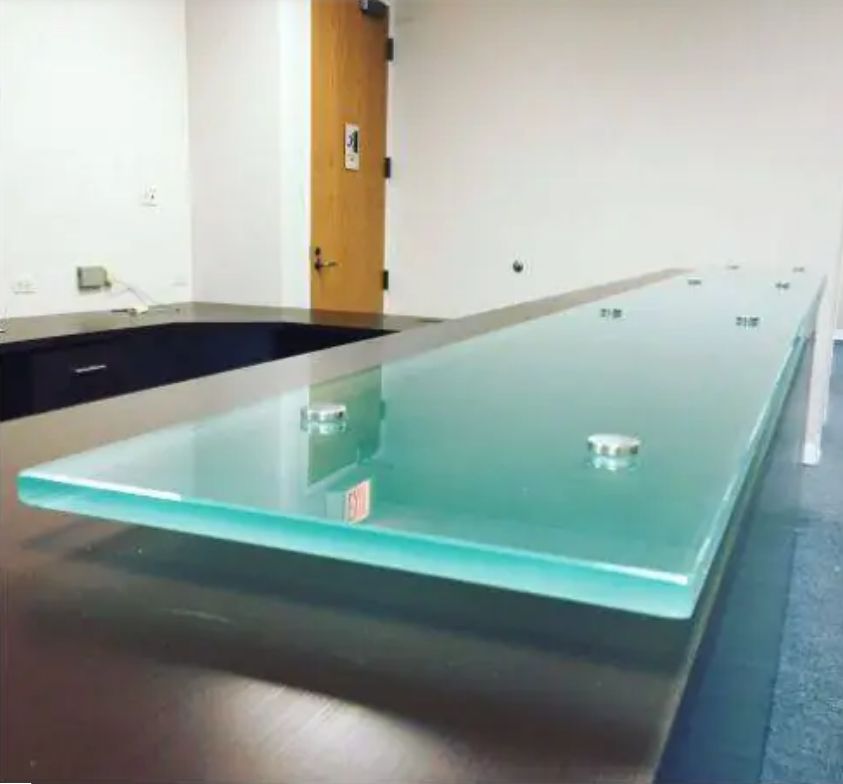
bad countertop puck fasteners
The stress point
In a cantilevered configuration, the drill hole required for a through-puck sits in a section of glass that experiences the highest torque loading during an impact event — a slip, a fall against the bar edge, a lateral force from a crowd. These events concentrate stress at exactly the point where the material has been compromised. Our bracket systems anchor to the underside of the glass and to the island structure, eliminating the penetration entirely.
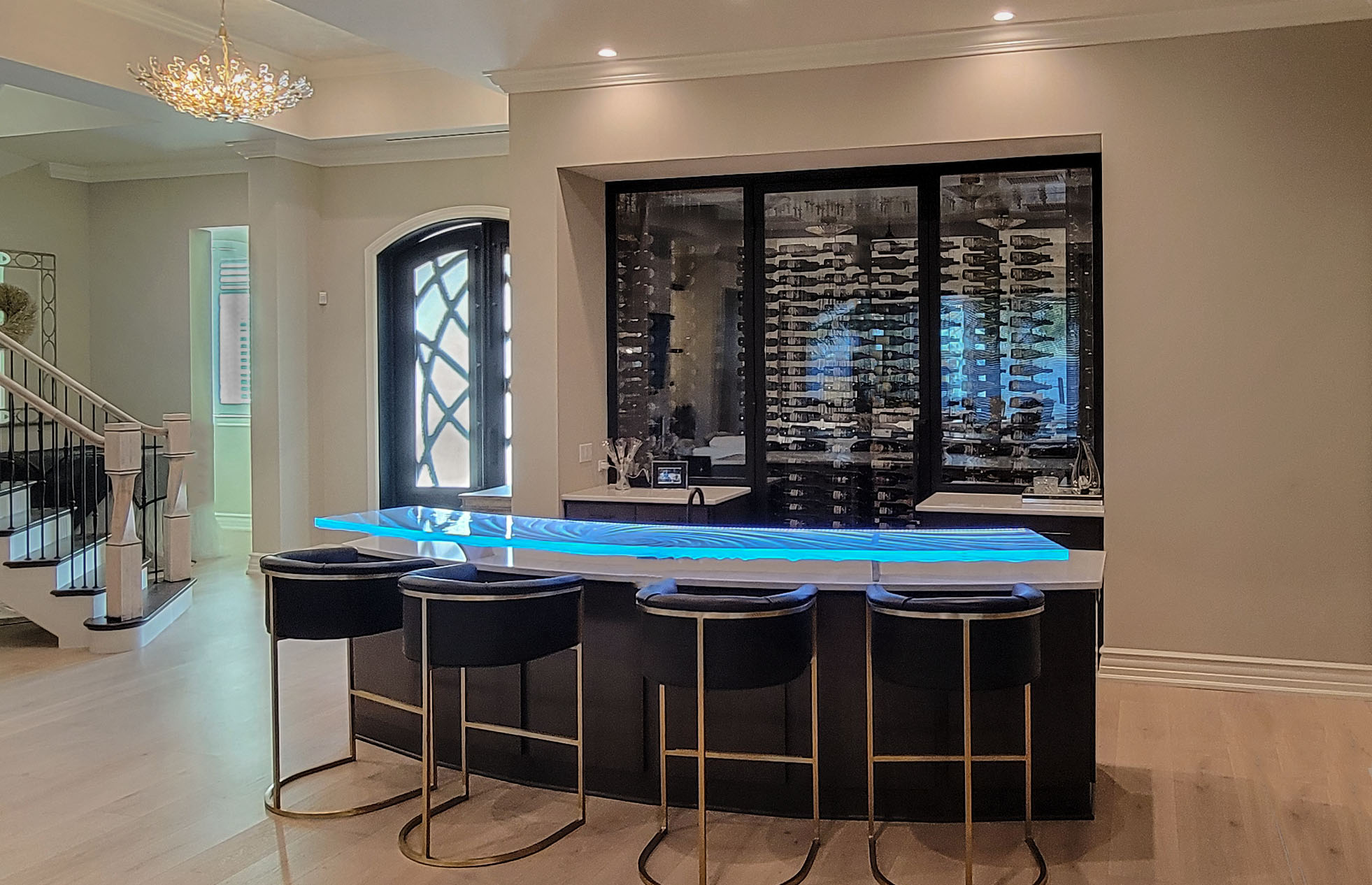
Naples Florida Custom Glass Bar Top with LEDs 125″ x 20″ x 1.5″ thickness
The light
A compression puck sitting on the glass surface creates a shadow in the LED backlight. You have gone to the trouble of engineering a light-transmitting cantilever, and you have placed opaque hardware on the emitting surface. It is the visual equivalent of leaving a price tag on a painting. For more bad”support engineering” see here.
Support geometry: the minimum viable bracket count
- Straight bar run: Two brackets carry a 10 to 12 inch overhang on standard 1.5-inch glass. Three brackets are strongly preferred for any run over 72 inches — the additional point eliminates flex at midspan and becomes critical on low-iron glass, which has a slightly lower modulus than standard float.
- L-shaped configuration: Minimum three brackets. The corner joint requires a bracket within 12 inches of each side of the miter. The torque at an unsupported corner under dynamic loading is not theoretical. We design for it.
- Bracket placement is a laser-level operation, not a tape-measure operation. Even a two-degree tilt creates a stress concentration at the contact point. On a 1.5-inch slab, that concentration is invisible until it isn’t. The St. Petersburg installation required a full day of bracket sequencing before a single piece of glass was lifted.
The Ambiance Machine™ lives in the cantilever zone
There is a detail that matters most at 9:30 in the evening, when the overhead lights have come down and the kitchen is running on the glow from the bar.
The cantilever zone — the portion of the glass that extends past the last support point — is the only section of the bar top with an unobstructed view from below. The island cabinet blocks the LED channel on the supported section. The overhang does not have that obstruction. The light comes straight down, grazes the floor, and fills the space between the barstool and the cabinet face with a column of colored or white light that is not coming from the ceiling.
This is not incidental. This is the point.
When we specify bracket placement, one constraint is preserving the LED channel run through the full depth of the cantilever. The bracket cannot interrupt the channel. The channel cannot terminate before the edge of the glass. The light must reach the tip, or the tip goes dark — and the floating effect collapses into a bar top that simply doesn’t have a base.
The Ambiance Machine™ is not a feature. It is the reason the cantilever exists.
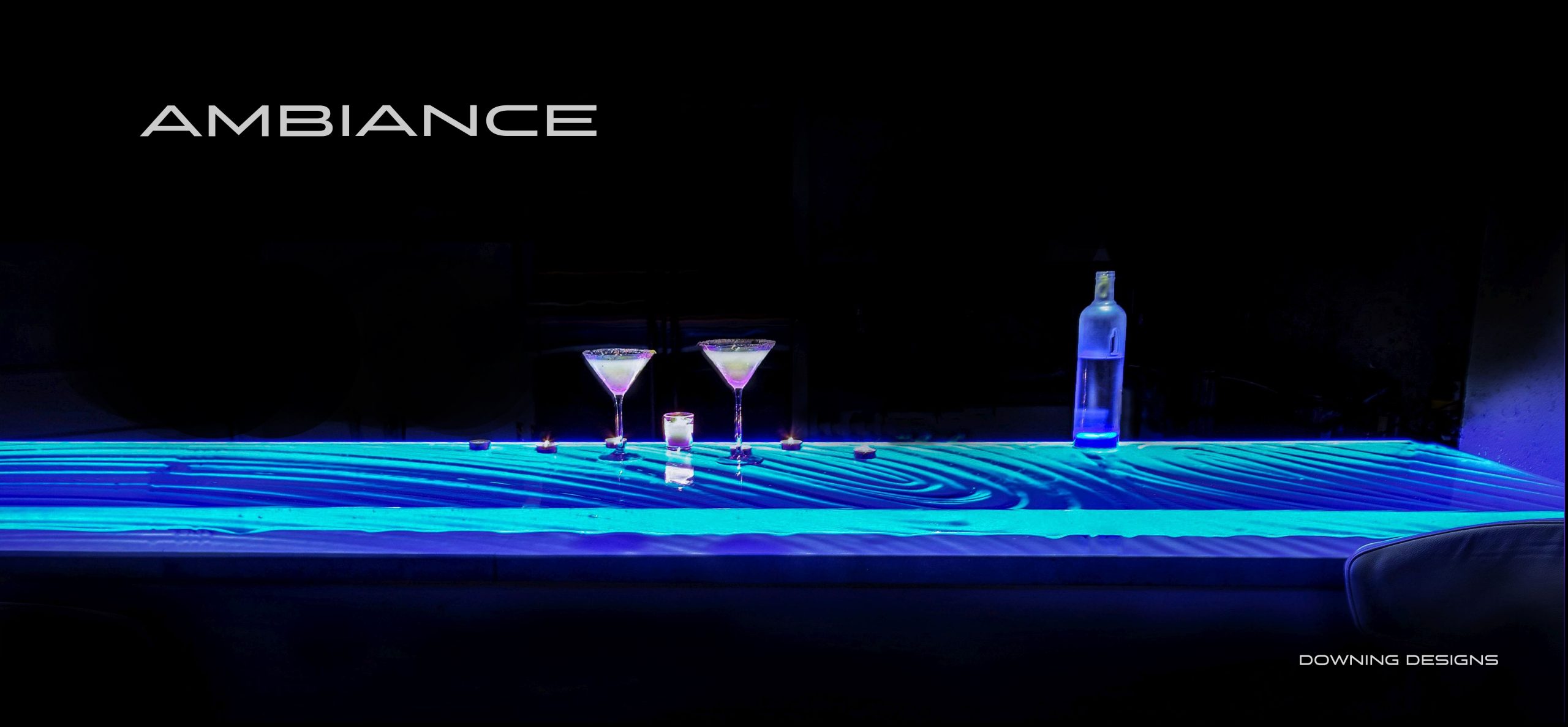
Glass Bar Top with LED Ambiance Machine in Tampa, Florida Downing Designs
Accessibility: the overlooked dividend of the deep overhang
A cantilevered bar top with a 12-inch or greater overhang and a clear underside creates wheelchair-accessible bar seating without modification. No adaptive hardware. No designated accessible section that reads as an afterthought. The knee clearance that makes the overhang comfortable for tall standing guests is the same clearance that brings a power wheelchair to the bar.
On longer custom runs — we have engineered cantilevers up to 37 inches from the last support point — this clearance becomes architectural. The glass is not just floating. It is floating high enough, and far enough, that the space beneath it is genuinely useful.
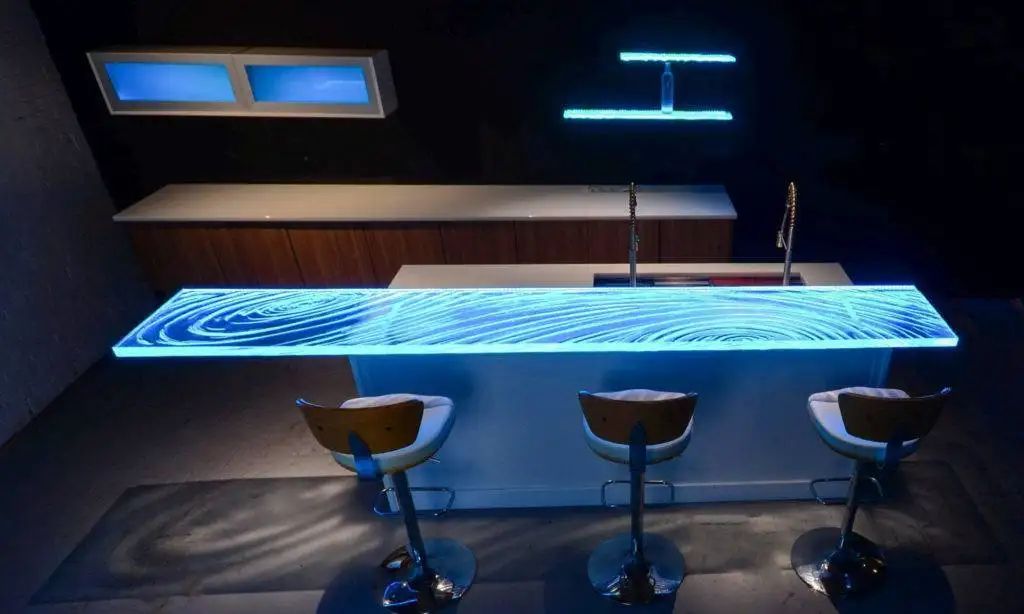
126″ x 20″ x 1.5″ Glass High Bar with 37″ cantilever suppoted by 2 brackets
Glass Bar Top installation notes for architects and designers
- Faucet conflicts. If the bar top runs over a sink, the faucet position often needs to migrate away from the rear edge before templating. We resolve this at the template visit, not after fabrication.
- Annealing on 1.5-inch glass. Full-fuse kiln-formed glass at 1.5 inches requires a controlled cooling schedule through the annealing range to eliminate residual stress. Skipping or shortening the anneal on large-format pieces — anything over 60 inches — creates a bar top that tests fine and fails at 18 months. The firing schedule is not negotiable.
- Template before you finalize the bracket spec. Bracket locations go on the template, not on a drawing. Walls are not plumb. Islands are not square. The only accurate template is a physical one.
FAQ: Cantilevered glass bar tops
How far can a cantilevered glass bar top safely overhang?
For standard 1.5-inch kiln-formed glass at 42 inches AFF, a 10 to 12 inch overhang is the design target for comfort and structural simplicity. With engineered bracket placement and additional support points, overhangs of 24 to 37 inches are achievable. Every installation beyond 12 inches should be evaluated case by case; the variables are glass thickness, run length, bracket count, and anticipated loading conditions.
What causes most cantilevered glass bar top failures?
Inadequate strength of the bar top matrix. Brackets installed without laser leveling (creating point stress rather than distributed bearing), and drop edge profiles that conflict with seating geometry — causing users to exert lateral force on the overhang rather than resting normally. Drilled penetrations in high-torque sections are a secondary failure mode.
Is 1.5-inch glass necessary, or can I use thinner stock?
Thinner glass — 3/8 inch or 1/2 inch — is appropriate for supported countertops with minimal overhang. For a cantilevered raised bar top with 10 to 12 inches of unsupported extension, 1.5 inches provides the stiffness and visual weight the application requires. It also carries the LED backlight more evenly; thinner glass tends to hot-spot near the source.
Can I put a sink behind a cantilevered glass bar top?
Yes, with planning. The drain location, faucet position, and any undermount hardware must be resolved before templating. Cutouts in the cantilever zone are possible but increase the complexity of the bracket engineering. We avoid penetrations in the high-torque section immediately adjacent to the last support bracket.
How does LED integration work in a cantilevered bar top?
The LED channel runs along the back edge.
If you look at our prior drawing, you will see that the LED wire is cleverly hidden insie the bracket itself. A pre-drilled channel guides the wire from the back of the glass through a hole in the island contertop to wher it is hooked up to the Ambaince Machine controller.
What is the standard height for a raised bar top?
42 inches above finished floor, plus or minus one inch, is the industry standard for raised bar seating. This accommodates standard 28 to 30 inch counter-height stools. Deviating more than an inch in either direction typically requires custom stool specification to maintain ergonomic clearance.
Does a cantilevered glass bar top require a building permit?
In most residential jurisdictions, a bar top is finish work and does not trigger permit requirements. Commercial installations — hospitality, restaurant, retail — may require structural documentation depending on the jurisdiction and load rating of the surface being specified. We can provide installation documentation for permit submittals on commercial projects.
How do I care for a kiln-formed glass bar top?
Standard glass cleaner and a microfiber cloth for daily maintenance. Avoid abrasive pads on the polished surface. LED components are sealed at installation and require no routine service.
What does a custom cantilevered glass bar top cost?
Projects begin in the range of several thousand dollars for a straightforward straight-run bar top and scale with size, configuration, glass complexity, and installation logistics. L-shaped configurations, large-format pieces, and installations requiring crane service carry additional fabrication and installation cost. We provide fixed-price quotes after an in-person or virtual template consultation.
Where does Downing Designs install?
We fabricate in our Tampa studio and install throughout USA…especially Florida — Miami, Naples, Jupiter, St. Petersburg, Orlando, Jacksonville — as well as internationally. We have completed installations in the Caribbean accessible only by private boat transfer. If the project is right, geography is a variable, not a constraint.
The geometry of light
A bar top that cantilevers 12 inches past its last support is not showing off. It is doing the work the Ambiance Machine™ requires: creating a zone of illuminated glass that floats above the floor with nothing beneath it but light.
The engineering that makes that possible — the bracket placement, the annealing schedule, the LED channel running to the tip — is invisible by design. The room should feel effortless. The work that produced it is not.
If you are designing a kitchen, a home bar, or a hospitality environment in Florida or beyond and you are ready to stop thinking about bar tops as surfaces and start thinking about them as the primary light source in the room, the conversation starts here.
Start the conversation
Jeff Downing • Downing Designs • Tampa, Florida
(813) 784-5211 • [email protected] • DowningDesigns.com
Feel it. Form it. Light it.™

Jeff Downing
Founder, Lead Designer & Custom Glass Countertop Expert
Jeff Downing of Downing Designs, is a Tampa Florida–based design studio specializing in custom Glass Countertops, Glass Bar Tops, Glass Vanity tops and Glass Stair Treads. With decades of hands-on experience, Jeff is widely recognized for delivering textured glass surfaces integrated with LED lighting to create dazzling abstract statement pieces.
"Glass. Lights. Ambiance".